


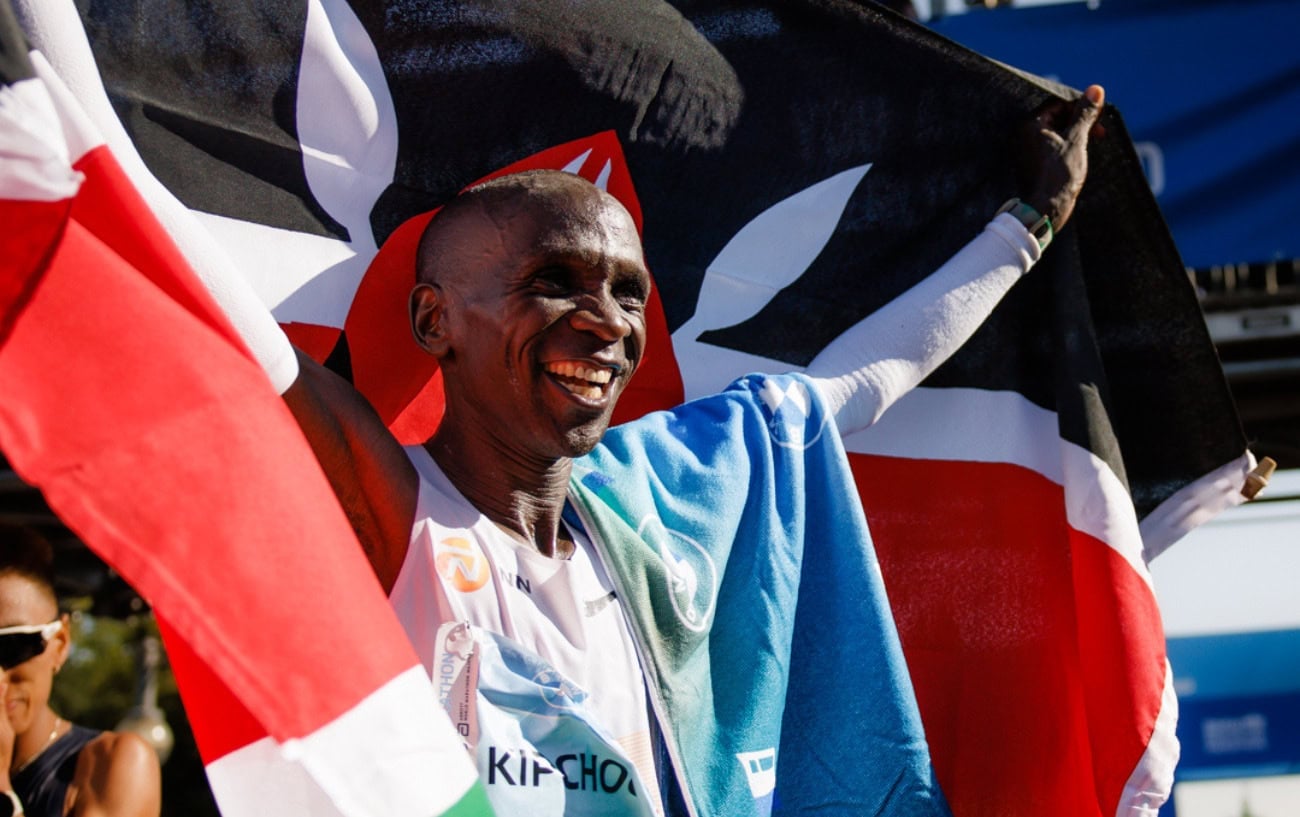
Eliud Kipchoge thinks the men’s marathon world record has further to fall, and he says the runners chasing it now have no idea where the limit actually is.
“The next generation will run more, because the next generation now doesn’t know where the limits are,” the 41-year-old Kenyan told Olympics.com in an interview published Tuesday. “And the sport will be interesting in the future. I think it can still go lower.”
Kipchoge held that record himself until three years ago. He ran 2:01:09 in Berlin in September 2022, 30 seconds quicker than the 2:01:39 he had run on the same course four years before, and for a while it looked like the outer edge of what was possible. The late Kelvin Kiptum then took it to 2:00:35 in Chicago in October 2023, and this April, Sabastian Sawe ran 1:59:30 at the London Marathon, the first sub-two-hour marathon anyone has managed in an ordinary race, since ratified by World Athletics. That is 99 seconds off Kipchoge’s Berlin mark in under four years.

Eight consecutive men’s world records were set in Berlin between 2003 and 2022, from Paul Tergat’s 2:04:55 through to Kipchoge’s own, and for most of those two decades the fastest marathon ever run was a Berlin marathon. Both records since have been set elsewhere, in Chicago and then in London.
Kipchoge won there five times, more than anyone, and he is not especially romantic about why. “Berlin Marathon actually is a special race,” he told Olympics.com. “It’s a flat course, well organised, good temperatures, good environment.”
Berlin runs again this Sunday, Sept. 27, but right now there is nobody in the men’s field anywhere near the current world record. Sawe was entered but unfortunately withdrew with an injury in August. The fastest man left on the start list is Kenenisa Bekele, whose 2:01:41 from Berlin in 2019 missed Kipchoge’s record of the day by just two seconds and now sits two minutes and 11 seconds outside Sawe’s. Gabriel Geay, at 2:03:00, is the next quickest.
Kipchoge’s own sub-two run never counted, and he still rates it as the thing that changed how runners think about the distance. In October 2019 he covered 26.2 miles in 1:59:40 in Vienna, on a sheltered loop, with rotating pacemakers and his drinks handed up from a bicycle, all of which put the time outside World Athletics’ rules before he had taken a step. It took another seven years for anyone to do it inside them, and then two men did it in the same race, Sawe in 1:59:30 with Yomif Kejelcha only 11 seconds behind him in 1:59:41. Jacob Kiplimo came third in 2:00:28, also under the old record.
“I removed the thinking from human minds about the limits. And for now, I think the whole population now doesn’t believe in limits,” Kipchoge said. “And that’s why I’m really grateful and proud of the 1.59 challenge.”
Kipchoge will not be on the start line himself this weekend. He is partway through a two-year tour of seven marathons on seven continents, built around getting people running rather than around results, which opened in Cape Town in April, where he finished 16th in 2:13:29, and carried on to Porto Alegre in July, where he was 12th in 2:18:39. Next is the Melbourne Marathon on Oct. 11, with four more continents to come in 2027.
RunClub
Get more running stories — join RunClub
Daily running news, a community of 300,000+ runners, free training plans for every distance, and a daily running game. Free to join — no card.
Already a member? Log in →









Start the conversation