


Tigst Assefa ran the final two kilometers of the Berlin Marathon on Sunday on a ruptured right Achilles tendon, won anyway in a course record of 2:11:04, and had the tendon repaired the next day at a trauma hospital south of Munich. We have followed her injury since the finish line, and on Monday her manager, Gianni Demadonna, confirmed to Marathon Handbook that the rupture was complete. On Tuesday morning his agency, Demadonna Athletics Promotion, shared the first news from her camp since the operation in a post on Instagram, along with a photo of Assefa smiling from her hospital bed.
“Surgery went well and we hope in few months she can be back in training,” the caption reads. In the photo she is sitting up in a patient’s gown with a man on either side of her, and the agency used the rest of the post to praise her for getting to the line, calling it “incredible and amazing to run the last 2km of a marathon with a tendon torn” and saying she had shown “an amazing courage and resilience to finish the marathon.”
Yomif Kejelcha, who was inducted into the Adidas Walk of Fame alongside Sabastian Sawe, was among the athletes who replied within hours. “Wish you faster recovery our hero,” the Ethiopian wrote. Jackie Joyner-Kersee, the six-time Olympic medalist and an Adidas global ambassador, praised “the will to never give up you demonstrated to very end.” Assefa races for Adidas, and the post carried the brand’s hashtags.
Demadonna had already laid out a plan along those lines when we spoke to him on Monday. “It will be two months without walking, then one month of walking and cycling, and after that she will start running slowly,” he said, which would put her first easy runs at the end of December at the earliest. That timeline sits close to a 2024 rehabilitation guide in the International Journal of Sports Physical Therapy, which our explainer on the injury draws on, and which allows running from 12 to 16 weeks after a repair and a return to sport from about 24 weeks.
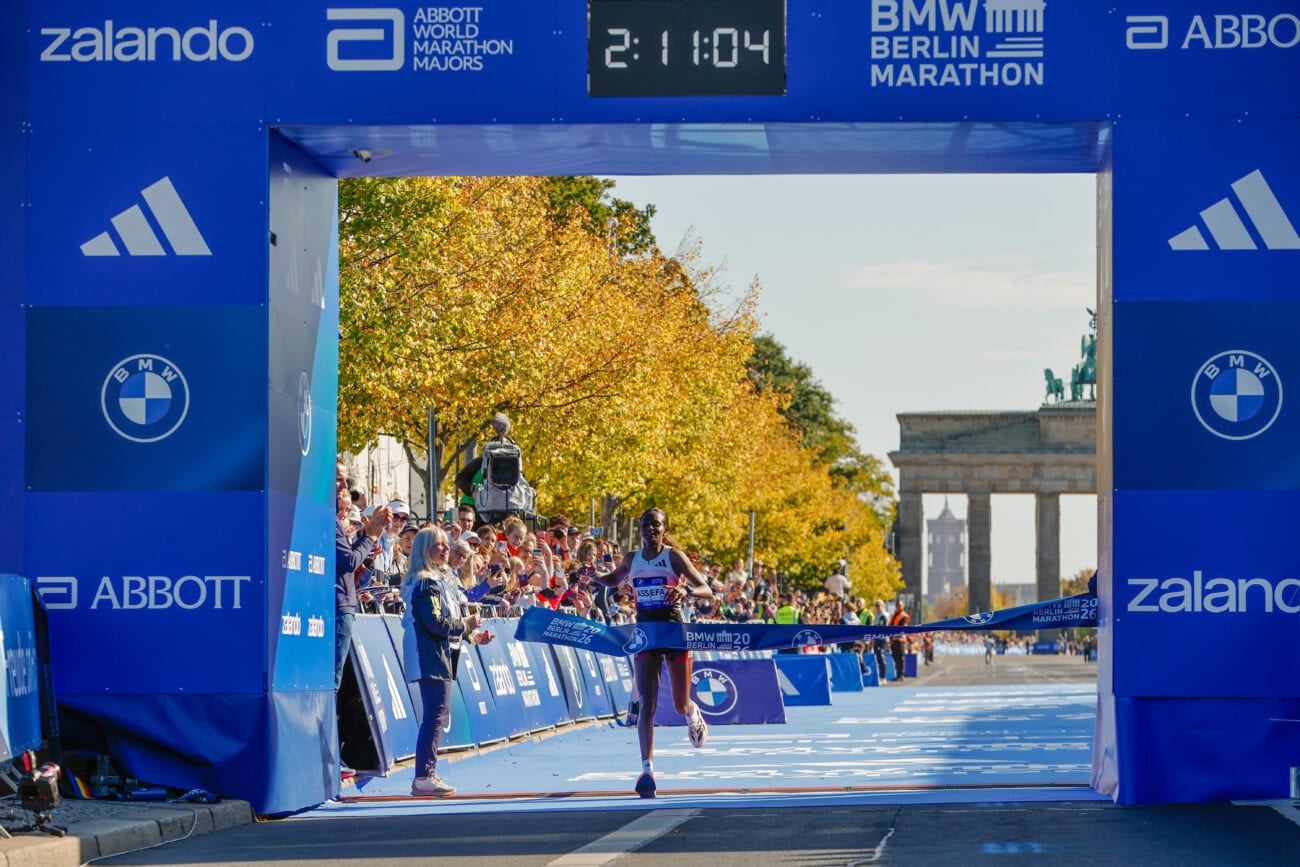
Assefa first felt pain at about 31K, according to Demadonna, and she still held world record pace for another 9K. She passed 40K in 2:03:00, about 10 seconds up on the schedule for Ruth Chepngetich’s 2:09:56, then needed 8:04 for the last 2.195K. Her time took 49 seconds off the 2:11:53 she ran in Berlin in 2023, and the win was her third in the city, leading an Ethiopian sweep of the top five in the women’s results only five months after she set a women-only world record of 2:15:41 in London. Her decision to keep going to the finish is the subject of our op-ed on where runners should draw the line.
Neither the post nor Demadonna has put a date on her return to racing. Asked on Monday whether the six months he had first suggested still stood, he told us, “We don’t know.” He said she slept for most of the day after the operation and was “very sad about the injury and about missing the world record.”
RunClub
Get more running stories — join RunClub
Daily running news, a community of 300,000+ runners, free training plans for every distance, and a daily running game. Free to join — no card.
Already a member? Log in →


Start the conversation