


Testosterone declines with age, but total concentration is only part of the story. The hormone also follows a daily rhythm, usually peaking in the morning and falling later in the day. That rhythm often becomes less pronounced with age.

A cross-sectional study asked whether long-term endurance running was associated with a more youthful daily pattern.1Bartko, B., Oreská, Ľ., Buzgó, G., Berisha, G., Zemaníková, V., Okuliarová, M., Zeman, M., & Sedliak, M. (2026). Long-term endurance running training and testosterone daily variation in ageing men; a comparative cross-sectional study. In Experimental physiology (p. 10.1113/EP093482). PubMed. https://doi.org/10.1113/EP093482 Researchers recruited 45 men divided among four groups: young endurance athletes, young sedentary men, master endurance athletes, and older sedentary men. They measured total testosterone, sex hormone-binding globulin (SHBG), cortisol, and estradiol in the morning and afternoon, then calculated free testosterone, biologically available testosterone, and the free androgen index. Participants also completed leg-strength testing and a graded cycling test.
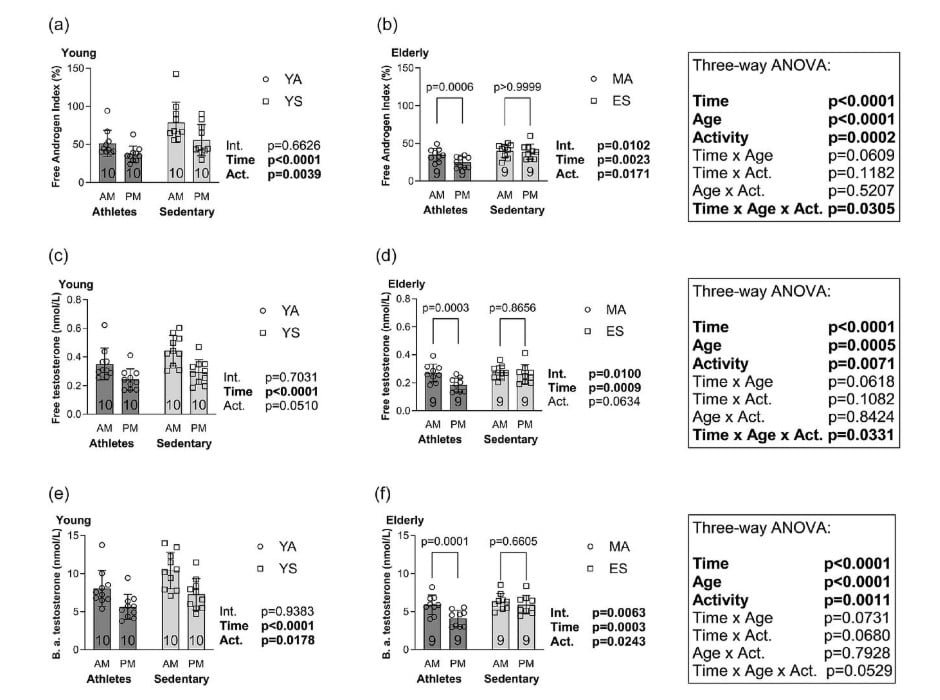
- Among the master athletes, free testosterone and the free androgen index fell from morning to afternoon, mirroring the daily variation seen in the younger groups. The older sedentary men showed no meaningful morning-to-afternoon change. This suggests long-term training may preserve testosterone rhythmicity in older men.
- SHBG increased with both age and endurance-training status. Because SHBG binds testosterone, the athletic groups had lower calculated free testosterone, biologically available testosterone, and free androgen index than their sedentary counterparts even though total testosterone was not lower.
That creates an important paradox. The master runners appeared to preserve the timing of the signal while having less testosterone available in its unbound or bioavailable forms.
The performance findings were similarly mixed. Leg strength declined with age and was not significantly higher in the runners. Peak cycling power, however, was much better preserved. The master athletes produced greater absolute and body-mass-adjusted power than the older sedentary men and performed similarly to young sedentary men. Their predicted VO2 max showed a similar pattern.
What this means for runners
Lifelong endurance training may help preserve the daily organization of testosterone secretion and physical power, but it does not guarantee higher available testosterone. In this study, the runners had a more youthful rhythm and better performance, along with higher SHBG and lower calculated free and bioavailable testosterone.
Older male runners who feel well and perform well should not assume that a lower free-testosterone calculation means endurance exercise is harming them. Runners with persistent fatigue, declining performance, low libido, recurrent injuries, or inadequate energy intake should discuss the full pattern with a qualified clinician rather than trying to “optimize” one lab number.
References
RunClub — Free
Join 300,000+ runners in RunClub
Free training plans for every distance, a daily running game, exclusive coaching content, and a real community of runners. Create your free account in 20 seconds — no card.
Already a member? Log in →







Start the conversation