This 12 week marathon training plan is designed for runners looking to get ready to run 26.2 miles in just 3 months. Whether you’re a first-timer or returning to the distance, this free schedule will guide you from your current fitness to the start line feeling confident and prepared.
The 12 week marathon training schedule is best suited to runners with at least 6 months of running under their belts; you should be able to run 10km continuously before you begin.
Not sure 12 weeks is enough? Compare alternatives in our complete marathon training plans hub — including 16-week, 20-week, and 6-month options.
Think of this as more of an intermediate or even advanced plan than a beginner’s plan.
It ramps up the mileage and training quickly to suit your tight training schedule.
Scroll down to grab a copy of the free marathon training plan – available in both PDF and Google Sheets and in km or miles, so you can customize it!
Otherwise, let me walk you through some of the finer points of training for a marathon in 12 weeks.
Can You Train For a Marathon in 12 Weeks?
Yes – 12 weeks is sufficient to get marathon-ready.
The main pre-requisite is that you should already have a foundation of running experience.
If you can run 10k without stopping right now, you’re in good shape to begin the 12 week marathon training plan.
The plan includes quite a rapid increase in weekly mileage, so it’s important to follow the plan closely, but also know when to take breaks – in other words, listen to your body.
The 12 week marathon training plan includes a 3 week taper period – meaning that your training actually peaks after 9 weeks, then the final 3 weeks are a gradual reduction in training volume to ensure you’re rested and prepped for your 26.2 mile race day.

The Honest Truth About A 12-Week Marathon Training Plan
Twelve weeks is the standard “late-decision” window for marathon training and the binding-constraint question matters more here than at any other duration. The cardiovascular and metabolic systems can deliver substantial gains in this window; tendon, bone, and lactate-buffering capacity respond more slowly. Whether 12 weeks is enough — and what it can deliver — depends almost entirely on what running base you bring into week 1.
What 12 weeks can and cannot deliver physiologically
The fast-adapting systems do most of their work in this window. Plasma volume expands 10–15 percent within 1–2 weeks; mitochondrial enzyme activity rises measurably within 2–4 weeks; VO2max gains plateau around 6–8 weeks of structured stimulus 1Convertino VA. Blood volume: its adaptation to endurance training. Med Sci Sports Exerc. 1991;23(12):1338-48. 2Midgley AW, McNaughton LR, Wilkinson M. Is there an optimal training intensity for enhancing the maximal oxygen uptake of distance runners? Sports Med. 2006;36(2):117-32.. The slow-adapting systems do not. Tendon stiffness adapts on an 8–14 week timeline 3Arampatzis A, Karamanidis K, Albracht K. Adaptational responses of the human Achilles tendon by modulation of the applied cyclic strain magnitude. J Exp Biol. 2007;210(Pt 15):2743-53.; bone-remodelling capacity for impact loading takes months. Cardiac structural remodelling — expanded left-ventricular volume that supports a higher stroke volume at marathon pace — takes 4–6 months 4Joyner MJ, Coyle EF. Endurance exercise performance: the physiology of champions. J Physiol. 2008;586(1):35-44.. The honest implication: a runner with an established 25–35 km/wk aerobic base entering week 1 can ride the cardiovascular gains of 12 weeks to a respectable marathon. A true beginner cannot, because the slow systems will not be ready.
Intensity distribution that compresses well into 12 weeks
Twelve-week plans punish high-intensity volume more than longer plans because there’s less recovery margin. The format with the strongest evidence is polarised distribution — roughly 80 percent easy, 20 percent at threshold or above — with the bulk of intensity work landing in marathon-specific (M-pace) and threshold sessions, not heavy VO2max intervals 5Seiler S. What is best practice for training intensity and duration distribution in endurance athletes? Int J Sports Physiol Perform. 2010;5(3):276-91.. Tempo-style cruise intervals (4–6 minutes at threshold) and progression-style long runs that finish at marathon pace deliver more transferable gains than 800m repeats in this duration 6Daniels J. Daniels’ Running Formula. 4th ed. Human Kinetics; 2021.. The dose-response curve for marathon mileage flattens past about 65 km/wk for most amateur runners; pushing past that threshold in 12 weeks raises injury risk faster than it raises performance, with sudden volume spikes the dominant injury predictor 7Tanda G. Prediction of marathon performance time on the basis of training indices. J Hum Sport Exerc. 2011;6(3):511-20. 8Nielsen RO, Buist I, Sorensen H, et al. Training errors and running related injuries: a systematic review. Int J Sports Phys Ther. 2012;7(1):58-75..
The long run and marathon-specific work
Long-run length is the single biggest training-stimulus correlate of marathon performance, but the relationship is non-linear. The data show diminishing returns past about 32–35 km of long-run distance, with risks rising past 35 km for runners not already accustomed to that volume 9Tanda G. Prediction of marathon performance time on the basis of training indices. J Hum Sport Exerc. 2011;6(3):511-20.. Marathon-specific (M-pace) blocks within long runs — 16–25 km of cumulative M-pace across the final 4–6 weeks — are the highest-yield intensity for marathon performance, more so than threshold or VO2max work in this window 10Billat V. Interval training for performance: a scientific and empirical practice. Sports Med. 2001;31(1):13-31.. The fueling rehearsal is not optional: gut training to absorb 60–90 g/h of carbohydrate is itself an adaptation that must be practised in long runs to be available on race day 11Jeukendrup AE. Training the gut for athletes. Sports Med. 2017;47(Suppl 1):101-10.. Plans that omit M-pace volume in favour of pure easy mileage tend to produce well-trained but slow marathoners.
Taper and the trade-off in shorter cycles
The taper question gets harder in 12-week plans. Mujika’s meta-analytic and prospective work on tapering finds the optimal pre-race load reduction for endurance is 41–60 percent of training volume across 8–14 days, with maintained intensity, producing a roughly 3 percent performance gain on average 12Mujika I, Padilla S. Scientific bases for precompetition tapering strategies. Med Sci Sports Exerc. 2003;35(7):1182-91.. In 12 weeks the cost of a 3-week taper is much higher in proportional terms than in an 18–24 week plan; most 12-week plans use a 10–14 day taper and accept slightly less freshness in exchange for not losing aerobic gains. The Mujika-Padilla work on detraining shows VO2max declines measurably after just 2–4 weeks of substantially reduced training, which is why the more aggressive 3-week taper that helps highly-trained marathoners can backfire for the runner who built their fitness in 8–9 weeks of work 13Mujika I, Padilla S. Detraining: loss of training-induced physiological and performance adaptations. Part I. Sports Med. 2000;30(2):79-87..
When 12 weeks isn’t enough
The clean candidates for 12 weeks are: returning runners with at least 6 months of consistent base in the prior year, current 5K/10K runners moving up a distance with comparable cardiovascular fitness, and second-time marathoners chasing a modest improvement on a previous time. The candidates 12 weeks doesn’t serve well are: true beginners with no running history, runners returning from injury that included reduced loading, and runners targeting a sub-3:30 or sub-3:00 finish without prior marathon racing experience 14Kluitenberg B, van Middelkoop M, Diercks R, van der Worp H. What are the differences in injury proportions between different populations of runners? Sports Med. 2015;45(8):1143-61.. The realistic alternative for those groups is 18–24 weeks; the realistic version of “a 12-week plan worked for me” is “the runner had more base than the headline suggests.” Hulme’s systematic review of running injury identifies training-error variables — sudden volume jumps, rapid intensity escalation, inadequate recovery — as the dominant predictors regardless of plan length, and 12-week plans amplify the cost of those errors 15Hulme A, Nielsen RO, Timpka T, et al. Risk and protective factors for symptoms and risk of injury among long-distance runners. Sports Med. 2017;47(5):869-86..
12 Week Marathon Training Plan: Essential Info
Who Is It For?:
Runners who have established an initial running base, or have an existing good fitness level. You should be able to run 10km without stopping.
You don’t need to be an advanced, or very experienced runner, to follow this free plan – but you do need to have built up some running experience.
The 12 week marathon training plan’s weekly mileage builds fairly quickly, so it’s important that your body is already well-adapted to running before starting.
Not sure this is the plan for you? – Check out our other marathon training plans.
How Long?:
3 months // 12 weeks.
This includes 9 weeks of gradually increasing mileage, peaking with a 21 mile long run 3 weeks before your marathon.
The final 3 weeks are your taper period – we gradually reduce training volume over those 3 weeks to ensure that when you get to your start line you are rested, recovered, and well-fuelled.
Description:
This 12 week marathon training plan has you working out five days a week – four days of running and a day of cross-training, with two days off.
I always include one day of cross training in my marathon training plans – for me, cross-training is the secret sauce that makes you less injury-prone, stronger, faster, and boosts your endurance. However, some runners choose to skip the cross training and take an additional rest day.
If that’s you, no worries!

Training Breakdown: What Will Your Weekly Schedule Consist Of?
Given the relatively short training time, the important thing to focus on is building your endurance rather than speed.
Attempting to improve both endurance and speed in this short window is likely to stress your system too much, and will quickly lead to injury, illness, fatigue, burn-out, and exhaustion.
That’s why a balanced marathon training plan is so important; you need a plan which adds the requisite mileage while pushing the limits of your endurance but allowing time for recovery too.
Regular Training Runs
There are 3 regular training runs per week in the 12 week marathon training program.
Your regular training runs should be performed at a sustainable pace – unless you have a specific pace target, aim to run at a conversational pace throughout. In other words, maintain a pace at which you could comfortably hold a conversation.
These runs are all about adding to your weekly mileage and honing your running economy and form.
If you have a specific pace target or finishing time goal, you can make use of our Marathon Pace Calculator to plan your race day pacing.
Long Slow Runs
For your Long Runs, the aim is simply to get your body used to running for a long time – so take them easy, don’t push yourself.
These long runs are all about increasing your endurance, specifically;
- Improves your muscles’ ability to perform after running for hours (time to fatigue)
- Improves your cardiovascular system’s efficiency while running
- Boosts your mitochondria (i.e. your body’s fuel-burning ability), so your body is better equipped to turn energy stores into muscle power on marathon day
- Mental and logistical preparation for running long distances!
If necessary, take occasional walking breaks – just try to maintain a good rhythm and not stop completely
Cross Training
Cross-training is a great way to keep fit and ensure your marathon training does not negatively impact other parts of your body.
Cross-training improves your cardiovascular health and strengthens some of the muscles weakened through running, thereby reducing your chance of injury.
Recommended cross-training exercises include bodyweight exercises, light gym work, swimming, yoga, pilates, and cycling!
Check out our cross-training guide for runners to learn more.
Just avoid high impact of very intense workouts – I recommend giving activities like spin classes and CrossFit a rest when following the 12 week marathon training plan, otherwise you increase the risk of injury and burnout.
Run Intensity and Rest Days
When it comes to run training intensity, don’t overdo things – given you only have 12 weeks to prepare, speed is secondary to getting the miles in.
If your body is worn out, allow it some rest.
Don’t be too worried about skipping a training day during the 12 week marathon training plan – but if at all possible, don’t miss your weekly long runs.
Get The Complete Guide
My guidebook, Marathon in 3 Months, is available now for instant download. It maps out the complete training strategy and rationale behind the 12 week marathon training program supplied. It walks you through your week-by-week training and preparation to get you to the finish line in under four hours.
Your Week-by-Week Training Schedule
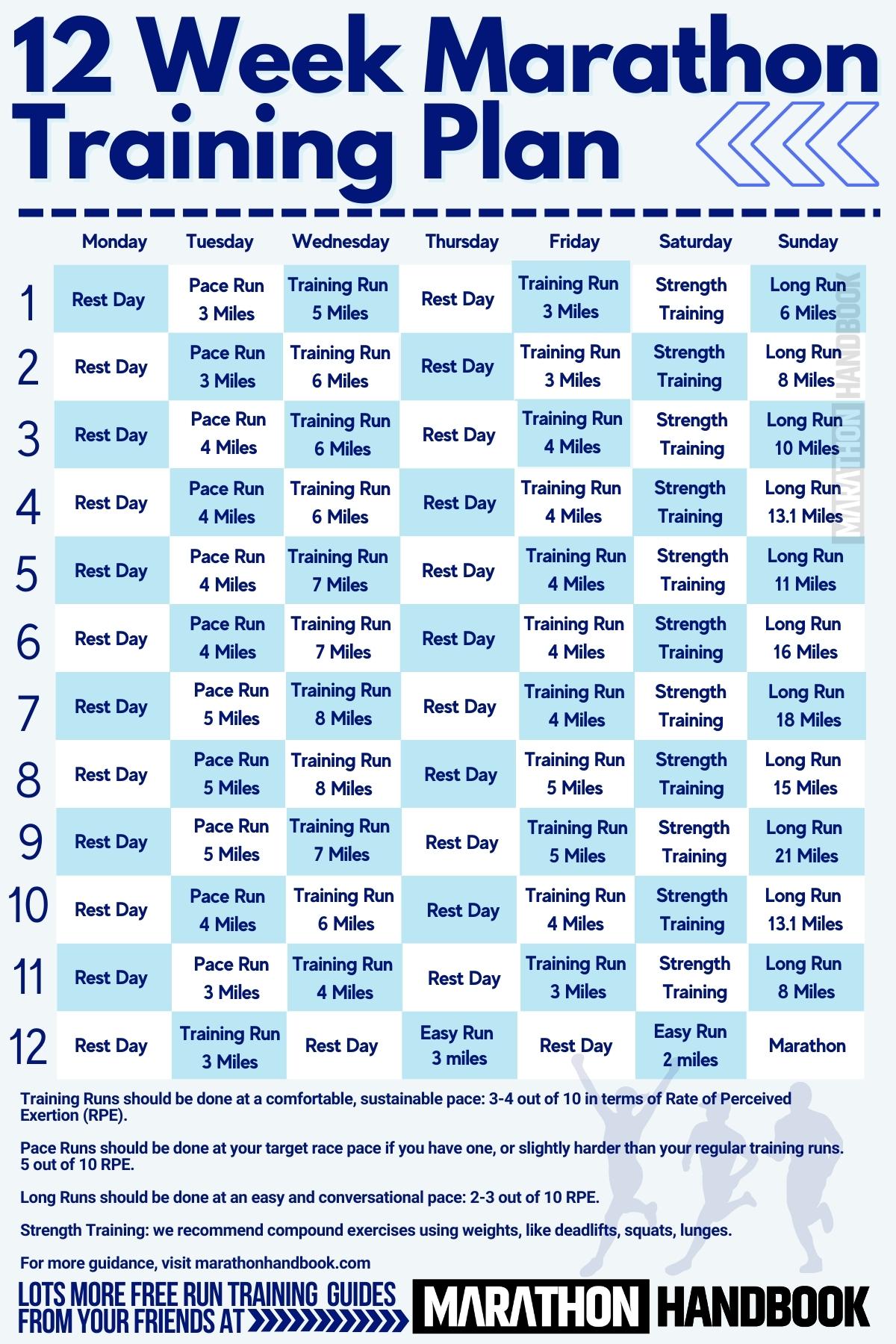
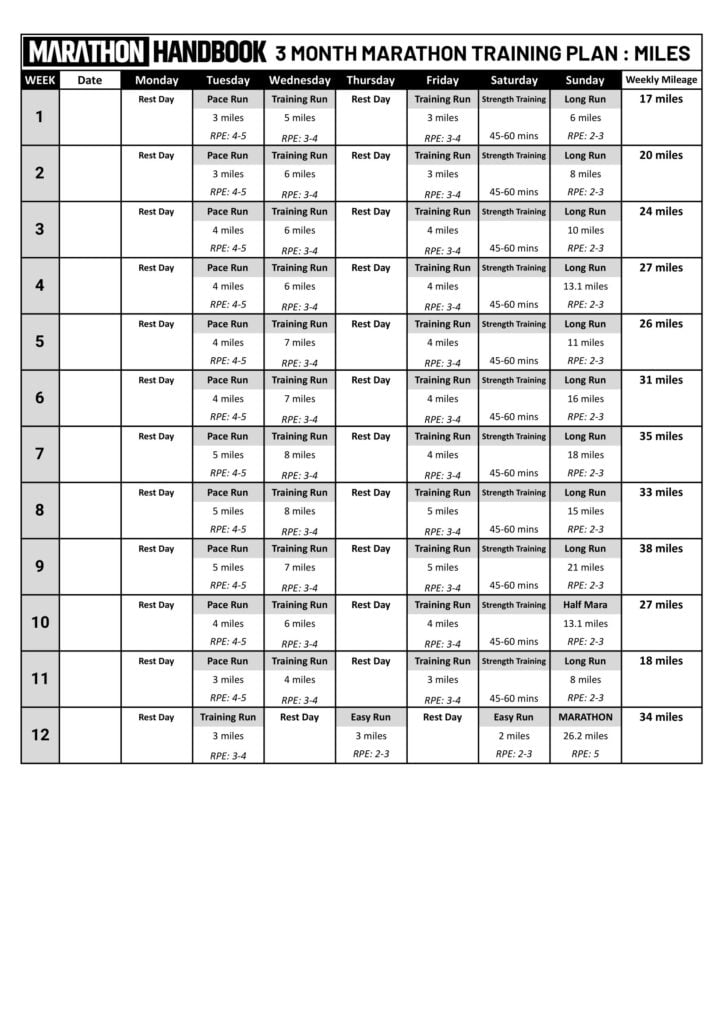
Here’s the complete week-by-week breakdown. Monday and Thursday are rest days throughout. All distances are in miles.
| Week | Tue | Wed | Fri | Sat | Sun | Total |
|---|---|---|---|---|---|---|
| 1 | Pace Run 3 miles | Training Run 5 miles | Training Run 3 miles | Strength Training | Long Run 6 miles | 17 miles |
| 2 | Pace Run 3 miles | Training Run 6 miles | Training Run 3 miles | Strength Training | Long Run 8 miles | 20 miles |
| 3 | Pace Run 4 miles | Training Run 6 miles | Training Run 4 miles | Strength Training | Long Run 10 miles | 24 miles |
| 4 | Pace Run 4 miles | Training Run 6 miles | Training Run 4 miles | Strength Training | Long Run 13.1 miles | 27 miles |
| 5 | Pace Run 4 miles | Training Run 7 miles | Training Run 4 miles | Strength Training | Long Run 11 miles | 26 miles |
| 6 | Pace Run 4 miles | Training Run 7 miles | Training Run 4 miles | Strength Training | Long Run 16 miles | 31 miles |
| 7 | Pace Run 5 miles | Training Run 8 miles | Training Run 4 miles | Strength Training | Long Run 18 miles | 35 miles |
| 8 | Pace Run 5 miles | Training Run 8 miles | Training Run 5 miles | Strength Training | Long Run 15 miles | 33 miles |
| 9 | Pace Run 5 miles | Training Run 7 miles | Training Run 5 miles | Strength Training | Long Run 21 miles | 38 miles |
| 10 | Pace Run 4 miles | Training Run 6 miles | Training Run 4 miles | Strength Training | Half Mara 13.1 miles | 27 miles |
| 11 | Pace Run 3 miles | Training Run 4 miles | Training Run 3 miles | Strength Training | Long Run 8 miles | 18 miles |
| 12 | Training Run 3 miles | Rest Day | Rest Day | Easy Run | MARATHON 26.2 miles | 34 miles |
Want a printable version? Download the free PDF or Google Sheets version below.
Download The 12-Week Marathon Training Plan For Free:
- Open the Google Sheets version of this plan
( File > Make A Copy) to create your own version
- Get the TrainingPeaks version of this plan, which you can sync with your device.
Download The Training Plan Here
Enter your email, and I’ll send you this free training plan now, in PDF and Google Sheets formats (completely customizable), in both miles and kilometers.
After entering your email, you’ll be prompted to create an account on the Grow platform we use to control access to the plans. It’s completely free – make sure to complete the process to gain access to the plan!
Previous visitor or not seeing where to sign up?
Head over to our marathon training plan database for full access to all plans.

Check Out The Premium Version of The 12 Week Marathon Training Plan . . .
We’ve teamed with TrainingPeaks to offer a premium version of the 12 Week Marathon Training Plan:
Access the plan via the TrainingPeaks website and app, track your workouts in real-time against the plan, and get performance data analysis on your progress.



Proven Training Plans by a UESCA-Certified Running Coach
Every one of our training plans has been developed by Thomas Watson, a UESCA-certified running coach.
Thomas is also a podium-finishing ultra-marathon runner and has dozens of marathons under his belt.
Each training plan has been road-tested by hundreds of runners, refined and improved, and is free to download and customize to suit your needs!
Prerequisites: Can You Train for a Marathon in 12 Weeks?
Yes — but not from zero. A 12-week marathon plan assumes you already have a meaningful running base. You should be able to comfortably run 6-8 miles and be running at least 3 times per week with 15-20 miles of weekly volume. Without this foundation, 12 weeks isn’t enough time to safely build to marathon distance.
If your current base is lower, our 16 week marathon training plan or 20 week marathon training plan will give you more room to build gradually and reduce injury risk.
Tapering: The Final 2 Weeks
In a 12-week plan, your taper is necessarily short — about 2 weeks. Your peak long run (typically 18-20 miles) happens around week 10, and then mileage drops sharply. In week 11, total volume drops by about 30-40%. Race week is lighter still, with short easy runs to keep your legs moving without accumulating fatigue.
Don’t try to cram in extra miles during the taper because you feel undertrained. The work is done. These final weeks are about rest, recovery, and arriving at the start line with fresh legs and full glycogen stores.
Nutrition and Fueling Strategy
Marathons deplete your body’s glycogen stores, and no amount of pre-race pasta loading can fully prevent this. That’s why mid-race fueling is non-negotiable for the marathon distance.
Practice your fueling strategy during every long run over 90 minutes. Most runners take an energy gel every 30-45 minutes starting around mile 5-6 of the marathon, washed down with water. Find a brand and flavor that sits well in your stomach during training — this is not something to experiment with on race day.
Day-to-day, prioritize carbohydrate-rich whole foods as your weekly mileage climbs. Complex carbs (rice, oats, sweet potatoes) should make up roughly 50-60% of your calories during peak training weeks. Don’t neglect protein — aim for 1.2-1.6g per kg of bodyweight to support muscle recovery.
Frequently Asked Questions
Is 12 weeks enough time to train for a marathon?
Yes, 12 weeks is enough if you already have a solid running base of at least 20-25 miles per week. This plan assumes you can comfortably run 6-8 miles and ramps up mileage over 12 weeks to prepare you for 26.2 miles.
How many days per week should I run on a 12 week marathon plan?
Most 12 week marathon training plans include 4-5 days of running per week, with 1-2 rest or cross-training days. This balances sufficient training volume with adequate recovery time.
What is a good weekly mileage peak for a 12 week marathon plan?
Peak weekly mileage in a 12 week marathon plan typically reaches 35-45 miles, depending on your experience level. The plan then tapers in the final 2-3 weeks before race day.
Other Suggested Marathon Training Plans
Beginner + Novice Training Plans
Intermediate Training Plans
- 16 Week Marathon Training Plan
- 12 Week Marathon Training Plan
- Sub 4-Hour Marathon Training Plan
- Sub 3:30 Marathon Training Plan
- 8 Week Marathon Training Plan
Advanced Marathon Training Plans
- Sub 3-Hour Marathon Training Plan
- 20 Week Advanced Marathon Training Plan
- 20 Week *Intense* Advanced Marathon Training Plan