


The Novablast and Clifton both occupy the “lightweight, daily trainer with energy return” niche — both run around 9 oz, both stack ~35 mm of foam, both market themselves as the versatile workhorse you reach for most days. They’re genuinely close on paper, but the underlying foam, geometry, and ride feel are different enough to reward different runners.
ASICS Novablast vs Hoka Clifton: Quick Verdict
For runners who want a versatile daily trainer with a bouncy, springy ride, the ASICS Novablast 5 wins — its FF Blast+ Eco foam delivers more energy return per stride and the trampoline-like geometry rewards turnover. For runners who want a smooth, rocker-driven daily trainer that protects the calves, the Hoka Clifton 10 wins — its Meta-Rocker carries you forward and shifts load away from the Achilles.
The Honest Truth: Bouncy vs Smooth Is the Real Choice
Both shoes deliver max-versatility daily training in similar weight classes, but they make opposite choices on energy return vs ride smoothness. Picking right depends on your gait and what you want the shoe to do for you.
1. FF Blast+ Eco vs EVA blend — different “bouncy”
The Novablast 5 uses ASICS’s FF Blast+ Eco foam — a nitrogen-infused EVA blend with a measurably higher energy-return percentage than the Clifton 10’s standard compression-moulded EVA1Worobets J, Wannop JW, Tomaras EK, Stefanyshyn DJ. Softer and more resilient running shoe cushioning properties enhance running economy. Footwear Science. 2014;6(3):147–153.. The Novablast feels noticeably bouncier underfoot at marathon pace and faster, while the Clifton feels smoother and more uniformly cushioned. If you want energy return, Novablast; if you want plush forgiveness, Clifton.
2. Geometry: trampoline vs rocker
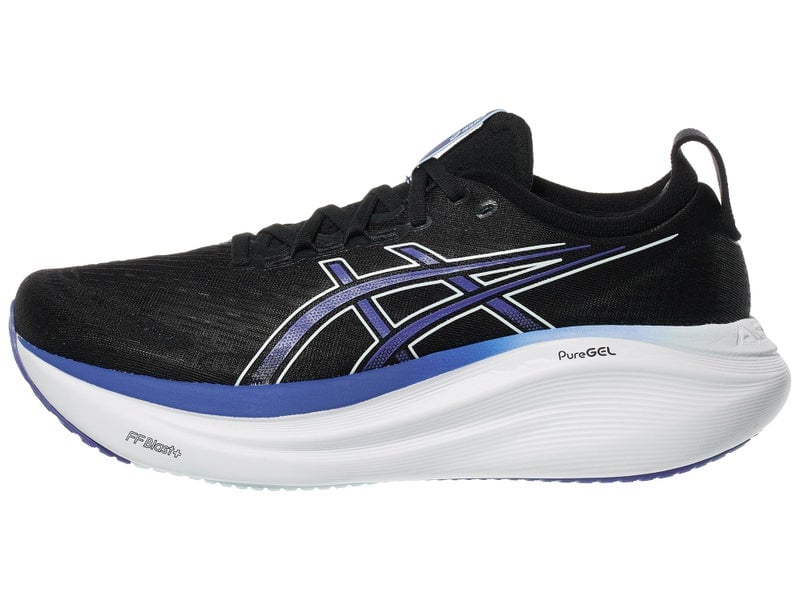
The Novablast uses a wide, flared midsole that creates a trampoline-like rebound at midstance. The Clifton uses Hoka’s signature Meta-Rocker — a moderate toe-spring that carries you forward through stance with less ankle dorsiflexion at toe-off. EMG studies show rockered shoes reduce calf-soleus activation meaningfully2Sobhani S, van den Heuvel ER, Bredeweg SW, et al. Effect of rocker shoes on plantar pressure pattern in healthy female runners. Gait & Posture. 2014;39(3):920–925.. So if you have Achilles or calf history, the Clifton is friendlier; if those tissues are healthy, the Novablast feels more responsive.
3. Stack and drop
The Novablast 5 sits at 41.5 mm under the heel with an 8 mm drop; the Clifton 10 at 32 mm with a 5 mm drop. The Novablast is the taller, plusher platform; the Clifton is the lower, more grounded one. Lab work on stack height shows that taller stacks reduce peak vertical loading rates while preserving slightly less proprioceptive feedback3Chambon N, Delattre N, Guéguen N, et al. Is midsole thickness a relevant parameter to control running shoe comfort? Footwear Science. 2014;6(1):S3–S5.. The 9 mm stack difference is enough to make these feel like meaningfully different shoes despite similar marketing.
4. Weight is roughly identical
The Novablast 5 weighs around 8.6 oz (men’s 9); the Clifton 10 around 8.7 oz. The 0.1 oz gap is well within normal manufacturing variance — neither shoe wins on mass. Both are unusually light for the cushioning they provide, which is why both have become category-defining daily trainers.
5. The clean answer
For runners who want energy return on tempo days as well as easy mileage, the Novablast is the more versatile single-shoe pick. For runners who want pure cushioning and rocker-driven calf protection, the Clifton wins. Multi-shoe rotations beat single-shoe training in injury-rate studies, so most committed runners benefit from owning one of each. If you’re still mapping picks to a goal race, the best marathon running shoes guide covers the model-level picks across both brands.
Novablast vs Clifton: Side-by-Side Specs
| Spec | ASICS Novablast 5 | Hoka Clifton 10 |
|---|---|---|
| Weight (men’s 9) | ~8.6 oz | ~8.7 oz |
| Stack heel | 41.5 mm | 32 mm |
| Heel-toe drop | 8 mm | 5 mm |
| Foam | FF Blast+ Eco | Compression-moulded EVA |
| Geometry | Wide trampoline base | Meta-Rocker |
| Best for | Bouncy daily + tempo work | Smooth daily + recovery |
Novablast vs Clifton: Pros & Cons
ASICS Novablast 5
- ✅ Higher energy return foam
- ✅ Versatile across paces
- ✅ Taller stack absorbs more impact
- ✅ Trampoline geometry rewards turnover
- ❌ Higher drop loads knee more
- ❌ Less Achilles-friendly than rockered shoes
Hoka Clifton 10
- ✅ Meta-Rocker reduces calf load
- ✅ Smoother heel-to-toe transition
- ✅ Lower drop suits posterior chain
- ✅ More grounded feel
- ❌ Less responsive at fast paces
- ❌ Lower energy return than Novablast
Frequently Asked Questions
Is the Novablast or Clifton better for marathon training?
For most runners, the Novablast 5 is the better single-shoe marathon trainer because its bouncier foam handles both easy mileage and weekly tempo sessions. The Clifton excels for high-volume easy mileage and recovery runs. The cleanest setup for marathon-specific training is owning both: Clifton for daily mileage, Novablast for tempo + steady-state work, plus a super-shoe for race day.
Are Novablasts good for beginners?
Yes — the Novablast 5 is widely recommended for beginners because of its forgiving cushioning, energetic ride, and accessible price point. Its slightly higher 8 mm drop suits new runners who haven’t developed strong calf-Achilles tolerance. The wide, stable platform also helps with balance on early easy runs.
How long do Novablasts last?
500–700 km for most runners. FF Blast+ Eco holds energy-return properties longer than pure EVA but shorter than premium PEBA super-foams. Watch the bounce — when the Novablast starts feeling flat rather than springy, the foam has set; replace before injury risk climbs.
Do Cliftons run small?
Yes — Hoka traditionally runs about a half-size short compared to ASICS, Brooks, and Nike. Most runners need to size up a half-size from their usual non-Hoka size. The Clifton 10 also runs slightly narrower through the midfoot than Brooks; if you have a wide forefoot, choose the 2E (wide) version rather than just sizing up.
Should I rotate the Novablast and Clifton?
Yes — they’re an excellent rotation pairing because their geometries shift load onto slightly different tissues. Use the Novablast for tempo and quality work where you want energy return, and the Clifton for recovery and easy mileage where you want pure cushioning. Multi-shoe rotation is associated with lower injury rates than single-shoe training.
Where to Buy
More Shoe Roundups From Marathon Handbook
References
RunClub — Free
Join 300,000+ runners in RunClub
Free training plans for every distance, a daily running game, exclusive coaching content, and a real community of runners. Create your free account in 20 seconds — no card.
Already a member? Log in →



Start the conversation