


The Novablast and Pegasus are the two top-selling versatile daily trainers in the global running shoe market. Both market themselves as workhorses for any runner, any pace, any distance up to a half marathon. They’re close enough on paper that runners genuinely struggle to choose. But the underlying foam, geometry, and ride character are different in ways that meaningfully favour different gaits.
Novablast vs Pegasus: Quick Verdict
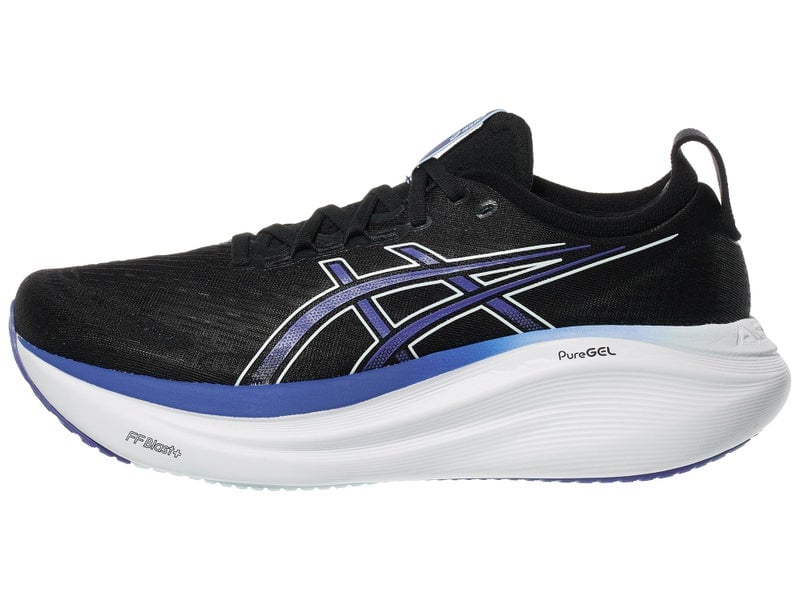
For runners who want a bouncy, plush daily trainer that handles tempo work better than most dailies, the ASICS Novablast 5 wins — its taller stack and FF Blast+ Eco foam deliver more cushion and energy return. For runners who want the most-tested, most-trusted versatile trainer with a slightly firmer responsive ride, the Nike Pegasus 41 wins — its ReactX foam and forefoot Air Zoom unit prioritise consistency over peak responsiveness.
The Honest Truth: Cushion Plushness Is the Real Axis
Both shoes are versatile daily trainers in similar weight classes. The genuine difference is how plush vs firm they feel underfoot, and how that translates to which paces they reward.
1. Stack height — 41.5 mm vs 33 mm
The Novablast 5 sits at 41.5 mm under the heel; the Pegasus 41 at 33 mm. That 8 mm gap is meaningful — the Novablast feels noticeably plusher underfoot, while the Pegasus feels more grounded with better proprioceptive feedback. Lab work on stack height shows that taller midsoles reduce peak vertical loading rates while preserving slightly less ground feel1Chambon N, Delattre N, Guéguen N, et al. Is midsole thickness a relevant parameter to control running shoe comfort? Footwear Science. 2014;6(1):S3–S5.. So if you want maximum cushion across high mileage, Novablast; if you want a snappier, more responsive feel, Pegasus.
2. Foam — FF Blast+ Eco vs ReactX + Air Zoom
The Novablast uses ASICS’s nitrogen-infused FF Blast+ Eco; the Pegasus 41 pairs ReactX foam with a forefoot Air Zoom unit. Energy-return measurements show the Novablast’s foam returns slightly more energy per stride at marathon pace, while the Pegasus’s Air Zoom unit adds a localised pop at toe-off2Worobets J, Wannop JW, Tomaras EK, Stefanyshyn DJ. Softer and more resilient running shoe cushioning properties enhance running economy. Footwear Science. 2014;6(3):147–153.. The Pegasus is more durable across high mileage; the Novablast is more rewarding when you push the pace.
3. Weight is roughly equal
The Novablast 5 weighs around 8.6 oz (men’s 9); the Pegasus 41 around 9.6 oz. The 1 oz gap is real and shows up at marathon pace and faster — Hoogkamer’s shoe-mass studies show roughly 1% economy cost per 100 g of added shoe mass3Hoogkamer W, Kipp S, Frank JH, et al. A comparison of the energetic cost of running in marathon racing shoes. Sports Medicine. 2018;48(4):1009–1019.. So at threshold pace, the Novablast is roughly 0.3% more efficient on mass alone. Small at easy pace; meaningful at tempo.
4. Last shape and forefoot fit
Nike daily trainers traditionally use a slightly narrower forefoot last than ASICS or Brooks; the Pegasus 41 runs slightly snug for runners with wide feet. The Novablast fits more accommodatingly through the forefoot but slightly narrower at the heel. Restricted toe-splay during loading is associated with bunion progression and metatarsalgia4Goldmann JP, Sanno M, Willwacher S, Heinrich K, Brüggemann GP. The potential of toe flexor muscles to enhance performance. Journal of Sports Sciences. 2013;31(4):424–433.. If you have wide feet or a history of pinky-toe rubbing, the Novablast tends to fit more comfortably out of the box.
5. The clean answer
For runners who want the most versatile single-shoe pick that handles both easy and tempo work in the same platform, the Novablast is usually the smarter buy. For runners who want a workhorse for daily mileage with a slightly snappier ride, the Pegasus is the more consistent choice. If you’re still mapping picks to a goal race, the best marathon running shoes guide covers the model-level picks across both brands.
Novablast vs Pegasus: Side-by-Side Specs
| Spec | ASICS Novablast 5 | Nike Pegasus 41 |
|---|---|---|
| Weight (men’s 9) | ~8.6 oz | ~9.6 oz |
| Stack heel | 41.5 mm | 33 mm |
| Heel-toe drop | 8 mm | 10 mm |
| Foam | FF Blast+ Eco | ReactX + Air Zoom forefoot |
| Best for | Plush daily + occasional tempo | Versatile daily + consistency |
Novablast vs Pegasus: Pros & Cons
ASICS Novablast 5
- ✅ Higher energy return
- ✅ Lighter mass
- ✅ Taller, plusher stack
- ✅ Wider forefoot last
- ❌ Less durable than Pegasus
- ❌ Higher stack = less ground feel
Nike Pegasus 41
- ✅ More durable foam
- ✅ Air Zoom adds toe-off pop
- ✅ Better ground feel
- ✅ Most-tested versatile platform
- ❌ Heavier than Novablast
- ❌ Narrower forefoot last
Frequently Asked Questions
Is the Novablast or Pegasus better for marathon training?
For most runners, the Novablast is the better single-shoe marathon trainer because its plusher cushion and lighter mass handle high weekly volume more comfortably. The Pegasus excels for runners who want consistent, predictable feel across hundreds of miles. The cleanest setup is owning both: Pegasus for daily easy mileage, Novablast for tempo and quality work.
Are Pegasus or Novablast better for beginners?
Both are widely recommended for beginners. The Pegasus has the longer track record (41 generations) and slightly firmer ride that some new runners prefer for its consistency. The Novablast has the plusher cushion that many beginners find more forgiving over the first few months of mileage. If you have wide feet, lean Novablast; if you prefer a grounded feel, lean Pegasus.
How long do Pegasus shoes last?
700–900 km for most runners — the Pegasus 41 is one of the most durable daily trainers on the market thanks to ReactX’s long compression-set life. The Air Zoom unit holds its responsiveness even longer than the surrounding foam. Watch the cushion underfoot, not the outsole — once it feels flat, replace.
Do Pegasus shoes run small?
Yes, slightly. Nike daily trainers traditionally run about a half-size short and slightly narrow in the forefoot compared to ASICS, Brooks, and Hoka. Most runners need to size up a half-size from their usual ASICS or Brooks size. If you have wide feet, look for the 4E (extra wide) version of the Pegasus — Nike doesn’t offer it on every model but the Pegasus 41 does have it.
Can I race a marathon in the Novablast or Pegasus?
Yes for both — neither will be as fast as a true super-shoe (Vaporfly, Endorphin Pro, Metaspeed) for runners chasing a goal time, but both are excellent first-marathon shoes for runners focused on finishing comfortably. The Novablast’s lighter mass and energy return give it a slight edge at race pace; the Pegasus’s durability makes it the better choice for back-to-back training and racing.
Where to Buy
More Shoe Roundups From Marathon Handbook
- Best Daily Running Shoes
- Best Marathon Running Shoes
- ASICS Novablast vs Hoka Clifton
- Nike Vomero vs Pegasus
References
RunClub — Free
Join 300,000+ runners in RunClub
Free training plans for every distance, a daily running game, exclusive coaching content, and a real community of runners. Create your free account in 20 seconds — no card.
Already a member? Log in →




Start the conversation