


Not every run has to be long, fast, or even particularly impressive to change how you feel.
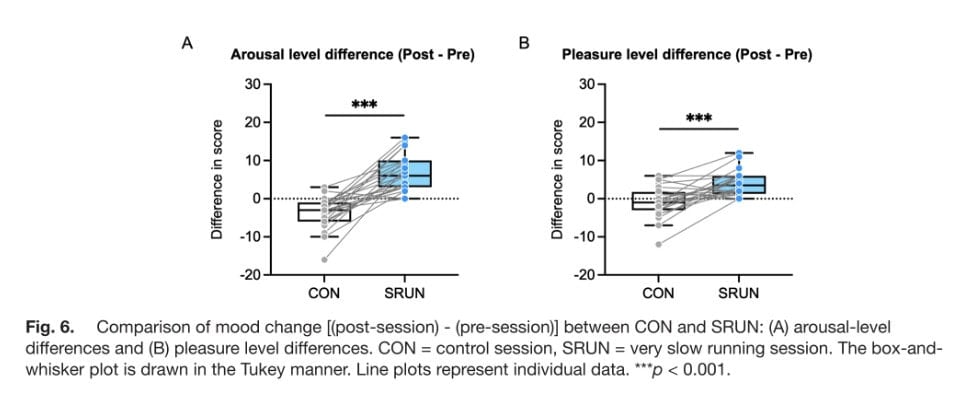
In a new study, 24 healthy young adults completed 10 minutes of seated rest on one day and 10 minutes of very slow treadmill running on another. The run was set at 35% of VO2 peak—a pace so slow it could have been walked. Average speed was 3.4 miles per hour/5.5 kilometers per hour for men and 2.3 miles per hour/3.8 kilometers per hour for women. Heart rate was roughly 105 to 107 beats per minute, and perceived exertion stayed below 9 on the 6-to-20 scale.1Damrongthai, C., Kuwamizu, R., Yamazaki, Y., Aoike, N., Lee, D., Byun, K., Torma, F., Hyodo, K., Churdchomjan, W., Yassa, M. A., Adachi, K., & Soya, H. (2026). Slow running benefits: Boosts in mood and facilitation of prefrontal cortex function even at very light intensity. Imaging Neuroscience (Cambridge, Mass.), 4, IMAG.a.1297. https://doi.org/10.1162/IMAG.a.1297

Five minutes after the jog, participants completed a Stroop task, which tests the ability to suppress an automatic response (in other words, your “inhibitory control).
- The very slow run produced a moderate improvement in the reaction-time measure compared with rest.
- Brain imaging also showed greater activation in two brain regions involved in cognitive control and mood regulation. The largest changes were in psychological arousal and pleasure, both of which increased.
The researchers also found that vertical head acceleration during exercise correlated with increased pleasure. That is interesting, but it does not show that bouncing your head causes a mood change, and head acceleration was not related to the other cognitive or brain-activation outcomes.
What this means for runners
When time or motivation is low, a 10-minute shuffle may still be enough to change your state. This study supports using very easy running as a short mood-and-focus reset, not just as a way to accumulate training volume.
However, it does not show that 10 minutes of jogging creates lasting cognitive gains, nor that running is better than a brisk walk. But it does make “junk miles” harder to dismiss. If the alternative is remaining sedentary, easy movement can matter almost immediately.
References
RunClub — Free
Join 300,000+ runners in RunClub
Free training plans for every distance, a daily running game, exclusive coaching content, and a real community of runners. Create your free account in 20 seconds — no card.
Already a member? Log in →











Start the conversation