Sodium bicarbonate is one of those supplements that sounds too good to be true—like you can outsmart fatigue with a simple chemistry trick. Load up on baking soda to buffer lactate production during high-intensity exercise and perform better. The problem is that running isn’t a lab bench, and bicarbonate has a not-so-minor side effect profile that most runners learn about the hard way.
A new systematic review and meta-analysis1Miller, L. E., Bhattacharyya, R., Katz, S. J., Bhattacharyya, M., & Herbert, W. G. (2025). Negligible benefit of oral single-dose sodium bicarbonate on continuous running performance: systematic review with meta-analysis of randomized, double-blind, placebo-controlled trials. Journal of the International Society of Sports Nutrition, 22(1). https://doi.org/10.1080/15502783.2025.2538606 set out to answer a very specific (and very runner-relevant) question: Does a single oral dose of sodium bicarbonate actually improve continuous running performance?
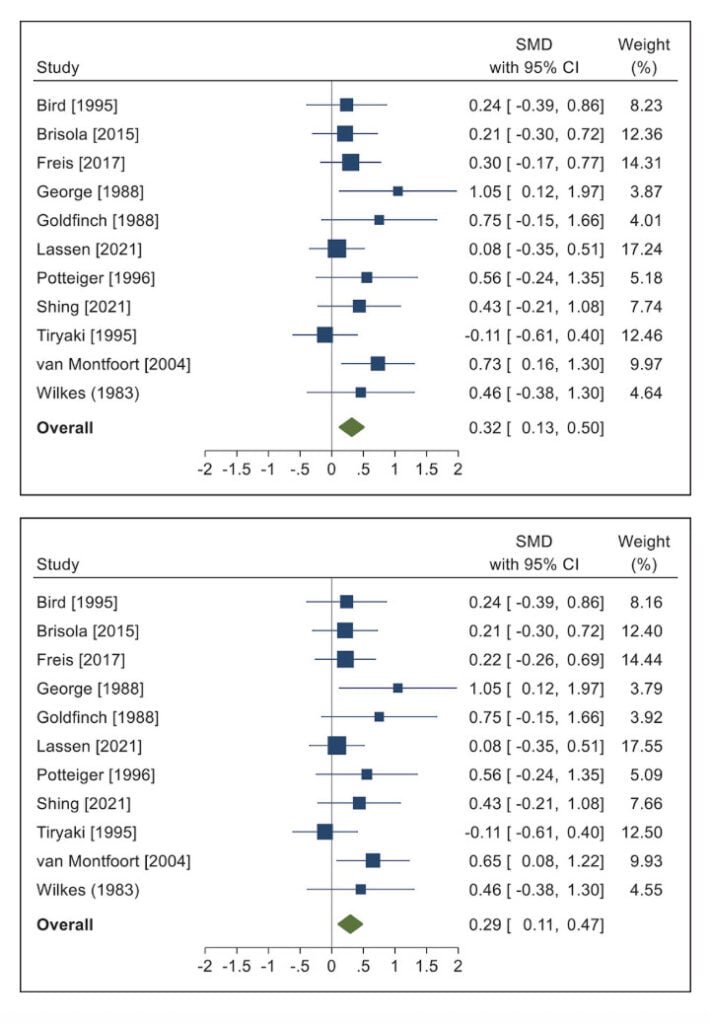
The authors searched major databases for randomized, double-blind, placebo-controlled trials and included only studies that assessed continuous running performance after a single oral dose of sodium bicarbonate. They excluded multi-day loading protocols and excluded repeated-sprint/interval running designs, which helps keep the question specific to a single, hard, continuous run.
They ended up with 11 studies totaling 126 participants. Most subjects were men (84% male), generally young (roughly early 20s), and mostly trained/competitive runners. The dosing was typically 0.3 g/kg body mass (range 0.2–0.4 g/kg), usually taken ~90 minutes before the performance test. Performance tests ranged from 1 to 30 minutes and included fixed-distance time trials (like 400, 800, and 1500 meter runs), time-to-exhaustion protocols, a 30-minute maximal distance test, and a graded test.
Across studies reporting symptoms, GI issues occurred in 29.5% of bicarbonate trials versus 2.6% of placebo trials. And GI-related withdrawal (i.e., people who couldn’t complete the protocol) happened in 8.7% of bicarbonate conditions versus 1.6% with placebo. The most common complaints were diarrhea (9.0%), unspecified GI upset (9.0%), nausea/vomiting (6.4%), and stomachache (5.1%).
In performance tests, bicarbonate produced a small overall improvement. After adjusting for GI-related withdrawals (excluding people who “dropped out”), effects were still small. They also explored who might benefit more. Across studies, a higher proportion of male participants and a higher average body mass were associated with larger effects.
What this means for runners
In the best-case scenario, the average benefit for sodium bicarbonate on continuous running performance looks tiny once you correct for the ways this literature tends to overstate effects, while the GI risk is very real (roughly a 1-in-3 chance of symptoms and close to 1-in-11 odds of not tolerating it at all). If you’re a larger male runner targeting shorter, very hard events (think a few minutes to ~15 minutes), you might be in the subgroup where it’s more likely to help, but even then you should treat it like any other high-risk strategy: test it in training, control the timing (~60–150 minutes before), don’t debut it on race day, and be honest about whether a small potential upside is worth the real chance of GI distress.