


Maximal aerobic capacity (VO2 max) is determined by several factors: the ability of the lungs to take in air and oxygenate the blood, the ability of the heart to pump oxygen-rich blood to the rest of the body, and the ability of the muscles to extract oxygen from the blood and turn it into energy in the mitochondria (the so-called “powerhouses” of our body).
If you want to become fitter, at least one of these factors must increase. You have to get bigger and stronger lungs, a bigger and stronger heart and vascularity, or denser, more efficient mitochondria. These are the determinants of VO2 max, but not all of them are equally limiting.
For most people, aerobic capacity is limited by the heart’s ability to deliver blood to working muscles—otherwise known as cardiac output. This is the amount of blood pumped from the heart each minute. During endurance training, cardiac output increases. But how?

Cardiac output has two components: heart rate and stroke volume, the latter being the amount of blood the heart pumps with each beat. Multiplying heart rate by stroke volume yields cardiac output.
However, only one of these components increases with endurance training: stroke volume. Our maximal heart rate doesn’t increase as we get fitter, but our heart’s pumping ability gets stronger. That’s a bit counterintuitive, as it would seem like the easiest way to pump more blood would be for the heart to “just go faster.” But that’s not what happens with training.
This begs the question—what’s limiting cardiac output in humans?
That’s the question that Ilkka Heinonen (@ileximius on X) delves deeply into in a new review article—detailing the mechanisms restricting maximal cardiac output and proposing a novel perspective on myocardial physiology.1Heinonen, I. (2025). Cardiac output limits maximal oxygen consumption, but what limits maximal cardiac output? Experimental Physiology. https://doi.org/10.1113/ep091594
While it might seem intuitively beneficial for maximal cardiac output to increase with higher maximal heart rates (a faster beating heart delivers more blood), endurance training paradoxically reduces maximal heart rates.
Heinonen clarifies that maximal heart rate remains stable or even decreases post-training due to physiological constraints: higher heart rates shorten diastolic duration (the time our heart spends in the relaxation or filling phase), thereby compromising myocardial blood flow, which predominantly occurs during diastole. The myocardium, already extracting oxygen at high rates even at rest, cannot easily cope with reduced perfusion time. In other words, if heart rate gets too high, the cardiac muscle doesn’t have enough time to get enough oxygen, risking ischemia (a lack of blood flow) and hypoxia (oxygen deprivation).
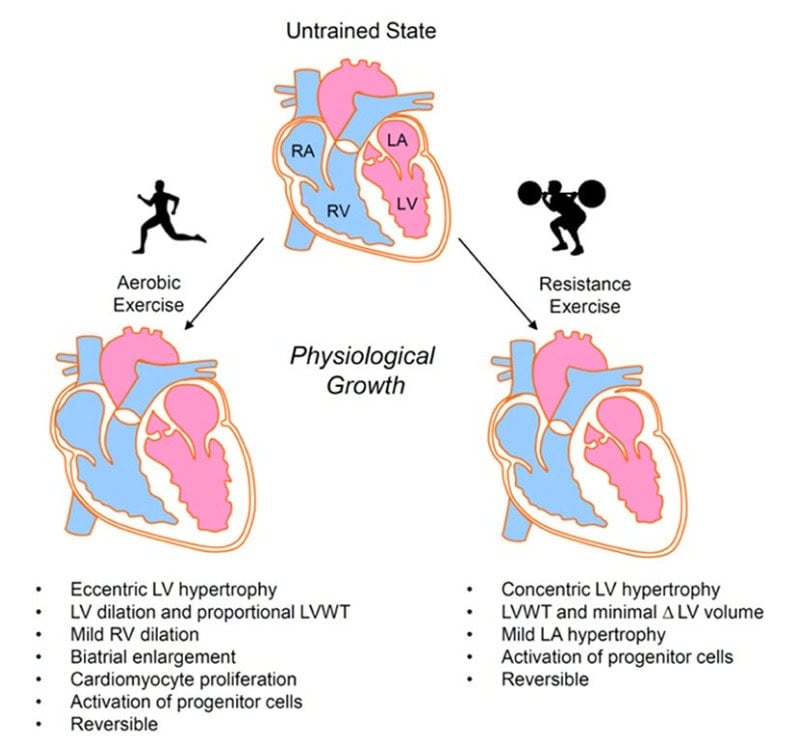
Rather, the primary adaptation of the endurance-trained heart is not a faster beat, but a significantly larger stroke volume—the amount of blood pumped with each beat.
Endurance training causes the heart to grow bigger, and this hypertrophy, primarily eccentric (outward), enlarges cardiac chambers (which hold the blood), thus enhancing stroke volume while simultaneously moderating oxygen demand by maintaining lower maximal heart rates—oxygen extraction is optimized in endurance-trained individuals because the blood spends more time in the coronary arteries that supply the heart with blood, even though resting and submaximal blood flow aren’t enhanced.
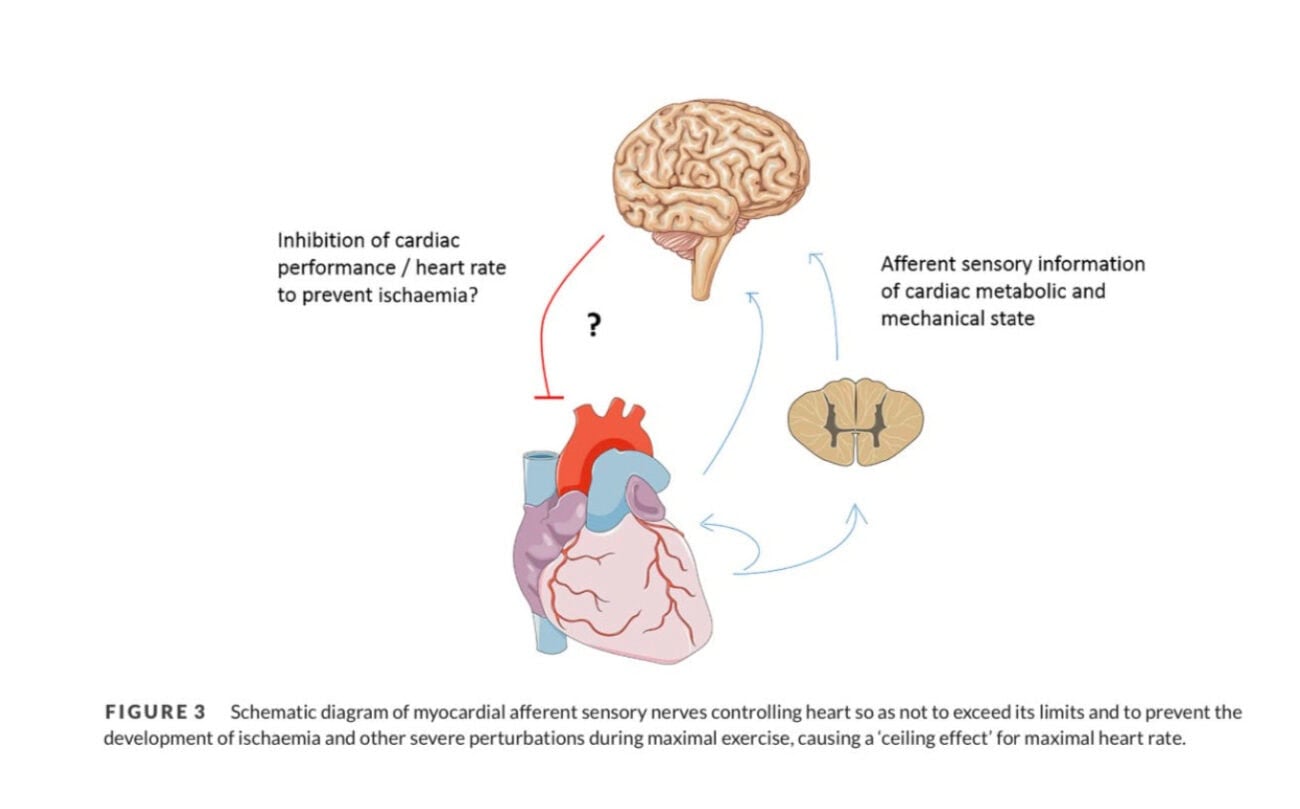
What’s putting a constraint on the body’s ability to elevate heart rate above some predetermined max?
The paper introduces an intriguing hypothesis: nerves that communicate from the heart to the rest of the body (technically, cardiac afferent sensory nerves) may serve as a protective mechanism by limiting maximal heart rate to prevent myocardial ischemia. These nerves, sensitive to metabolic, mechanical, and oxygen levels within the heart muscle, may function as a regulatory “ceiling,” preventing the heart from reaching harmful metabolic states. This protective mechanism explains why elite athletes do not simply develop progressively faster heart rates; instead, they benefit from structural adaptations that optimize stroke volume.
Heinonen further elaborates that the myocardial oxygen supply-demand balance is delicately maintained through structural rather than functional adaptations, thereby improving the efficiency of myocardial oxygen utilization.
What this means for runners
Exercises optimizing stroke volume, typically rhythmic and dynamic low- to moderate-intensity activities that maximize venous return, are most beneficial. These stretch the heart to its maximum for extended periods.
Heinonen suggests integrating diverse training intensities, tailored to fitness levels, to progressively challenge and improve cardiac function. That means plenty of “zone 2” training, along with a balance of high-intensity intervals. While resistance training has plenty of merits, maximizing gains in stroke volume isn’t one of them—hence why lifting weights is a poor way to increase VO2 max.
I found this review to be a brilliant illustration of the incredibly complex way that our body operates—it’s almost as though there’s intentionality behind it.
Physiology is smart enough to side-step the obvious (to us) solution to a problem and come up with unique (and far superior) ways of accomplishing a goal. Next time you’re out training, think about what’s going on under the hood and appreciate how the body makes us stronger and fitter in ways that, mechanistically, we are only just beginning to understand.
References
RunClub — Free
Join 300,000+ runners in RunClub
Free training plans for every distance, a daily running game, exclusive coaching content, and a real community of runners. Create your free account in 20 seconds — no card.
Already a member? Log in →












Join the conversation
This article notes: "While resistance training has plenty of merits, maximizing gains in stroke volume isn’t one of them—hence why lifting weights is a poor way to increase VO2 max."
While I cannot put my fingers on it, another Marathon Handbook article indicated that lifting weights improved VO2 max through the downstream effects of better oxygen use in the last mile (i.e. at the cellular level) and that age-related VO2 max reduction may be more related to a lack of strength training than a decrease in cardiac output--although both can contribute to said reduction.
Any thoughts about the apparent discord may be helpful in a future article.