


The consensus on carbon-plated shoes is clear: they make you faster. The mechanism is… less clear. But the leading theory is that they reduce the “energetic cost” of running, essentially making runners more efficient at the same speed.
A new systematic review and meta-analysis1Kobayashi, E. N., de Toledo, R. R. F., de Almeida, M. O., Sprey, J. W. C., & Jorge, P. B. (2026). Metabolic effects of carbon-plated running shoes: a systematic review and meta-analysis. Frontiers in Sports and Active Living, 7. https://doi.org/10.3389/fspor.2025.1710224 investigated whether, when you compare carbon-plated shoes to non-plated shoes, you reliably see lower metabolic demand during running, and how big is the effect?
Researchers included 14 studies comparing plated vs non-plated running shoes in healthy adults. In all of the studies, each participant ran in both shoe conditions, which helps control for the enormous between-runner variability in economy with “supershoes.”
They focused on a few metabolic outcomes that are essentially different ways of asking the same question (“how expensive is it to run at a given pace?”):
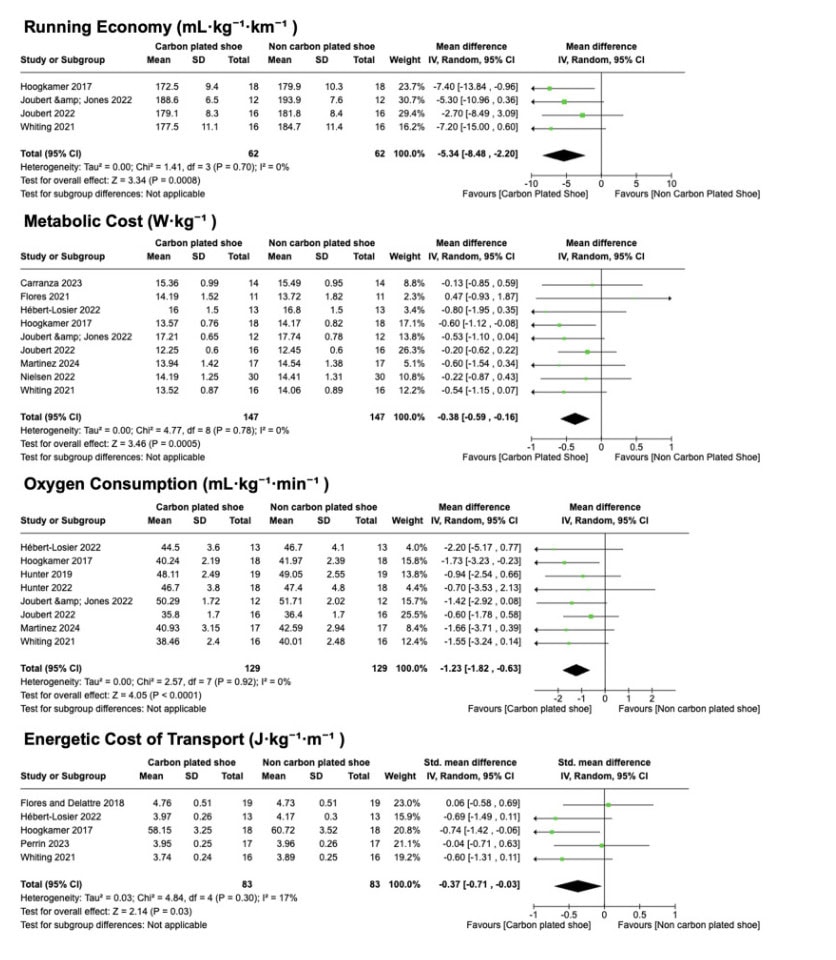
- Running economy (mL·kg⁻¹·km⁻¹)
- Metabolic cost (W·kg⁻¹)
- Oxygen consumption (mL·kg⁻¹·min⁻¹)
- Energetic cost of transport (ECOT; J·kg⁻¹·m⁻¹)
On average, carbon-plated shoes lowered metabolic demand across the board. The estimates favored plated shoes for running economy (a 5.34 mL·kg⁻¹·km⁻¹ advantage), metabolic cost (0.38 W·kg⁻¹ advantage), oxygen consumption (a 1.23 mL·kg⁻¹·min⁻¹ advantage), and ECOT (a 0.37 J·kg⁻¹·m⁻¹ advantage).
The authors also translated the pooled effects into something a bit more intuitive: plated footwear lowered metabolic demand by ~2–3% (average −2.75%, with a range from about −1% to −4.5% depending on the specific outcome and study).
That magnitude matches what most runners “feel” in super shoes. It’s not a night-and-day transformation, but a meaningful edge, especially as pace increases and races get longer.
What this means for runners
If you’re deciding whether carbon-plated shoes are “worth it,” the scientific answer is yes: across controlled crossover studies, plated shoes are associated with about a 2–3% reduction in metabolic cost during submaximal running.
References
RunClub — Free
Join 300,000+ runners in RunClub
Free training plans for every distance, a daily running game, exclusive coaching content, and a real community of runners. Create your free account in 20 seconds — no card.
Already a member? Log in →












Start the conversation