


The finish line is where ego, adrenaline, and physiology all collide. And it’s also where the risk of sudden cardiac arrest (SCA) spikes.
A new study uses a decade-plus of prospective data1Chocron, R., Laurenceau, T., Cezard, P., Chabrol, M., Mignot, S., Meli, U., Langlois, C., Schwartz, P. J., Kääb, S., Levy, B. I., Beganton, F., Bougouin, W., Cariou, A., Adnet, F., Dumas, F., Loeb, T., Feral-Piersens, A.-L., Heidet, M., Jost, D., & Empana, J.-P. (2026). Characteristics of sudden cardiac arrest during endurance racing: a decade of the Paris registry. Europace, 28(2). https://doi.org/10.1093/europace/euaf313 from Paris to answer when sudden cardiac arrest happens during big endurance races, what it looks like, who it happens to, where in the race it happens, and whether we know why it happens.
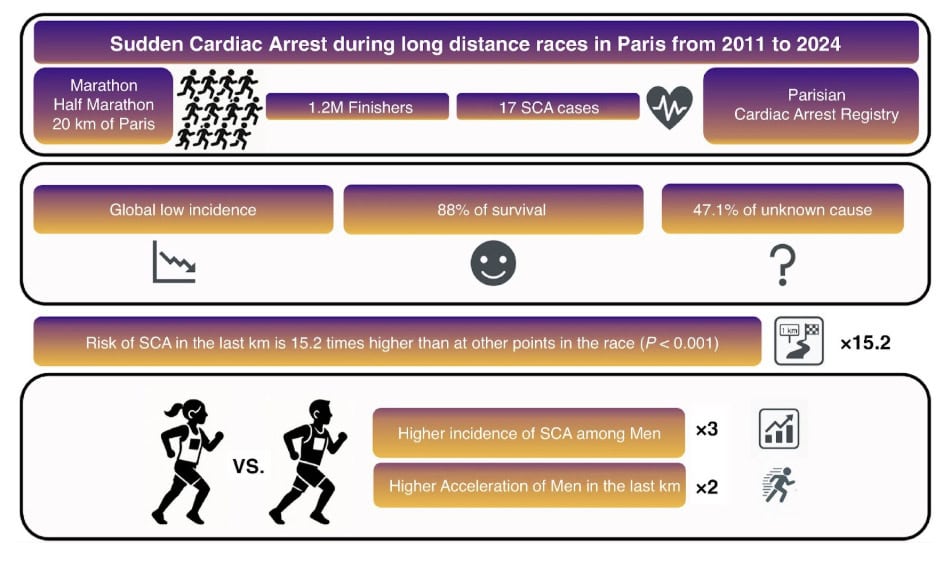
Researchers combined two data sources. First, the Paris Sudden Death Expertise Centre registry (SDEC), which prospectively tracks out-of-hospital cardiac arrest across a population of ~6.7 million people. Second, they pulled participation and timing data from official race results for the Paris 20 km, the Paris Half Marathon, and the Paris Marathon from 2011 to 2024 (excluding 2020). They then identified race-related SCA cases (adults, occurring on race day within a defined time window, and not clearly due to a non-medical cause), verified where on the course each arrest occurred, and linked that to participation numbers to calculate incidence.
Across about 1.2 million participations, there were 17 sudden cardiac arrests during these three events. The absolute risk is low. When they broke it down by sex, the incidence was 16.9 per million participations in men and 5.7 per million in women—so men were overrepresented (and 15 of the 17 cases were male). The average age of cases was 42 years.
The second big takeaway is the “where.” In the 20 km race, 6 of 7 arrests occurred in the final kilometer. In the half-marathon, 3 of 5 occurred in the final kilometer (with two additional arrests happening just before that). In the marathon, this clustering pattern didn’t hold: only 1 of 5 arrests happened in the last kilometer. The risk of an SCA in the final kilometer of the shorter races was 15.2 times higher than at other points on the course.
On the reassuring side, outcomes were excellent: 88% survived (15/17), and survivors had excellent neurological status at discharge.
On the unsettling side: even with extensive in-hospital evaluation, the cause was often unclear. They identified a specific cause in just 9 of 17 cases. The most common known cause was ischemic cardiomyopathy (5 cases). There were also isolated diagnoses like Brugada syndrome, myocarditis, and an anomalous right coronary artery. But in 8 of 17 cases (47.1%), no cause was found—despite workups that included advanced imaging and other testing.
Finally, the behavioral/performance angle: among 323,028 half-marathon finishers, most sped up at the end (87% showed some acceleration). But men were more likely to surge, and compared with women, they were nearly twice as likely to accelerate in the final kilometer. That sex gap in end-of-race acceleration widened with age.
Putting it together, the finish-line clustering and the male-specific surge pattern point toward a plausible mechanism: the final kilometer is a unique physiological stress test in which maximal sympathetic drive, greater mechanical and metabolic strain, and a more abrupt intensity change occur. Some runners (more often men) seem more likely to spike that demand right at the end, and this could raise the risk of a cardiac event.
What this means for runners
The conclusion here isn’t that races are dangerous, because the incidence here is genuinely low. Rather, the finish line is a distinct risk window where intensity often jumps abruptly, especially for men. If you’re a middle-aged runner with cardiovascular risk factors (or you’re the type who goes from controlled effort to an all-out sprint the moment you see the clock), this is a reminder to heed caution. Zooming out, the 88% survival rate is an argument for racing in well-supported events, because fast recognition, fast CPR, and fast defibrillation seem to be making a difference in outcomes.
References
RunClub — Free
Join 300,000+ runners in RunClub
Free training plans for every distance, a daily running game, exclusive coaching content, and a real community of runners. Create your free account in 20 seconds — no card.
Already a member? Log in →












Start the conversation