


Vitamin D is one of those supplements that feels boring and mysterious. It’s boring because it’s not flashy, and it’s mysterious because people swear it changes everything from mood to muscle function, especially during the fall and winter months when the days get shorter, and most of our runs are happening before the sun comes up.
So, if you give runners vitamin D through the darkest months of the year, do you actually move the needle on anything that matters, like blood markers tied to immune health, and (more important to some) real performance?
A new study followed 45 healthy adults1Gervasi, M., Fernández-Peña, E., Zeppa, S. D., Annibalini, G., Bartolacci, A., Formiglio, E., Agostini, D., Barbato, C., Fiaccarini, G., Spaccazocchi, I., Patti, A., Sestili, P., Bellomo, R. G., & Pegreffi, F. (2026). Effects of vitamin D supplementation during autumn and winter on blood biomarkers and physical performance in runners and non runners. Scientific Reports. https://doi.org/10.1038/s41598-026-38528-1 from October to March (a period with minimal sunlight exposure at their latitude). Participants were randomized into four groups:
- Supplemented runners
- Non-supplemented runners
- Supplemented non-runners
- Non-supplemented non-runners
The supplement was vitamin D₃ (2000 IU/day) delivered with a dissolvable strip and taken daily for 8 weeks. Then the researchers stopped supplementation and tracked everyone for another 12 weeks to see what happened as winter continued.
They measured serum 25(OH)D₃ (the standard vitamin D status marker) plus blood counts that reflect immune status. They also tested performance, including VO₂max (direct for runners; estimated for non-runners, countermovement jump (explosive power), and maximal isometric force (strength).
Runners had to be consistently active: at least 3 years of endurance running, ≥3 runs/week, and a minimum weekly mileage of 30 miles/50 kilometers for men and 25 miles/40 kilometers for women.
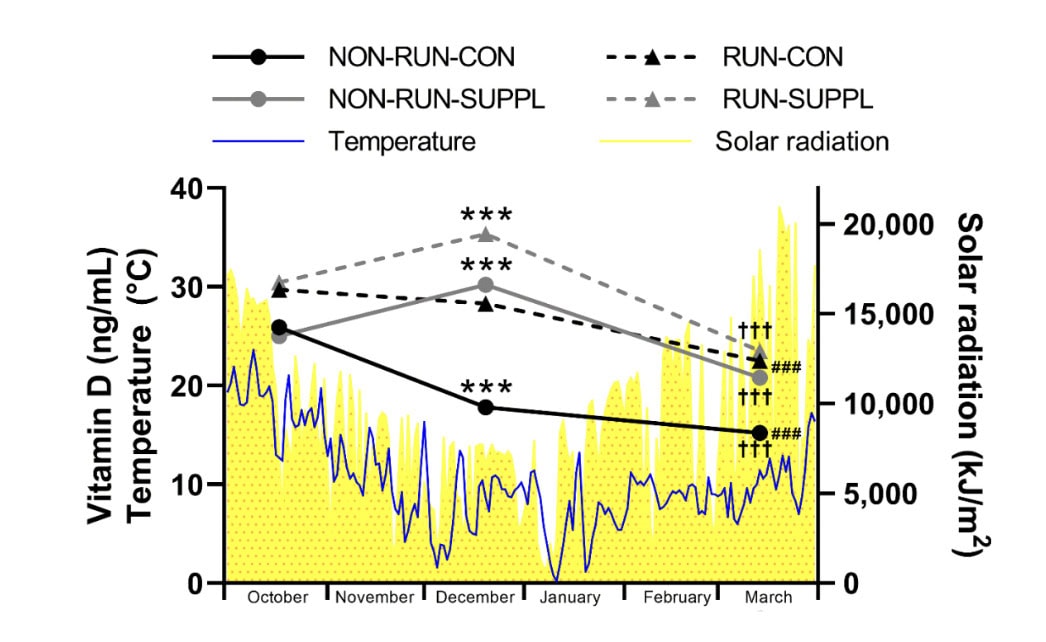
At baseline (mid-October), runners started a bit higher than non-runners. After 8 weeks:
- Supplemented runners increased from 30.45 → 35.35 ng/mL (~21% increase).
- Supplemented non-runners increased from 25.0 → 30.2 ng/mL (~29% increase).
- Non-supplemented non-runners dropped from 25.93 → 17.8 ng/mL (~32% decrease).
- Non-supplemented runners were relatively stable early on (about 29.7 → 28.3 ng/mL).
Once supplementation stopped, vitamin D fell across the board by March. Even the supplemented runner group dropped to ~23.5 ng/mL, and the non-supplemented groups ended up similarly low (or lower). So the supplement worked, but its benefits didn’t “stick” once they stopped.
Second, there was a noticeable immune signal, especially in the non-runners. Total leukocyte and neutrophil counts declined over the winter in the non-supplemented non-runners, whereas supplemented participants remained more stable.
Finally, vitamin D provided no real performance boost. VO₂max stayed essentially flat in runners (around ~60 mL/kg/min in both runner groups across all time points), countermovement jump didn’t change meaningfully, and strength showed only a hint of improvement.
What this means for runners
If you’re heading into fall/winter and your vitamin D tends to run low (or you live somewhere with minimal sun), this supports a simple strategy: 2,000 IU/day (or potentially more) can keep your vitamin D status from sliding during the darkest months, and it might help maintain a steadier immune profile in the background… just don’t expect it to magically boost VO₂max. I’d treat vitamin D less like a performance supplement and more like a seasonal maintenance tool. It’s useful if your levels are trending down, especially if you’re injury-prone, frequently sick, or training hard through winter, but not something to bank on for faster workouts.
References
RunClub — Free
Join 300,000+ runners in RunClub
Free training plans for every distance, a daily running game, exclusive coaching content, and a real community of runners. Create your free account in 20 seconds — no card.
Already a member? Log in →












Start the conversation