


Many runners have long followed a simple rule for indoor training: Set the treadmill to 1%, and the energetic cost will roughly match running outside (supposedly because it accounts for wind speed, which is absent indoors).
That rule was never meant to be universal (and personally, I’ve never bought into it), and a new study suggests it may not hold even in highly trained runners.

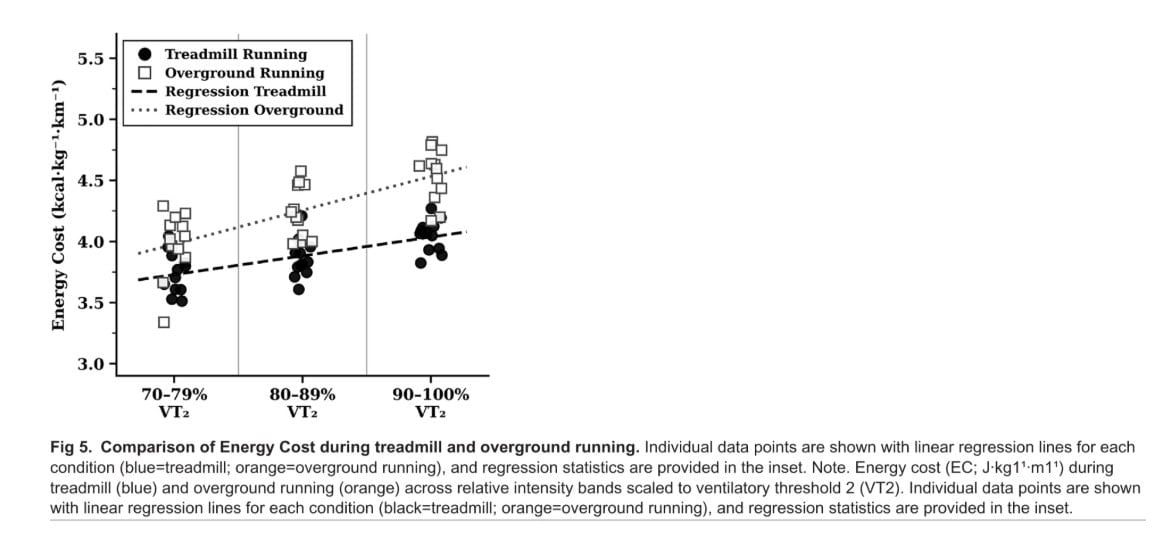
Twelve national-level male endurance runners completed the same test twice. They ran from 5 to 9 miles per hour (8 to 15 kilometers per hour) in three-minute stages, first on a treadmill set to a 1% grade and then, 48 to 72 hours later, on a 400-meter outdoor track. The researchers measured oxygen consumption, oxygen cost per kilometer, total energy cost, and fuel use across different running intensities.1Shahidi, S. H., Can, R., Paça, F. M., & Zengin, M. D. (2026). Overground running incurs a higher energetic cost than treadmill running at a 1% grade: A comparison of running economy, oxygen cost of transport, and energy cost in endurance athletes. PloS One, 21(8), e0355988. https://doi.org/10.1371/journal.pone.0355988
Overground running was consistently more “expensive.”
- Oxygen cost of running averaged 204.2 versus 197.1 milliliters per kilogram per kilometer outdoors and on the treadmill, respectively—a difference of about 3.6%.
- At 7 miles per hour/12 kilometers per hour, the energy cost was 0.93 versus 0.87 kilocalories per kilogram per kilometer. Near the runner’s second ventilatory threshold (denoting a heavy intensity), the gap widened.
- Carbohydrate use was also higher outdoors between the first and second ventilatory thresholds: the runners used 3.20 versus 2.75 grams per minute. Near the second threshold, it reached 3.70 versus 3.03 grams per minute.
What this means for runners
A treadmill remains an excellent tool for controlled training. But treadmill pace and outdoor pace are not interchangeable, even when the belt is raised to 1%. If an outdoor threshold session feels a little harder than the same speed indoors, that does not necessarily mean your fitness changed.
The practical move here is to calibrate by effort, heart rate, or lactate rather than forcing one universal incline correction. Keep treadmill conditions consistent when tracking progress, and complete some race-specific work on the surface where you plan to compete. I wouldn’t turn this small study into a command to raise the belt another half-percent.
References
RunClub — Free
Join 300,000+ runners in RunClub
Free training plans for every distance, a daily running game, exclusive coaching content, and a real community of runners. Create your free account in 20 seconds — no card.
Already a member? Log in →









Start the conversation