


Caffeine is one of the most reliable performance aids in endurance sport, but athletes often talk about it as if it has a second superpower: unlocking fat stores and sparing carbohydrate.
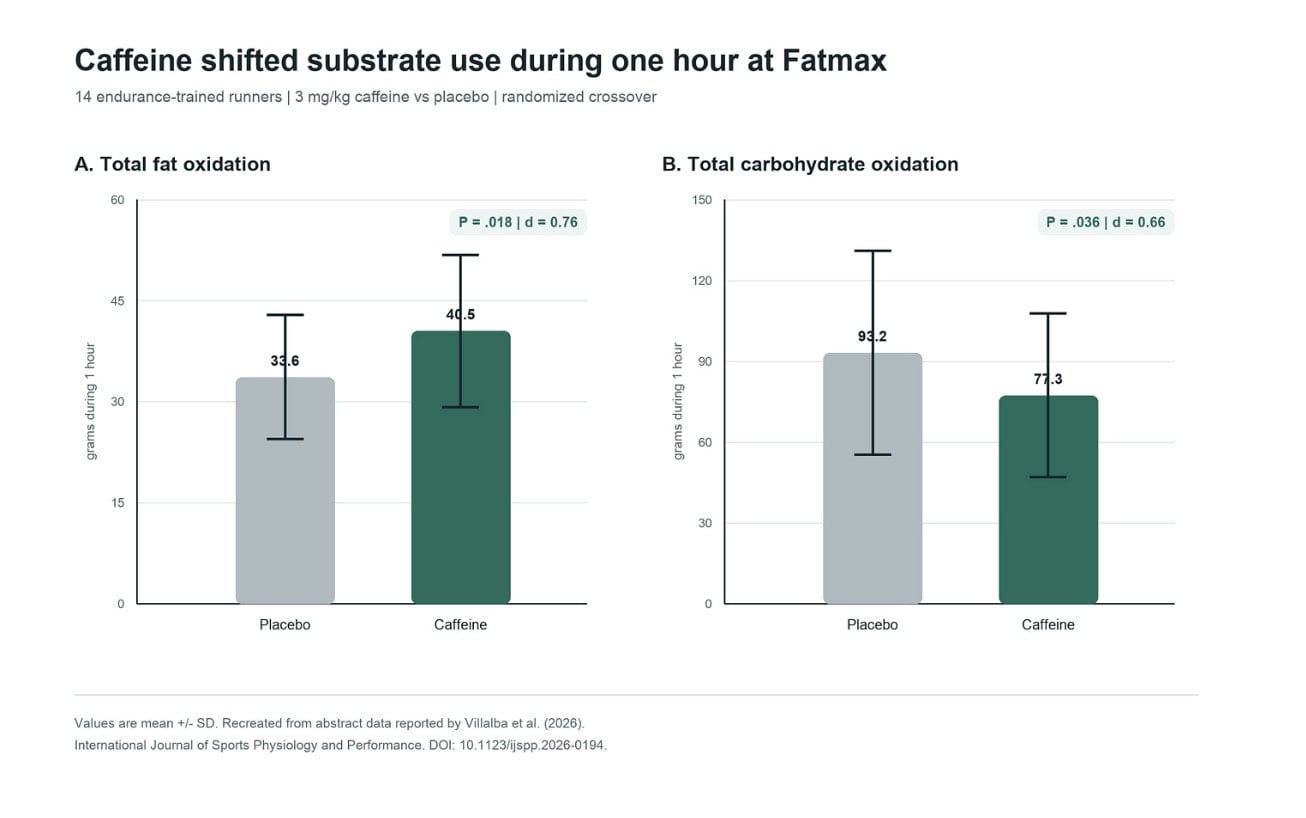
A randomized, double-blind crossover study1Villalba, I., Solano-Lizcano, V., Rodríguez-Castaño, A., García-Ortiz, C., Ranieri, L. E., Casado, A., Del Coso, J., & Trujillo-Colmena, D. (2026). Caffeine Shifts Substrate Utilization Toward Fat During Outdoor Running at Fatmax: A Randomized Field-Based Crossover Study. International Journal of Sports Physiology and Performance, 1–10. https://doi.org/10.1123/ijspp.2026-0194 tested that idea in the real world. Fourteen trained runners—11 men and three women, with an average VO2max of 58.6 mL/kg/min—completed two one-hour outdoor runs at their individual Fatmax intensity (the pace at which fat oxidation had previously been measured to peak). Sixty minutes before each run, they consumed either 3 milligrams of caffeine per kilogram of body mass or a placebo, then ran laps while wearing a portable device that measured their fuel use during exercise.
- With caffeine, the runners oxidized an average of 40.46 grams of fat during the hour, compared with 33.62 grams after placebo—a difference of about 6.8 grams, or roughly 20 percent.
- Carbohydrate use moved in the opposite direction: 77.32 grams with caffeine versus 93.16 grams with placebo. Total energy expenditure did not change.
The runners also rated effort slightly lower after caffeine, even though heart rate did not differ significantly. This combination—more fat oxidation, less carbohydrate oxidation, and lower perceived effort at the same individualized intensity—suggests that caffeine changed both substrate selection and how the run felt.
What this means for runners
Caffeine can shift fuel use during a controlled, moderate-intensity run, but that does not make it a substitute for carbohydrates. If you tolerate caffeine and already use it for performance, this study adds a plausible metabolic effect to the better-established benefits for alertness and perceived effort.
The practical dose here was 3 mg/kg taken one hour before running—about 200–300 mg for your average-sized runner. That is a meaningful dose, and more is not automatically better. Test it in training, account for other caffeine you consume, and remember that sleep lost to an afternoon dose can erase any advantage you hoped to gain.
References
RunClub — Free
Join 300,000+ runners in RunClub
Free training plans for every distance, a daily running game, exclusive coaching content, and a real community of runners. Create your free account in 20 seconds — no card.
Already a member? Log in →








Start the conversation