


Advanced footwear technology has changed road racing, but the benefits may not have been evenly distributed.
In this study, researchers compared elite performances from a pre-supershoe era (2009–2015) with an advanced-footwear era (2017–2024). For each sex, event, and era, they collected the top 50 performances in the road 10K, half marathon, and marathon. Each athlete contributed only one performance per event and era, which prevented a single superstar (or “super responder”) from flooding the data set.
The clever part was the control group. Instead of simply asking whether road times got faster, the researchers also examined the top 50 performances in four throwing events: shot put, discus, javelin, and hammer. Throwers benefited from many of the same era-wide changes as runners—better training, sports science, recovery, nutrition, talent development, and competition—but not from carbon-plated racing shoes.
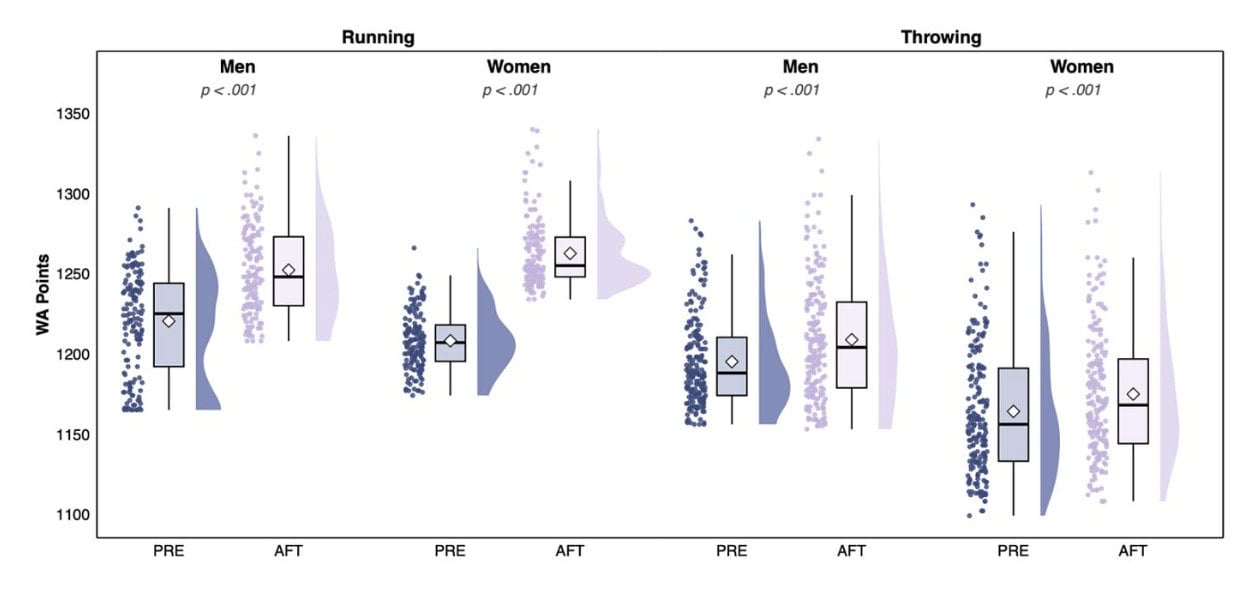
To compare very different events, the researchers converted performances into World Athletics points.
Road running improved much more than throwing after advanced footwear arrived.
- Across the three road events, women’s performances improved by 4.51 percent, while men’s improved by 2.62 percent. Throwing improved by about 1 percent in both sexes: 0.93 percent in women and 1.14 percent in men.
- Compared with the pre-supershoe era, women’s times improved by 3.52 percent in the 10K, 3.43 percent in the half marathon, and 3.04 percent in the marathon. The corresponding changes in men were 1.75 percent, 0.90 percent, and 1.13 percent.
In other words, the improvement associated with the new era was larger in running than throwing—and within running, it was larger in women than men.
The researchers also performed a wonderfully intuitive analysis: How many performances from the old era still survived in the current all-time top 50 at the end of 2025?
Among men, 8.9 percent of the pre-supershoe 10K performances, 10.7 percent of half-marathon performances, and 12 percent of marathon performances remained. Among women, the survival rates were 0 percent, 2 percent, and 2 percent. By contrast, half to more than 90 percent of old-era throwing performances still ranked in the top 50, depending on the event and sex.
What this means for runners
For most of us, the practical message is not that women should expect a three- or four-percent personal best simply by changing shoes. These figures describe the evolution of the world’s best performances across eras, not an individual runner’s response.
Supershoe benefits are probably more individual—and more context-dependent—than a single average suggests. Sex may be one contributor, but body mass, speed, mechanics, fatigue, shoe geometry, and comfort all matter.
In any case. I think it should be clear that shoes are driving the rapid performance leaps we are seeing in the sport.
RunClub — Free
Join 300,000+ runners in RunClub
Free training plans for every distance, a daily running game, exclusive coaching content, and a real community of runners. Create your free account in 20 seconds — no card.
Already a member? Log in →












Start the conversation