


Who are the most famous runners of all time? From Usain Bolt’s 9.58-second 100m to Eliud Kipchoge’s sub-2-hour marathon, the sport has produced some of the greatest athletes in history. Here are 30 famous runners who changed the game — spanning sprints, distance, and ultramarathons.
You might not be plugged into the current elite or competitive running scene and be able to readily rattle off the fastest runners in the world.
However, some of the most famous runners of all time have become household names in the same way that famous athletes of other sports such as Shaquille O’Neal, Tiger Woods, Serena Williams, and Mike Tyson have.
In this guide, we have put together a list of some of the most famous marathon runners, famous track runners, famous female runners, and other notable or notorious runners throughout history and today that true fans of the sport of running should know about.
Get ready to be inspired as you learn about some of the trailblazers in the sport of running, the fastest runners in history, and the most famous runners of all time!
The Honest Truth About What Makes A Runner Famous
The runners who get celebrated land in one of three different categories that “famous” collapses too easily: world-record holders measured in the 0.001 percent tail of human performance; Olympic medallists who deliver in a fixed three-week window once every four years; and cultural icons whose impact is partly performance and partly story. The physiology and the path to that fame look different in each.
The world-record tail: what 0.001 percent looks like physiologically
The world-record holders — Kelvin Kiptum’s 2:00:35 marathon, Faith Kipyegon’s 14:00 5,000m, Letesenbet Gidey’s 1:02:52 half — represent VO2max, lactate threshold, and running economy values clustered in the absolute upper tail of the distribution. Joyner and Coyle’s “physiology of champions” review describes the elite combination as VO2max in the 70–85 ml/kg/min range, lactate threshold above 85 percent of VO2max, and exceptional running economy — with no single trait sufficient on its own 1Joyner MJ, Coyle EF. Endurance exercise performance: the physiology of champions. J Physiol. 2008;586(1):35-44.. The training-volume profile of contemporary East African elites sits at 200–240 km per week of running, with characteristic threshold-heavy structure and altitude residence at 2,000–2,400 m for much of the year 2Tjelta LI. The training of international level distance runners. Int J Sports Sci Coach. 2016;11(1):122-32.. Bassett and Howley’s analysis of limiting factors places the maximal-end of human performance as a multi-factor product: cardiac output ceiling, oxygen-carrying capacity, capillary density, mitochondrial volume, and neuromuscular efficiency, all near their individual genetic ceilings 3Bassett DR, Howley ET. Limiting factors for maximum oxygen uptake and determinants of endurance performance. Med Sci Sports Exerc. 2000;32(1):70-84..
Genetics, training, and the talent-vs-work false binary
The popular framing that elites are made by training alone (or by genetics alone) is unsupported. Wilber and Pitsiladis reviewed the running success of East African distance runners and concluded the pattern reflects a combination of socioeconomic, geographic (high-altitude childhood), psychological, and genetic factors — with no single ACTN3 or ACE-style polymorphism explaining the bulk of the variance 4Wilber RL, Pitsiladis YP. Kenyan and Ethiopian distance runners: what makes them so good? Int J Sports Physiol Perform. 2012;7(2):92-102.. Twin studies on VO2max trainability find that roughly half the variance in trainability is heritable — some athletes simply respond more to the same stimulus than others — which is the “trainability gene pool” argument advanced by the HERITAGE family-study programme 5Bouchard C, Sarzynski MA, Rice TK, et al. Genomic predictors of the maximal O₂ uptake response to standardized exercise training programs. J Appl Physiol. 2011;110(5):1160-70.. The honest reading: an elite is someone whose genetic ceiling is unusually high and whose training has approached that ceiling. Either component on its own is not enough.
Beyond the records: cultural icons and the “impact” ranking
Some of the most famous runners are not the fastest. Roger Bannister’s 4-minute mile (3:59.4 at Iffley Road, 1954) is famous as a cultural barrier broken, not a record that survived — the men’s mile record now stands at 3:43.13 (Hicham El Guerrouj, 1999). Steve Prefontaine never held a world record at 5,000m or 10,000m at the time of his death; his fame is largely about racing style and cultural impact in 1970s American distance running. Kathrine Switzer’s 1967 Boston Marathon entry was, at the time, an act of civil disruption rather than a record run, but she shifted the trajectory of women’s long-distance access in a way that performance metrics don’t capture 6Lepers R, Stapley PJ. Master athletes are extending the limits of human endurance. Front Physiol. 2016;7:613.. Eliud Kipchoge’s INEOS 1:59 (sub-2 hour marathon, 2019) was not record-eligible because of pacing and equipment conditions, but reshaped what runners now believe is achievable. The lesson is that “famous” lists conflate impact and performance, and the most influential runners often score lower on the second axis than on the first.
Olympic medallist physiology vs world-record physiology
Olympic gold rewards a single race on a fixed day. The literature on tactical-vs-time-trial racing finds that championship medallists tend to combine excellent finishing speed (last 400m or 200m) with the lactate-threshold power to be in the lead pack at the bell 7Hanley B, Stellingwerff T, Hettinga FJ. Successful pacing profiles of Olympic male and female 3,000m steeplechase finalists. Int J Sports Sci Coach. 2019;14(2):136-43.. World-record runs are time-trial efforts paced by clock and pacers, and reward different physiology — metabolic-cost minimisation across 26.2 miles for the marathon, or sustained near-VO2max effort for the 10,000m. This is why some athletes (Mo Farah, Sifan Hassan) excel in championship racing without ever holding the world record at their primary distances, while others (Kelvin Kiptum, Eliud Kipchoge) have the physiology that translates to record marks but uneven championship results 8Joyner MJ, Hunter SK, Lucia A, Jones AM. Physiological and biomechanical aspects of distance running performance: a sex-specific review. J Appl Physiol. 2020;128(4):951-9.. The two axes of fame — medal count and record book — are correlated but not the same.
When “greatest of all time” rankings break down
Cross-era comparisons in distance running are harder than they look. Track surfaces have improved, altitude training has become routine, super-shoes since 2017 have shifted marathon and half-marathon times by 2–4 percent, and pacing technology and field depth have all changed within the last decade 9Hoogkamer W, Kipp S, Frank JH, Farina EM, Luo G, Kram R. A comparison of the energetic cost of running in marathon racing shoes. Sports Med. 2018;48(4):1009-19.. The Hoogkamer studies on super-shoe energy cost suggest 4 percent metabolic savings, which translates to roughly 2–4 percent finish-time improvement in real races; comparing pre-2017 marathon times to post-2017 times without that adjustment is misleading. Female participation depth is also a moving target — the women’s marathon record is a younger event than the men’s, and performance trajectory remains steeper. The honest reading: greatest-of-all-time lists are partly about the runner and partly about the era, and the runners who shaped what came next (Bannister, Switzer, Prefontaine, Radcliffe, Kipchoge) often deserve their place for reasons the stopwatch doesn’t capture.
30 Of The Most Famous Runners Of All Time
Eliud Kipchoge

Eliud Kipchoge Is probably the most famous runner in the world right now, at least in terms of distance runners or the most famous marathon runner.
Until very recently at the 2023 Chicago Marathon where Kelvin Kiptum overtook Kipchoge’s marathon world record, Kipchoge was the marathon world record holder for men and had earned that accolade after beating his own world record previously at the same distance.
This Kenyon distance runner has so many accolades and Olympic medals to his name and has won the vast majority of the 19 marathons he has competed in.
Eliud Kipchoge also holds five of the nine fastest marathon times in history and although not official given the logistics of the event, is the only runner to date who has completed the 26.2 mile distance, or full marathon, in under two hours.
#2: Kelvin Kiptum
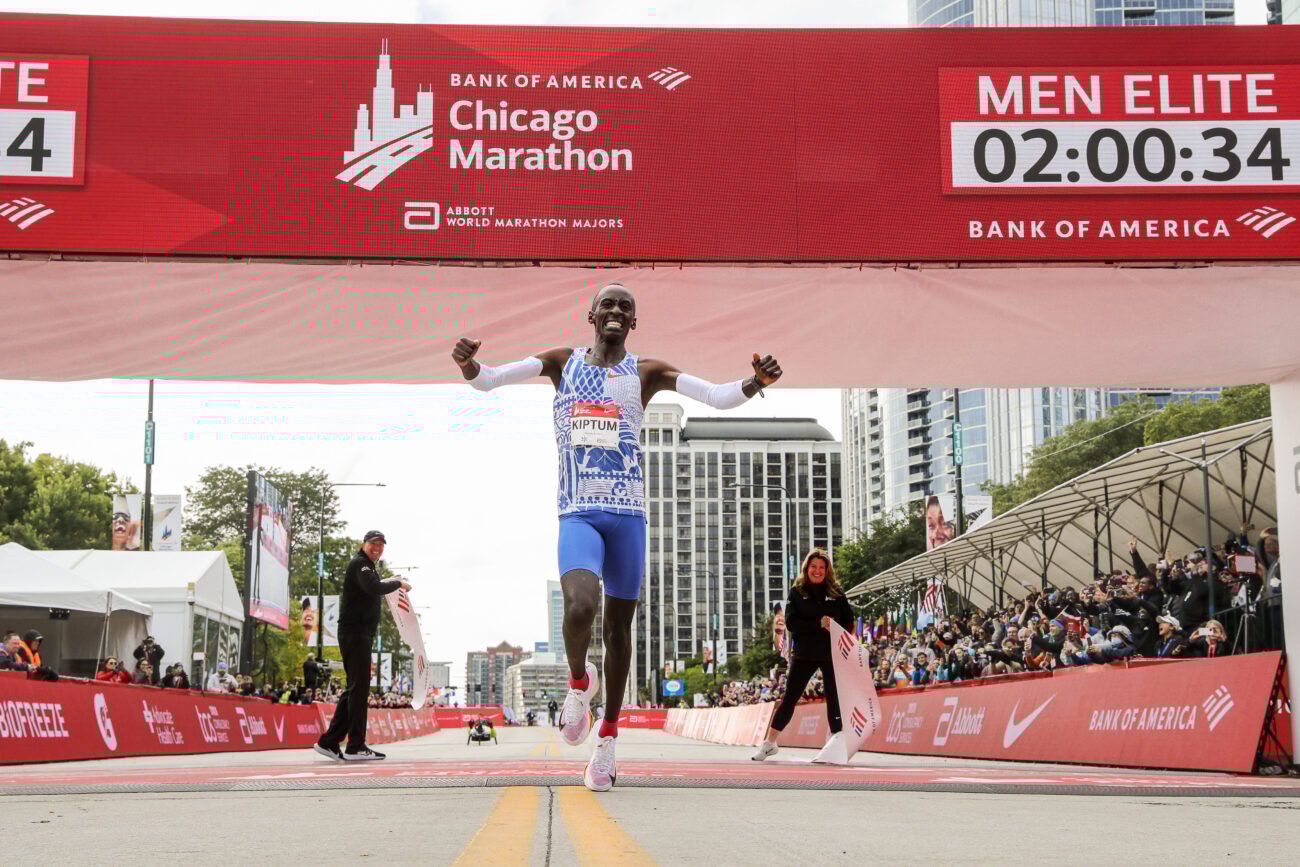
A just 23 years old, Kenyan marathon runner Kelvin Kiptum is quickly becoming one of the most famous marathon runners in history, as he is now the fastest marathon runner in history.
Kiptom shattered the men’s marathon world record (held by Eliud Kipchoge) at the Chicago Marathon on Sunday, October 8, 2023.
Kiptum ran 2:00:35, in what was only his third full marathon race.
Kelvin Kiptum set the fastest marathon debut time (2:01:53) in his first race at the distance at the 2022 Valencia Marathon, finishing in 2:01:53.
For context, this was faster than Eliud Kipchoge’s winning time at this year’s Berlin Marathon, which was 2:02:42.
Kiptum then won the 2023 London Marathon in April this year, running 2:01:25, which was just 16 seconds off Kipchoge’s marathon world record time at the time and the second fastest marathon time ever.
#3: Sir Mo Farah
British runner Sir Mo Farah recently hung up his competitive running shoes after finishing one of the most successful running careers of all time (and certainly going down in the books as the most famous British runner in history).
Mo Farah built a running resume that boasts 17 major titles on the track and set national records from the 1500m event up to the marathon—and who can forget—not one, not two, not three, but four Olympic gold medals.
Aside from all of the race wins and medals that Mo Farah has accumulated over his career as a competitive distance runner, perhaps nothing is as important and meaningful as the integrity with which Farah competed.
#4: Kathrine Switzer

No list of the most famous women runners of all time—or most famous marathon runners of any sex for that matter—is complete without Kathrine Switzer.
She was the first-ever official female competitor in the Boston Marathon (Roberta Gibb had unofficially run the full Boston Marathon as a bandit the year before).
Registering under her initials rather than her full name allowed Kathrine Switzer to bypass the rule that women could not run the Boston Marathon in 1967.
She did indeed start and finish the race, despite the attempts made by race director, Jock Semple himself, to physically try to remove her from the course once race organizers realized Switzer was indeed female.
Katherine Switzer managed to finish the race in about four hours and 20 minutes, proving that women could run the full marathon distance with no issues.
However, it wasn’t actually until 1973 that the Boston Marathon officially allowed women to register for the event.
That said, Switzer was instrumental in beginning the discussions and trailblazing the way for future women marathoners to have equal participation opportunities in marathon running.
Katherine Switzer went on to win the New York City Marathon in 1974 and has remained active in the sport in numerous ways both personally and in the advocacy of girls and women participating in running.
#5: Paula Radcliff

Paula Radcliff is one of the most famous female runners of all time and one of the fastest women marathoners of all time.
This British female distance runner held the marathon world record for women (2:15:25) for 16 years and won the London Marathon three times, the New York Marathon three times, and the Chicago Marathon.
#6: Haile Gebrselassie
Haile Gebrselassie broke 61 Ethiopian national records, a whopping 27 of which became world records.
This Ethiopian superstar runner also won two Olympic gold medals in the 10,000m distance and four world championship titles in the 10,000m.
Once he stepped up to the marathon, Haile Gebrselassie became one of the fastest marathon runners of all time.
He won the Berlin Marathon a record four times (until Kipchoge usurped this title with an astonishing five wins on the course when he won the 2023 Berlin Marathon this year) and the Dubai Marathon three times.
#7: Sir Roger Bannister
We can’t have a list of the best runners of all time or the most famous runners of all time without Sir Roger Bannister, the British runner who was the first runner to run a sub-4-minute mile.
Sir Roger Bannister broke the four-minute mile barrier in 1954 when he ran 3:59.4, breaking what had been seen as a glass ceiling.
Soon several other runners began to follow suit, with Sir Roger Bannister demonstrating that we shouldn’t put limits on human potential.
#8: Kenenisa Bekele
Kenenisa Bekele, often considered to be Haile Gebrselassie’s biggest rival, is a fellow Ethiopian long-distance runner.
Bekele really dominated on the cross-country circuit, though he also beat Haile Gebrselassie at the 2005 Paris World Championships, the 2004 Athens Olympic Games, and the 2008 Beijing Olympic Games.
Kenenisa Bekele has won a career total of 19 medals, such as 11 World Cross Country senior gold medals, one junior gold medal, two team gold medals, and three team silver medals, among others.
#9: Jesse Owens

Jesse Owens is one of the most famous track runners of all time.
This American track and field champion won four gold medals at the 1936 Olympic Games in Berlin, one of the most politically volatile Olympic Games in history.
As an African-American runner, Jesse Owens also played a big role in paving the way for other African-American sprinters to compete in the sport despite racial oppression.
#10: Usain Bolt

The most famous sprinter of all time is likely Jamaican sprinter Usain Bolt.
In 2009, Usain Bolt ran 9.58 seconds for the 100m, setting the world record.
This works out to an average of 23.35 mph (37.58 km/h), so Usain Bolt can be considered the fastest runner in history.
#11: Emil Zatopek

Emil Zatopek earns a spot on this list of the most famous runners because he revolutionized training for runners by being one of the first to implement interval training.
Emil Zatopek’s training style helped him break 18 world records and win five Olympic medals, and most running plans today still rely on the concepts introduced by this middle-distance runner.
#12: Michael Johnson
Michael Johnson is one of the most famous sprinters of all time.
In 1996, Michael Johnson won both the 200 m and 400 m gold medals at the Olympics, becoming the first and only runner in history so far to successfully land this double.
#13: Lynn Jennings

Lynn Jennings is often considered the best American female distance runner in history, showing command in the sport in cross country, track, and road running alike.
She won nine national championships and three world championships in cross country.
Lynn Jennings also held numerous American records in distances ranging from the 3k to 10k and still has some US road records at these distances, despite competing back in the early 90s when running training for women and shoe technology was far inferior to what it is today.
#14: Justin Gatlin

We almost didn’t want to include Justin Gatlin on this list of the most famous track runners of all time because we do not condone his acts, but for that very reason, we decided to choose to highlight this American sprinter.
Justin Gatlin was a 12-time World Championship medalist and a 5-time Olympic medalist and even beat Usain Bolt in 2017 when Gatlin was an astonishing 35 years old (old for a sprinter!).
But, sprinter Justin Gatlin may have amassed a lot of world titles, but he did so while doping, and was consistently caught throughout his career and then temporarily banned only to return again.
Don’t cheat; it simply ruins the integrity of the sport of running and makes a mockery of how pure the sport can be.
In many ways, we hope that this American sprinter remains one of the most famous runners of all time, not because of any titles that he “won“ but because he was the face of doping in the sport of track and field and maybe one day, that will be a thing of the past and Gatlin will be the example of “back when the running was tarnished.”
#15: Florence Griffith-Joyner

Florence Griffith-Joyner, known as Flo-Jo, Is one of the most famous female sprinters of all time, given the fact that she is the fastest woman ever.
Despite all the advancements in training and shoe technology since 1988 when Florence Griffith-Joyner was at her running prime, Flo-Jo still holds the woman’s 100m world record with a blazing time of 10.49 seconds and the 200 meter world record of 21.34 seconds.
Flo-Jo was an icon on and off the track, and won a silver medal in the 1984 Olympics for the 200m and took home three—yes three—gold medals in the 1988 Summer Olympics in Seoul.
#16: Fanny Blankers-Koen

One of the most influential women in running (and certainly one that should become more of a household name for the most famous women runners in history) is Fanny Blankers-Koen.
Fanny Blankers-Koen, better known by her running nickname, the “Flying Housewife,” played an instrumental role in allowing women to participate in sports during a time when women were largely excluded from sports or even criticized for wanting to participate.
Dutch Track athlete Fanny Blankers-Koen was a beacon for girls and women who wanted to run or take part in sports, winning four gold medals at the 1948 Summer Olympics in London, five other European titles, and 58 Dutch championships.
She also set or matched 12 world records during her hay day.

Honestly, there were so many amazing runners that we had to pick and choose just a few to highlight.
Here are some of the other most famous runners in history:
- Steve Prefontaine
- Courtney Dauwalter
- Joan Benoit Samuelson
- Sebastian Coe
- Allyson Felix
- Frank Shorter
- Bill Rodgers
- Carl Lewis
- Maurice Greene
- Ann Trason
- Marion Jones
- Mary Decker Slaney
- Suzy Favor-Hamilton
- Dean Karnazes
Curious to learn more about some of the fastest runners in the world? Check out our guide to the world’s fastest sprinters ever here.

References
RunClub — Free
Join 300,000+ runners in RunClub
Free training plans for every distance, a daily running game, exclusive coaching content, and a real community of runners. Create your free account in 20 seconds — no card.
Already a member? Log in →






Join the conversation
What about Henry Rono ?
HOW can you leave out Peter Snell? Won 3 Olympic golds in 2 Olympic games (1960 and 1964), 2 golds in the 800m and 1 gold in the 1500m. His 800/1500 double in the 1964 Tokyo Olympics was only the second time this had been done by a male athlete, and it has not been done since. In the 1500m win, he pulled so far out ahead of the field, heading to the finish line, that he looked like Secretariat at the Belmont.