


You trained for this. You BQ’d, you registered, you survived the wait, and now it’s finally happening. Your first Boston Marathon. You know about Heartbreak Hill. You’ve watched the finish line footage about a hundred times. You feel ready.
And yet, Boston has a way of surprising even the most prepared first-timers. Not just with the racing, but with the logistics, the quirks, and the emotional moments that hit you when you least expect them.
Here are 15 things that catch first-timers off guard every single year. I know they all got me. Consider this your insider briefing.
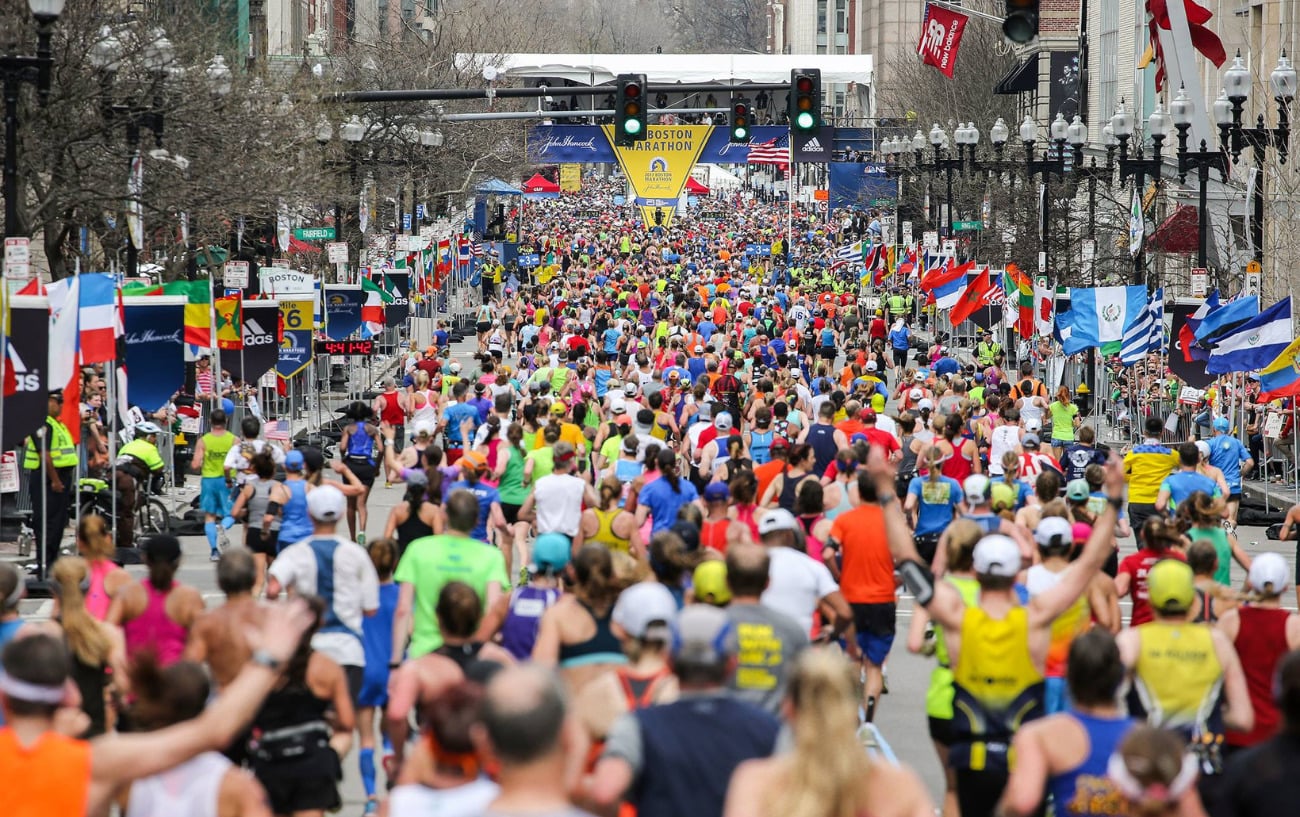
#1: Patriots’ Day shuts the city down — and wakes it back up
Marathon Monday is a Massachusetts state holiday, which means schools, banks, and most businesses are closed. But the city isn’t quiet — it’s electric. Bars open early, restaurants fill up with spectators, and the Red Sox play their beloved annual Patriots’ Day morning game at Fenway Park, first pitch around 11 a.m. — timed so fans can finish the game and make it to the finish line to cheer in runners.
In a good year, you can practically hear the Fenway crowd from the course. The whole city feels like it’s celebrating something. Because it is.
#2: Budget extra time — and extra money — for the expo
Bib pickup is at the Boston Marathon Expo at the John B. Hynes Convention Center, and it’s an experience all its own. You cannot skip it — bibs must be picked up in person before race day. Plan to go early in the weekend if you can; lines get long as Sunday approaches.
But fair warning: the official merchandise area is a hazard for your wallet. Boston-branded gear — jackets, hats, quarter-zips — appears once a year, and runners go all in. “I’ll just look” almost never survives a full lap.
Budget for it guilt-free, enjoy the energy, and take it all in. Just maybe leave the credit card at the hotel.
#3: Take a meditation break on Sunday
If you’re in town the day before the race, consider spending an hour at Old South Church. Amby Burfoot has been running the Boston Marathon since the mid-1960s, but two years ago was the first time he attended the Sunday “Blessing of the athletes” service at “The Church of the Finish Line.”
He recalls: “The huge church was filled to capacity, and it was somehow both calming and inspirational at the same time. I’m not religious, but I was glad I attended.” There are three services on Sunday, April 19, at 9 am, 11 am, and 1 pm.
#4: You have to arrive at the start four hours before the gun
Buses from Boston Common start loading as early as 6 a.m. for a 10 a.m. start. Factor this into your race-day logistics: your pre-race meal timing (be sure to bring plenty of extra snacks and hydration with you), your sleep schedule, and your warm-up routine. If you’re used to rolling up to a start line 45 minutes before the gun, Boston is going to require a whole new level of morning logistics.
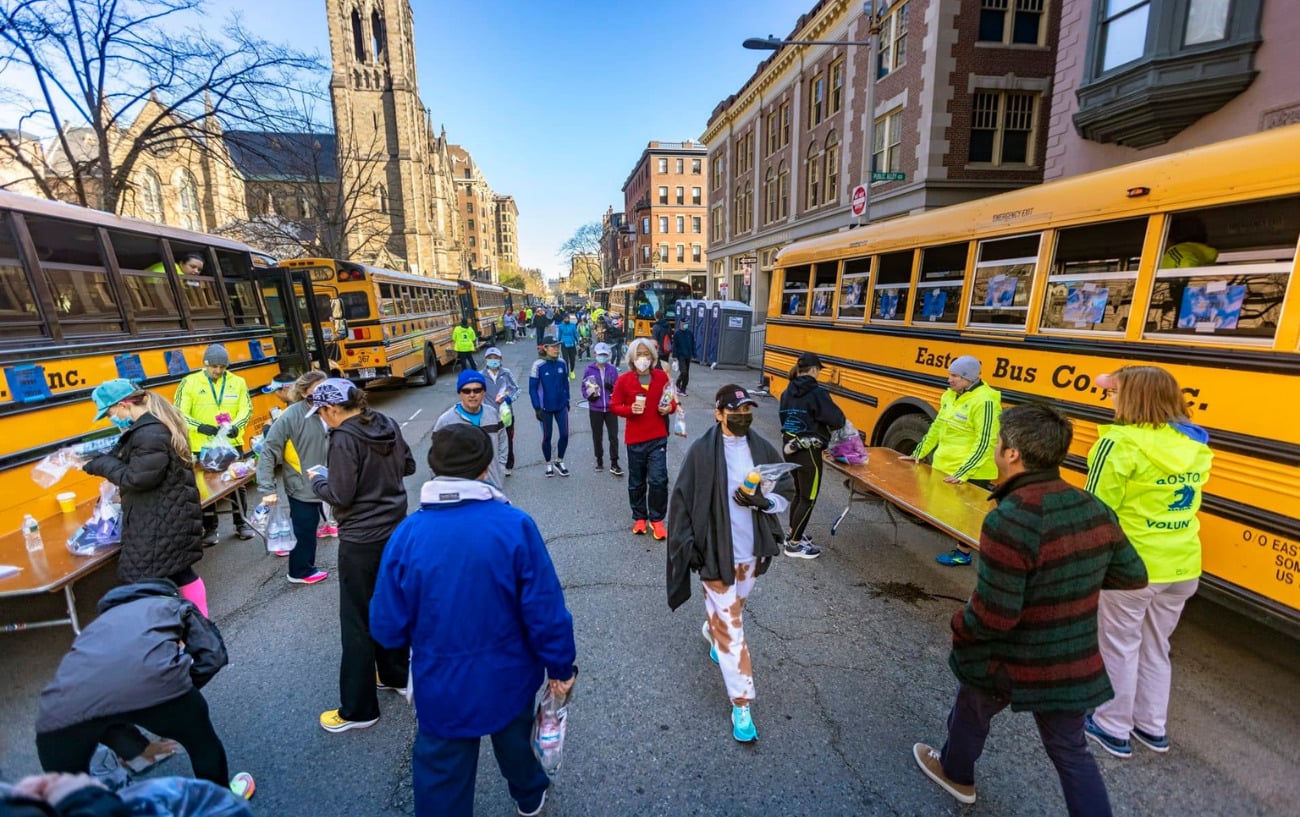
#5: Your gear check bag goes to the finish, not Hopkinton
Unlike many races that have a start-line bag drop, Boston moves your checked gear from the pre-race area to the finish. Whatever you need waiting for you at the end — dry clothes, snacks, your phone charger — needs to be packed and checked before you board the bus in Boston. You will not be able to drop anything in Hopkinton.
Last year I saw several runners racing with their clear, finish line bags slapping them on the back with every step. Not something you want to add to an already uphill battle.
#6: The downhills from miles 1–16 are the real enemy
Everyone trains for Heartbreak Hill. Almost nobody trains for the quad-crushing descent out of Hopkinton. The first half of this course drops nearly 450 feet in elevation, and those early miles have a way of luring you into a pace that feels effortless because gravity is doing some of the work.
Run them conservatively anyway. Do not try to “bank time” here. The damage from going out too fast on those descents will catch up with you around mile 18, and Heartbreak will finish what Newton started.
#7: The Wellesley Scream Tunnel will stop you in your tracks
You can hear it from half a mile away — a sound that builds and builds until you round the corner and it surges through you like a shot of pure energy.
The Wellesley College students line the course and scream with a ferocity that is, genuinely, hard to describe. First-timers often laugh out loud, partly from pure joy and partly because nothing prepares you for this kind of crowd.
There is no way you run past without smiling ear to ear. Let it lift you. It arrives right around the halfway mark, and that energy will carry you for miles.
#8: The Newton Hills are not one unbroken wall of suffering
Pull up the course topo map and look closely. Jack Fultz, 1976 winner and coach to thousands of Dana-Farber Boston runners, points out that there are three stretches of flat and even downhill running between miles 16 and 21. Stay calm, run confident, it’s not ALL uphill.
#9: Heartbreak Hill itself is… actually fine
After everything you’ve heard about it, Heartbreak Hill can feel almost anticlimactic, at least on its own. It’s a sustained climb, but if you’ve trained on hills at all, it won’t break you by itself.
What breaks people is that it arrives at mile 20, after four preceding hills in Newton have already quietly done their damage. Just remember, once you get over Heartbreak, you’ve got a nice, gradual downhill to reel it in.
#10: The Citgo sign is a liar
You’ll spot it around mile 25, and your brain will fire off a triumphant signal: you’re basically done. You are not done. You have just over a mile left, which, at mile 25 of a marathon, feels longer than you think. Acknowledge the sign, appreciate the sign, and then firmly resist the urge to kick. Save it for Boylston.
#11: “Right on Hereford, left on Boylston” will make you emotional
Even if you are famously not a crier. Even if you’ve been telling yourself all week that it’s just a race finish. When you make that final left turn onto Boylston and the crowd noise hits you, something happens. It’s the roar, it’s the straightaway, it’s the culmination of everything — the BQ, the training, the early mornings. There is nothing else in the sport quite like it.
Longtime race director and logistics expert Dave McGillivray, who will be running his 54th consecutive Boston Marathon this year, enjoys the famous final stretch. Hereford is about 195 yards long and sweeps slightly uphill. After taking the left on Boylston, you’ve got 630 yards to go, slightly downhill. Celebrate every step of the way. Give yourself a moment. Don’t rush through the finish chute. Take it in.
You haven’t finished just any marathon; you finished the Boston Marathon.
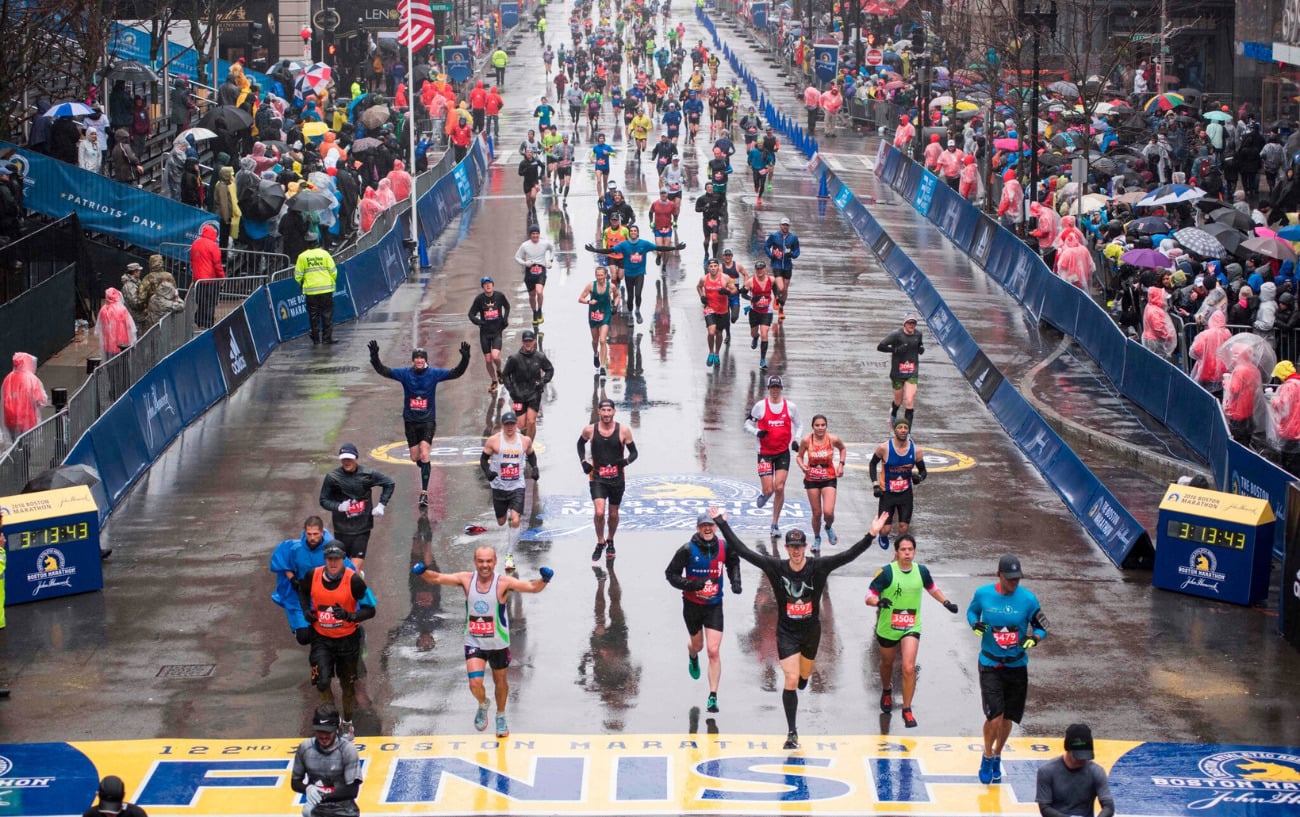
#12: Reuniting with your people after the finish is a logistical puzzle
Plan this before race day, not after. Cell service in the finish area is notoriously patchy, the post-race zone is enormous, and you’ll be funneled in one direction through gear retrieval, mylar blankets, and food stations whether you feel like it or not.
Agree on a specific meeting spot with everyone in your group — and agree on a backup. “By the finish line” is not a plan. “Outside the Marriott on Stuart Street” is a plan.
#13: You cannot get back to the start
It sounds obvious until it isn’t. Boston is a pure point-to-point course — 26.2 miles from Hopkinton to Boylston Street, with no loop back. Your car, your hotel, your post-race brunch spot, your family coming in from out of town — all of it needs to be organized around a Boston finish, not a Hopkinton start. Plan backward from the finish line, and you’ll save yourself a logistical headache.
#14: April in Boston is meteorologically unpredictable
The race has been run in 85°F heat and in near-freezing rain with 30-mph headwinds. There is no such thing as a “typical” Boston weather day. Pack for warm, pack for cold, bring a throwaway rain layer, and check the forecast obsessively in the final 48 hours. Then check it again.
#15: The crowd understands what a BQ means
Boston spectators are different. Many of them have been watching this race for years — some for decades — and they understand that every single person on that course earned their entry. There’s a particular kind of respect that comes from the sidelines here that you don’t quite feel anywhere else. The crowd isn’t just cheering for runners. They’re cheering for what it took to get there.
Boston isn’t just a race — it’s an entire experience that rewards the runners who show up prepared for all of it, not just the 26.2 miles. Know your bus time. Pack your throwaway layers. Set a meeting point. And when you turn onto Boylston, don’t forget to look up.
You earned this one. Enjoy every single second of it.
RunClub — Free
Join 300,000+ runners in RunClub
Free training plans for every distance, a daily running game, exclusive coaching content, and a real community of runners. Create your free account in 20 seconds — no card.
Already a member? Log in →








Join the conversation
Please come to the Blessing of the Athletes at the Old south church sunday 9, 11, 1......Known as the "Church of the Finish Line" It is a wonderful protestant worship service, great preaching, the music and the bag pipe player....It is not in your BM program guide!!. I am going to be your outside friendly greeter at 11 am service.
Thank you so much for this excellent article, I really appreciate all the advice. I'm 52 and have been running marathons for 4 years now. I'm heading to Boston for the first time and I'm beyond excited!!!