


This was supposed to be a story about how Jeff Galloway set a marathon longevity record at the December 14th Honolulu Marathon. However, a household accident sent the 80-year-old sprawling to the floor last week, banging his knee and head.
Doctors have now advised against the long flight to Honolulu.
Even without Honolulu this year, Galloway has made more contributions to more runners than anyone else I know. He has inspired and coached countless thousands of runners. His innovative Run-Walk-Run program, in particular, has been adopted by beginners, intermediate runners, and those with too many injuries.
No runner has ever completed a marathon in eight consecutive decades of his or her life. Galloway was on the cusp. He finished his first as an Atlanta teenager in 1963 when he was 18.
In fact, he actually won that Atlanta Peachbowl Marathon in 2:57:21. The website 7 Decades Marathon lists nearly a dozen runners who have achieved seven consecutive decades. The race to reach eight decades continues.
Since 1963, Galloway has completed more than 230 additional marathons, many in 4 hours, 5 hours, or even 6 hours. This represents quite a transition for a former elite athlete who also won the first Peachtree 10K Classic on July 4, 1970; qualified for the 1972 Olympics as a 10,000-meter runner; set an American record at 10 miles (47:49; 1973), and ran a personal best 2:16:36 in the 1980 Houston Marathon.
Most elite runners retire after their competitive careers, or switch to coaching college and professional runners who also hope to become elites. Galloway took the road less traveled, preaching the benefits of a slowish, accessible Run-Walk-Run approach.
Galloway’s frequent marathons came to a halt in early 2020, first because of COVID, and then because he suffered a serious heart attack in April 2021. It required five cardiac stents and a three-week hospital stay. He hasn’t run a marathon since. (Here’s a partial list of his marathons, from first to most recent.)
According to Galloway’s cardiologist, who had been planning to accompany him to Honolulu, the heart attack was likely caused by exposure to Agent Orange, a highly toxic herbicide, during Galloway’s service in the Vietnam War. Also, the cardiologist says that running may have saved Galloway’s life, as it increased his collateral cardiac circulation.
Since 2021, Galloway’s own running regimen has tailed off. He says he can barely break 16 minutes for a single mile. But he deliberately logs more than 15,000 steps per day, does various forms of cross-training, and takes long walks with short running intervals. On a recent “long run” in training for Honolulu, he covered 21 miles.
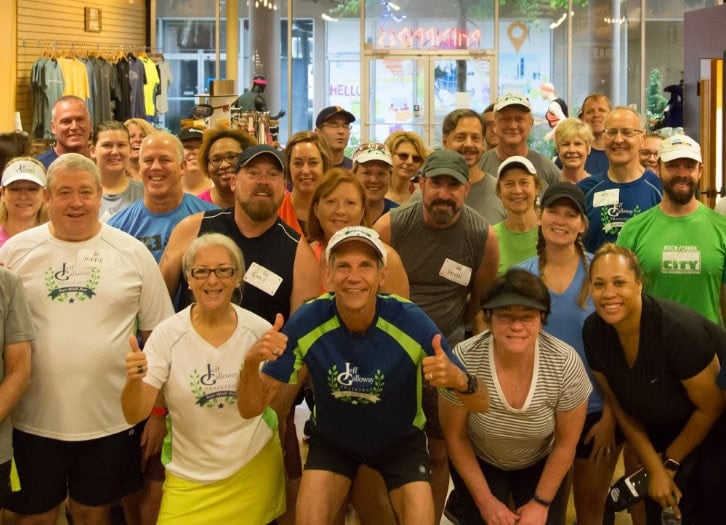
Father Of The Run-Walk-Run Revolution
Galloway has brought his message to the masses through more than 20 books and literally thousands of clinics and talks, many of which are moderate to small in size. He argued that the Run-Walk-Run method could produce revolutionary lifestyle changes.
And it did. Many of his followers now use the slang term “Jeffing” to describe their running.
Jeff can’t stop preaching the multiple benefits of running. It’s what he was born to do, and no one does it better.
Few have experienced running from as many perspectives as Jeff — from elite to back-of-the-pack; healthy and not-so-much, due to Agent Orange and tripping accidents. He says his own problems have helped him become a better guide for others with their particular issues, such as heart disease, cancer, and major surgeries.
Absolutely, no one can match Jeff’s hypnotic Southern drawl and the intensely direct eye contact.
Women in particular have embraced the wisdom of the Run-Walk-Run approach, and they have been the most important force in running over the last 30 years. Men can be dense, but they, too, come around. I’ve been run-walking my marathons for more than 20 years now.
While his own running slowed, Jeff continued serving up his unique brand of running wisdom through talks at Disney World, Zoom presentations, personal coaching, local Galloway running groups, master classes, and training-camp getaways. All these and more are available at JeffGalloway.com.
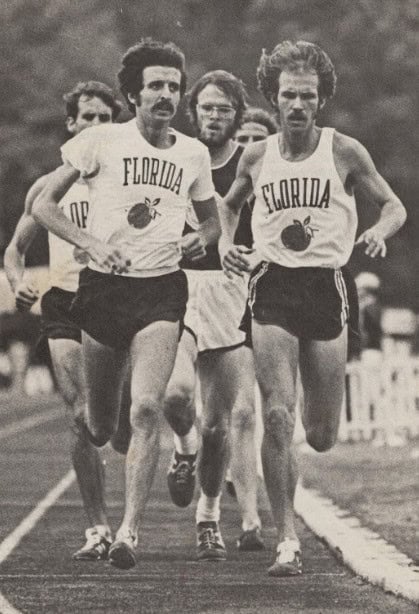
How I Met Jeff Galloway In College In The 1960s
I first met Galloway in the mid-1960s at tiny Wesleyan University in Middletown, Connecticut. We roomed together for two years, and ran side by side every single day for three.
Jeff was the most consistent, dedicated, and moderate runner I ever knew. Sure, we did the occasional crazy workout. I remember a long October afternoon when we ran 40 x 440 yards barefoot on a grassy athletic field, and the time we covered 25 miles on a rocky, hardwood “blue blaze” trail with never-ending hills.
But mostly we ran steady, controlled, within ourselves. We never once raced each other in training. Not once.
Oh, we harbored our ambitions. We both hoped to make a mark in the marathon world, but we never gave voice to our quiet dreams. We lived at a time when stoicism was the norm, not social media chest-thumping.
We simply trained steadily and quietly, side by side, day after day, month after month, year after year.
Somehow, we realized we’d rise higher by working together than competing against each other. We were partners, not rivals.
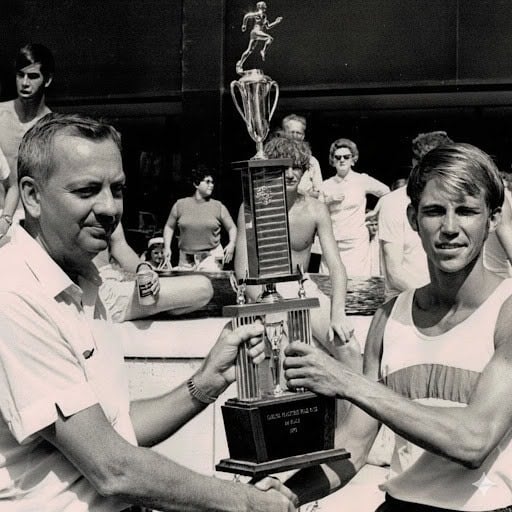
Jeff Galloway Tells His Own Story
Here, Jeff Galloway tells his own story through a series of questions and answers.
Why did you run that first marathon in Atlanta when you were 18, and how did it go?
JG: I heard they had a really big trophy for the winner, and I had never won a trophy. Also, the local guy who was faster than me hadn’t entered, so I figured it was worth the three-dollar investment. Then he showed up at the last moment and ruined my plan, so I decided to just do a long run and drop out at some point.
We did 10 laps around a park in Atlanta. After six or seven, I was getting really tired. I had never run more than 15 miles. I passed the race director at the end of one lap and said, “I’m done. That’s it.” He said, “You can’t quit. You’re way ahead of everyone else.”
It turned out the fast guy had already stopped. So I hunkered down and gutted it out. I did win the thing, but I was so sore afterwards that it was three months before I could run comfortably again.
How did you come up with the Run-Walk-Run method?
JG: It was an economic imperative. I had opened a Pheidippides running store in Atlanta in the early 1970s, but we didn’t have many customers. Somebody suggested I should teach a “beginning runners” course, so I gave it a try.
We had 22 people sign up for the class, and none of them had ever done any exercise. I had to start them off with walking first, and then gradually transition them to running.
Amazingly, they all succeeded with the Run-Walk-Run method, and they all became addicted runners. They kept telling me how much better they felt physically and mentally.
The big surprise came when I set a PR of 2:16:36 in the Houston Marathon in 1980 by taking short walk breaks at the water stops. That’s when I realized that Run-Walk-Run could work for beginners, for injured runners, for increasing your mileage and endurance, and sometimes even for running faster marathons.
You spent most of your adult life preaching the gospel of running to anyone who would listen. Why?
JG: My father was an educator who was very influenced by Dr. Martin Luther King. My dad always said we should find ways to help people improve the quality of their lives. Eventually, I realized the best way for me to do this was by giving talks and clinics about running.
I traveled around the country almost every weekend, and sometimes did more than 200 talks per year. There were all different kinds, some big, some small. I always tried to make the same major point: that running could improve your quality of life in many different ways.
These days, I’m still answering about 50 emails a day, trying to help runners with one problem or another, and I deeply love that. And we work with a lot of people through our website, JeffGalloway.com.

How Heart Disease Has Slowed Galloway … But Not Stopped Him
The heart attack must have been a terrible shock.
JG: Yes. But just so you know, it wasn’t linked to my running. It was caused by my Agent Orange exposure during the Vietnam War. I was on a Navy ship for 12 months in the combat zone. We got all our drinking water from areas where Agent Orange was heavily used. The Veterans Administration considers me a 100 percent disabled vet.
My heart damage required five stents, but my surgeon said running saved my life by creating so much collateral circulation in my heart. I can’t run like I used to, but I’m staying very active with 15,000 steps a day, mostly walking with a little running tossed in.
And I’ve learned there’s a positive side to heart disease. It’s allowed me to connect with thousands of new people who have had heart disease, or cancer, or another setback. Most of the time, I can help them find a move-your-feet strategy that improves their health and mental outlook.
You seem so mellow and soft-spoken with that drawl of yours, but you must be pretty tough to keep going through your recent challenges.
JG: Yes, there’s some fiber down there, as you’ll find in most of us Southerners, even though we may put up a facade. I’ve felt that toughness or anger most when I’ve experienced challenges to our country, like the crisis at the 1972 Munich Olympics, when they tried to take our Olympics away from us. I felt the same way when the Boston Marathon bombers did their thing.
It brought back those raw emotions that someone is trying to destroy this wonderful life and the democracy we have. I’m a very patriotic person. I love our country, and it makes me extremely angry when it is threatened.
What do you know now about running and fitness that you couldn’t have known when you ran that first marathon in 1963?
JG: There have been many sea changes in my thinking. Here are three big ones. First, when I started running, I was not good. So why did I continue? Because of the friendships. I have made so many wonderful friends in running through the years.
Second, I always felt better after a run, even after the hardest workouts when I got my butt kicked by other runners. And I realized this good feeling had a carry-over effect into my school studies and my work.
Third, we didn’t imagine it back in the 1960s, but research has shown that exercise elevates and maintains our brain circuits more than almost any other activity. Who wouldn’t want more of that? And I’m very proud that my Run-Walk-Run method has opened up running to so many people who didn’t think they could.
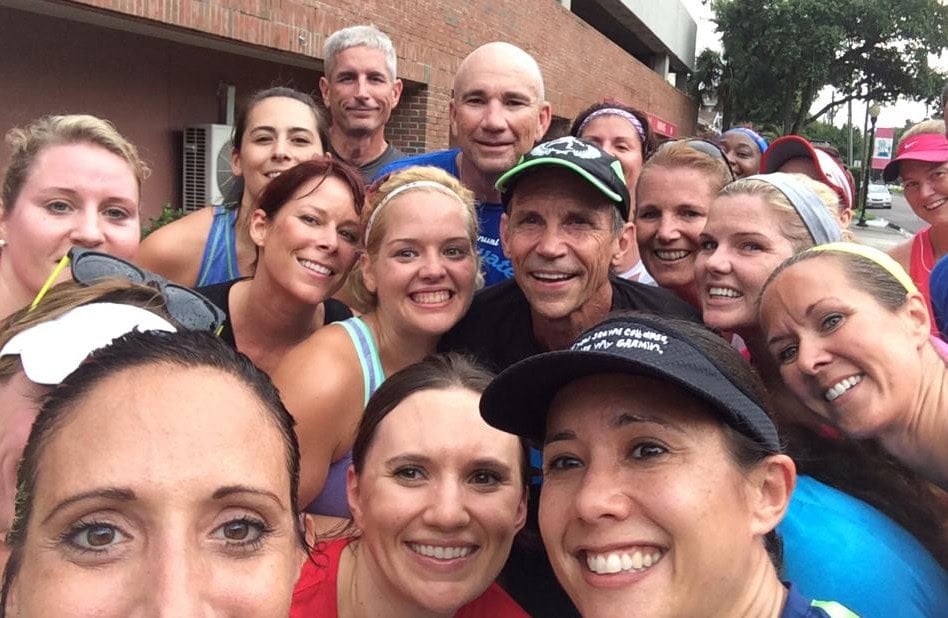
The Galloway Message: Keep Moving Forward
If I had to summarize Jeff Galloway’s running and fitness message, it would go something like this: Find your own pace, speed up when you feel good, slow down when you get tired, walk at regular intervals, but keep moving forward.
Your body has evolved over the ages to be super-efficient at walking and running, and terribly inefficient at sitting. Your two most important organs, your brain and your heart, need daily exercise. Don’t neglect them.
Be good to them, and they’ll be good to you. Use them or lose them. It’s a simple equation. And maybe the most important one in your life.
RunClub — Free
Join 300,000+ runners in RunClub
Free training plans for every distance, a daily running game, exclusive coaching content, and a real community of runners. Create your free account in 20 seconds — no card.
Already a member? Log in →









Start the conversation