


For many marathon runners, even the most experienced, the road to peak performance is pockmarked by too many hydration questions. How much do I have to drink over 26.2 miles? And how about carbs and sodium?
This is a topic I’ve been following since 1968. That April, I won the Boston Marathon despite a weight loss of 9.9 pounds, about 7% of my body weight. Exercise physiologist David Costill sent me the typewritten note (below) about my weight loss vs a handful of other runners he monitored that day.
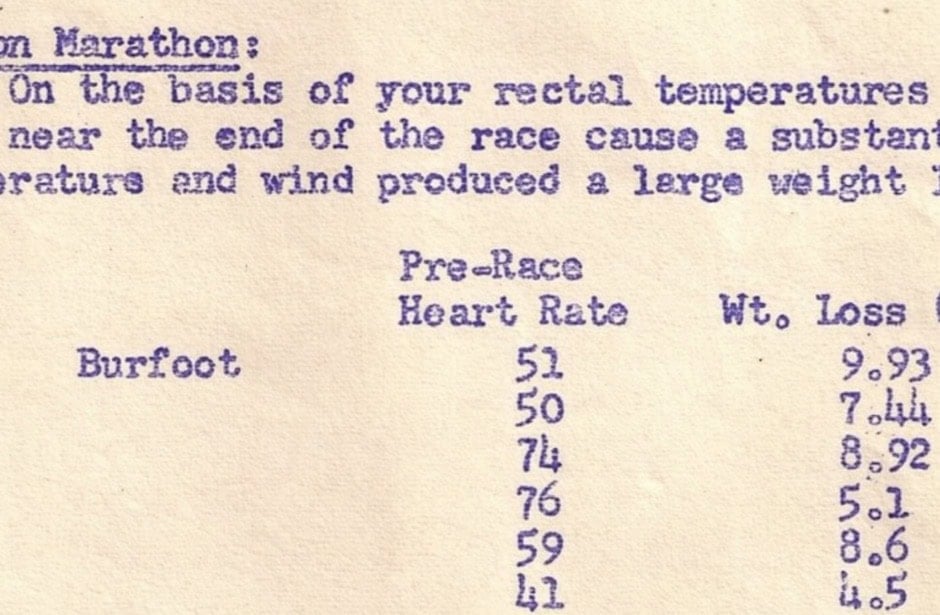
Intrigued by my weird, dehydrated victory at Boston, I’ve read all the research published in the last 50 years. (And there’s been a lot of it.)
The experts are now largely united. For example, a Position Stand1Sawka, M., Burke, L., Eichner, E., Maughan, R., Montain, S., & Stachenfeld, N. (2007, February 1). American College of Sports Medicine Position Stand. Exercise and Fluid Replacement. Medicine and Science in Sports and Exercise. https://pubmed.ncbi.nlm.nih.gov/17277604/ from the American College of Sports Medicine states: “The goal of drinking during exercise is to prevent excessive (>2% body weight loss from water deficit).”
Stated simply, this means: You can afford to become dehydrated in a marathon up to 2 percent of your body weight. But try not to go higher. (If you weigh 150 pounds, 2% is 3 pounds, or 48 liquid ounces, you don’t have to drink.)
This is specific, helpful advice, but it doesn’t cover the vast differences in hydration (and carbohydrate and sodium) strategies required by your own weight and pace, and by the race-day temperature.
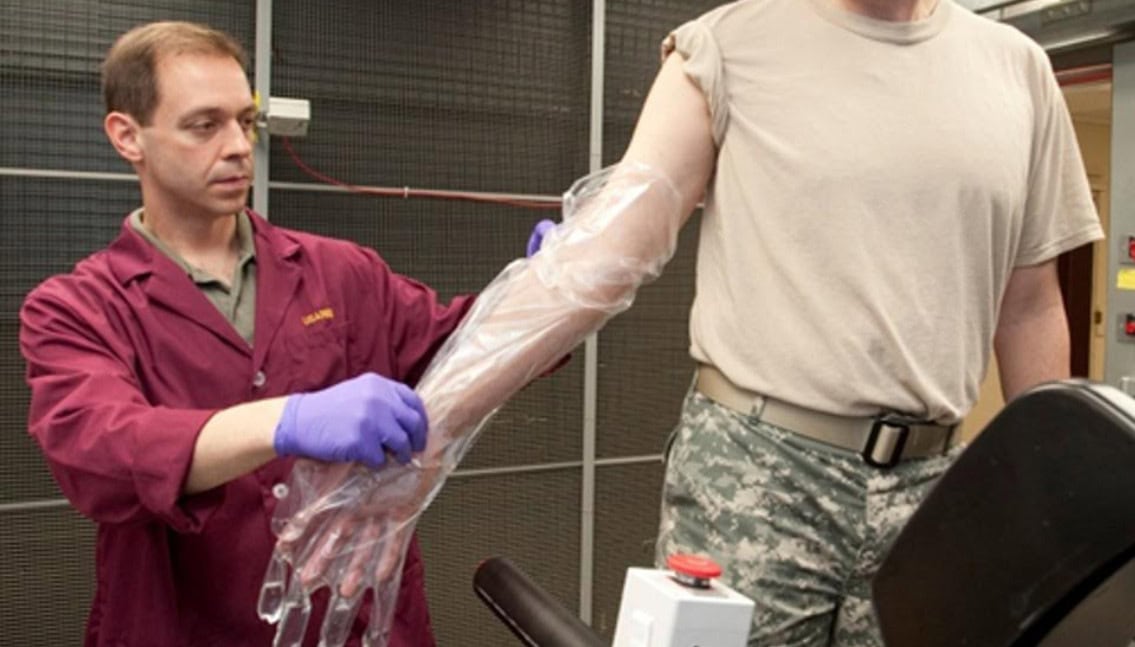
To fill in those gaps, I recently interviewed heat, hydration, and performance expert Samuel Cheuvront, PhD, RD. Cheuvront spent nearly 20 years as a research physiologist and team leader in the U.S. Army’s Thermal and Mountain Medicine Division. He has published more than 150 research papers and book chapters, and has served as a Boston Marathon consultant since 2012.
In 2016, Cheuvront founded Sports Science Synergy, LLC, where he created a free Road Race Water Planner2Calculator. (2021, August 16). Sports Science Synergy, LLC. https://sportssciencesynergy.com/calculator/ application for the sports medicine community.
This planner, “the first to provide a strong scientific basis for easily and accurately estimating water needs,” is used to conduct water-needs assessments for races with large numbers of runners. Cheuvront used similar modeling for several calculations in this article.
Below, Cheuvront answers key runner questions about marathon hydration and presents several clear tables to help you understand the factors that influence your individual fluid, carbohydrate, and sodium needs on race day.
The Scientific Facts Concerning Hydration And Marathon Running
Is there one simple, accurate “rule” for maintaining daily hydration?
SC: Sorry, no. There is no “one size fits all” rule. Biological and genetic factors contribute to human hydration needs, but these needs are primarily determined by our activity, diet, and the local temperature.
Water is the most abundant molecule in the human body, accounting for 60 to 70 percent of most athletes’ body mass. It is also the nutrient that is lost and consumed in the largest amount each day.
Drinking is necessary to replace what we lose, but also to dilute the metabolic and dietary waste we produce. Humans obtain about 80% of their hydration needs from fluids (most fluids are greater than 90% water), and about 20% from food.
What about the old bromide that humans need to drink 8 x 8-ounce glasses of water per day?
SC: It falls below the modern hydration recommendations for many of us, as Table 1 shows below.
Table 1: Your Daily Fluid Needs Based On Weight And Activity Level
| Body Weight | Low Activ | Mod Activ | High Activ |
| 120 lbs | 46 ounces | 56 ounces | 63 ounces |
| 150 lbs | 57 ounces | 70 ounces | 79 ounces |
| 180 lbs | 68 ounces | 85 ounces | 95 ounces |
| 210 lbs | 79 ounces | 98 ounces | 111 ounces |
Are some popular beverages diuretic, such that they subtract from our hydration rather than adding?
SC: Yes, spirits (wine and liquor) are diuretics because their water content is low and their alcohol concentration is high. Alcohol has a dehydrating effect on our kidneys. Most other popular beverages are fine because they are more than 90% water. That includes coffee and tea, and even beer consumed in moderation.
How can runners tell if they are sufficiently hydrated?
SC: You are probably well hydrated if: 1) your body weight is stable day-to-day (within 1-2 pounds of ‘typical’); 2) your first morning urine color is pale yellow; and 3) you are not noticeably thirsty. Another handy gauge: If you are urinating at least 5 times per day, you are probably hydrating properly.
How does dehydration affect runners?
SC: Dehydration slows running performance, mostly because water loss reduces the volume of blood circulating to muscles, which puts extra stress on the heart and body. This is especially true in longer distances like the marathon and in warmer weather.
How much do runners need to drink the day before and the morning of a marathon?
SC: Runners should arrive at their marathon site normally hydrated. Several hours before the race start drink about 16 ounces of fluid to ensure good hydration. About 30 minutes before the start, you can drink another 4 to 8 ounces to “top off” your fluid reserves. This process should also give you time for a final trip to the bathroom pre-start.

How about hydration during a marathon?
SC: During a marathon, runners should aim to prevent excessive dehydration, which is anything greater than a 2% to 3% weight loss. Table 2 illustrates suggested drinking rates (gathered from evidence-based sweat loss rates) for runners of different sizes and paces when racing a marathon in different temperatures.
It has also been suggested that runners should “drink to thirst,” or at an average rate of 14 ounces to 28 ounces per hour. These can both work at different times.
However, in my opinion, all runners should learn to personalize their hydration plan according to their individual needs. This requires taking into account your weight, your goal pace, your sugar- and salt-intake goals, and the race-day temperature. It’s also important to know where and when fluids will be available on the course.
Table 2 may appear complex, but it is deeply informative about your weight, your pace, the race-day temperature, and your optimal fluid and carbohydrate requirements. I suggest you review it and the accompanying explanations several times. You can approximate your personal needs from the provided weights and paces.
Note particularly that your weight and race-day pace play an important role in your hydration needs. Temperature is not the only important factor.
Table 2: How Much To Drink On The Run, According To Your Weight, Pace, And The Temperature
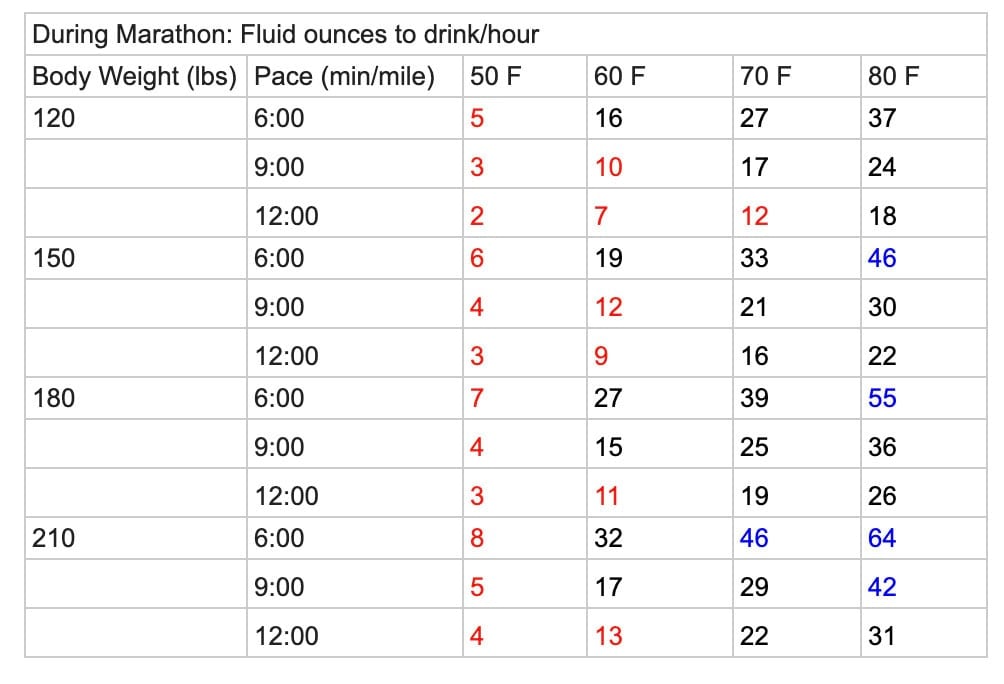
Table 2 shows the estimated fluid ounces you must drink per hour of marathon running to prevent excessive dehydration (2%) and loss of performance.
It is based on body weight, running pace, and temperature (with relative humidity set at 50% throughout). All calculations were made by SportsScienceSynergy.com.3Sports Science Synergy, LLC. (2026). Sports Science Synergy, LLC. https://sportssciencesynergy.com/
Table 2 assumes that you are drinking a typical endurance sports beverage with about 60 grams of carbohydrate per 32 ounces (approximately 1 liter).
It shows illustrative data only. Use your own weight and pace to approximate your personal hydration needs.
Red numbers indicate drinking rates that are insufficient to provide at least 30 grams/hour of carbohydrates. In these situations, you must use gels or other carbohydrate sources to get enough total carbohydrates.
Blue numbers indicate drinking rates that could be difficult to achieve due to gastric issues or the logistics of race-day fluid stations. In addition, there are few runners who can maintain the shown marathon paces at the noted weights and temperatures.
What about carbohydrate and salt intakes during a marathon? These days, many are proposing that more of both is better.
SC: Carbohydrate intake has long been recognized as advantageous for events like the marathon. Traditional sports drinks are designed to replace water and to provide energy (sugar) in amounts that are evidence-based (approximately 30 to 60 grams/hour).
They also include a small amount of salt. However, the classic sports drink formula cannot meet the needs of every runner shown in Table 2, in large part because individual fluid volume needs vary so much. As a result, new sports nutrition products frequently enter the market. Some may prove effective for runners who benefit from an atypical drink.
Recently, there has been a lot of buzz about higher carbohydrate consumption during endurance events, including intakes beyond 100 grams per hour. Midpack and slower runners must realize this research has involved elite athletes who can complete the marathon distance in just over two hours.
These runners burn through their energy sources much faster than non-elites, who don’t need similarly high carb intakes. For most runners, it’s smart to keep your carbohydrate-intake goal at 30 to 60 grams per hour, which is what Table 2 shows.

And how about sodium?
SC: There’s little research to support taking more sodium during a marathon than what is contained in typical endurance sports drinks. Most runners get enough salt in their daily diet, and don’t need more in marathon races.
However, additional salt should be considered in hot and very long events (ultras). Also, some runners are “salty sweaters.” If your sweat tastes very salty or dries as crystals on your clothing after a workout, you may be a salty sweater who needs to consume extra sodium.
Do runners have to rehydrate quickly after a depleting effort in the same way they are told to restock carbohydrates soon after a long workout or race?
SC: No. In fact, gradual replacement produces better results, due to the way our kidneys respond to rapid changes in body fluid volume. Complete rehydration requires the recovery of water and salt. Beverages consumed with or near meals will produce faster and better sustained rehydration.
Whether training or racing, the best way to recover from fluid losses is to weigh yourself before and after your run. The difference is roughly how much fluid you should aim to replace for recovery. So, if you lose two pounds during your run (about one liter of sweat), you should rehydrate with at least 32 fluid ounces (2 pounds) in the several hours afterwards.
What is different, if anything, about hydration during ultra races far longer than 26 miles?
SC: Length of time does make a difference. While sweat rates are lower in ultras, due to the slower running pace, overall energy and salt requirements increase with longer event times. So ultramarathon runners need to pay even more attention to their individual fluid, carbohydrate, and salt plans.
Do runners need to hydrate during shorter races like 5Ks, 10Ks, and half-marathons? How about on training runs?
SC: For 5Ks and 10Ks, no, not normally. These races don’t last long enough for you to become dehydrated.
In half marathons, sweat rates are only a little more than in marathons, while the race distance is half as long. Therefore, you can reduce your drinking rate by about half that shown in Table 2. Energy is still important in a half-marathon. So you should still aim to consume about 30-60 grams of carbohydrate hourly.
On most training runs, where your pace is considerably slower than in races, you can probably get by with little drinking (until after you have finished). However, remember that you should always complete some long training runs according to your race-day fluid plan, including water, carbohydrates, and salt.

Conclusions: How To Stay Well Hydrated
Your individual hydration needs can’t be summarized in a simple, universal way, because every runner has uniquely different needs. However, if you follow Tables 1 and 2 above and the guidelines below, you can determine the best ways to satisfy your personal needs.
- Don’t obsess about your hourly or daily hydration needs. If you eat a variety of healthy foods and consume a variety of beverages when you feel thirsty during the day, you will likely achieve healthy hydration. Also, use the tips outlined above (day-to-day weight change, urine color, and frequency), especially when training hard in hot weather.
- To prepare for an upcoming marathon race, occasionally train as you plan to compete, especially during your long runs. Consume the fluids, carbs, and sodium you expect to use on race day.
- Weigh yourself before and after these race-simulation long runs to see how successful your drinking plan works. If you lose no more than 2% of your body weight, you are drinking enough to prevent excessive dehydration.
- Study your marathon’s instructions, and be sure to understand the placement and frequency of fluid stations on the course.
- Always adjust your pace and hydration plan to the race-day weather.
If there’s one message here, it’s that hydration works best when it’s personalized and practiced. Arrive normally hydrated, drink enough to stay under roughly a 2% loss, and use training weigh-ins to fine-tune what “enough” means for you.
References
RunClub — Free
Join 300,000+ runners in RunClub
Free training plans for every distance, a daily running game, exclusive coaching content, and a real community of runners. Create your free account in 20 seconds — no card.
Already a member? Log in →









Start the conversation