


The past 12 months produced an impressive variety of new studies on endurance science. As participation in marathons, ultras, and triathlons continues to grow, so does scientific interest in the ways exercise can affect performance and health.
I found the following nine studies particularly illuminating.
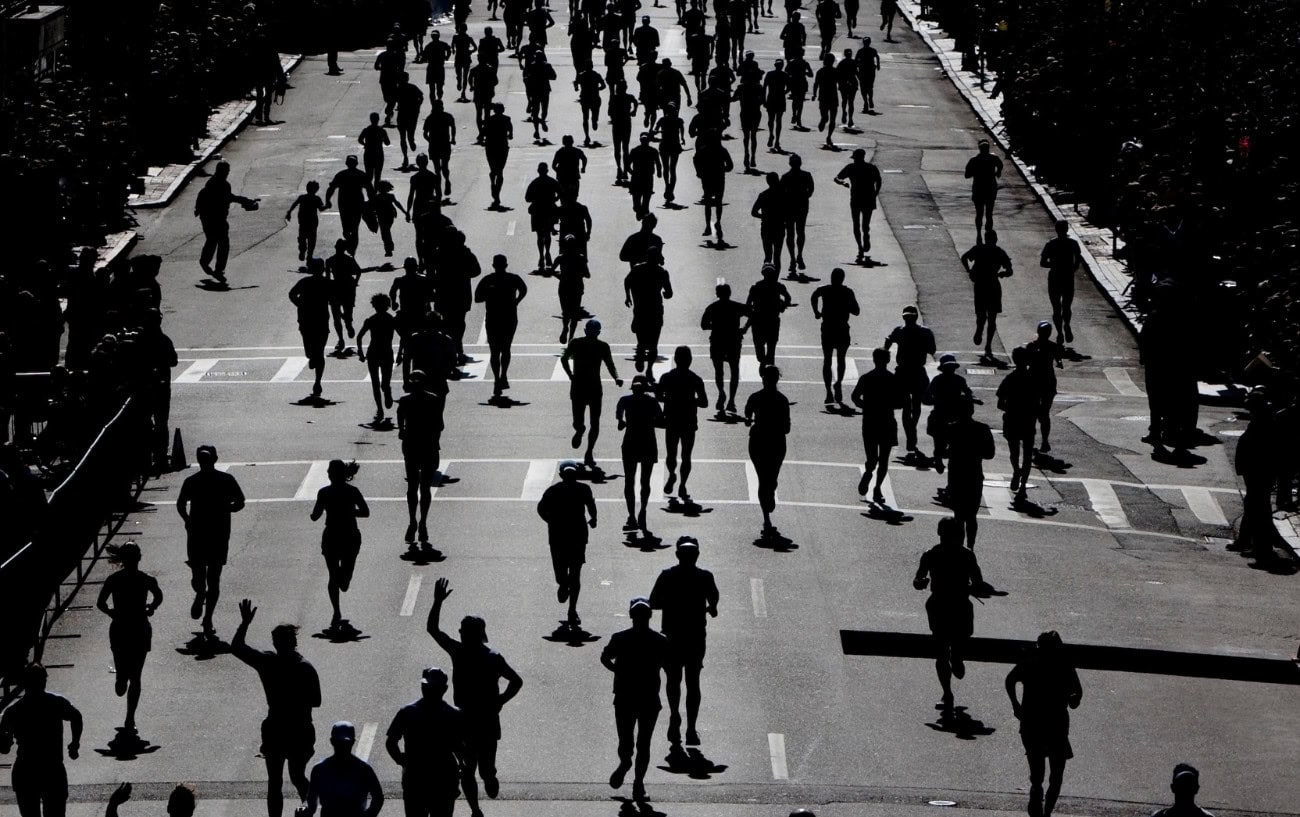
Successful Boston Marathon Runners Use A Polarized Training Plan
There are hundreds of marathon training plans, and we all invest significant time and effort in blindly following one or another. It would be nice to see evidence of which strategies actually work. Here’s some.
The paper: “Training Volume and Training Frequency Changes Associated with Boston Marathon Race Performance” appeared in the journal Sports Medicine.1DeJong Lempke, A. F., Ackerman, K. E., Stellingwerff, T., Burke, L. M., Baggish, A. L., d’Hemecourt, P. A., Dyer, S., Troyanos, C., Saville, G., Adelzadeh, K., Holtzman, B., Hackney, A. C., & Whitney, K. E. (2025). Training volume and training frequency changes associated with Boston Marathon race performance. Sports Medicine. Advance online publication. https://doi.org/10.1007/s40279-025-02304-4
Method: Researchers followed more than 900 Boston Marathon runners to determine how they trained during the 12 months pre-Boston. The runners were serious recreational athletes who trained about 40 miles a week, and finished Boston between 3:30 and 3:50.
Result: While all runners trained about the same total amount, the fastest of the group followed a more “polarized” approach in the last four months of their buildup. They did fewer total workouts (but more “quality” ones) and more cross-training as they gradually tapered toward marathon day.
Take-home message: Don’t try to continually build mileage as race day draws nearer. It’s smarter to be fresher and better-rested at the start line. Cut down on total training volume, use cross-training for recovery, and focus on quality workouts at or near goal marathon pace.
More here: Boston Study Reveals Surprising Marathon Training Secrets
Second study: Later in the year, a randomized trial published in Scientific Reports gave polarized or pyramidal training plans to 120 runners for their 16-week training block. Those following the polarized approach “produced superior marathon performance “ by about 30% despite reduced training volume.
To Beat Injuries, Be Careful With Long-Run Increases
All runners want to avoid injury as much as possible, but it’s not easy. Dozens, if not hundreds, of prior injury studies have found that injury causes are so “multifactorial” that it’s hard to say what actually works, and what doesn’t. Here’s one with a clear, evidence-based guideline.
The paper: “How much running is too much? Identifying high-risk running sessions in a 5200-person cohort study” appeared in the British Journal of Sports Medicine.2Frandsen, J. S. B., Hulme, A., Parner, E. T., Møller, M., Lindman, I., Abrahamson, J., Simonsen, N. S., Jacobsen, J. S., Ramskov, D., Skejø, S., Malisoux, L., Bertelsen, M. L., & Nielsen, R. O. (2025). How much running is too much? Identifying high-risk running sessions in a 5200-person cohort study. British Journal of Sports Medicine, 59(17), 1203–1211. https://doi.org/10.1136/bjsports-2024-109380
The method: More than 5,000 runners were tracked (via Garmin data) over 18 months to analyze their injuries relative to their training styles.
Result: The most significant injury indicator was the increase in the length of runners’ single longest run. Any increase greater than 10% produced a substantial jump in injury risk. As increases climbed, so did risks.
Take-home message: Be cautious and calculated about increasing the length of your long run. The more graduated your approach, the better your chances of escaping injury.

How Can You Build Your Marathon Muscle Durability?
There used to be three big physiological pillars of marathon success: VO2 max, lactate threshold, and running economy. Now there’s a fourth, muscle durability (also called muscle fatigue-resistance), and it has become a major new research subject. The question is: How can you train to maintain high running efficiency after you’ve covered 20 miles?
The paper: “Strength Training Improves Running Economy, Durability, and Fatigued High-Intensity Performance in Well-Trained Male Runners: A Randomized Control Trial” appeared in Medicine & Science in Sports & Exercise.3Zanini, M., Folland, J. P., Wu, H., & Blagrove, R. C. (2025). Strength training improves running economy durability and fatigued high-intensity performance in well-trained male runners: A randomized control trial. Medicine & Science in Sports & Exercise, 57(7), 1546–1558. https://doi.org/10.1249/MSS.0000000000003685
Method: The research had an impressive design, beginning with 28 well-trained male runners who had equivalent performance bests. The two groups were divided in half, with one continuing normal training for 10 weeks while the other did twice-weekly maximal strength and plyometric training.
Result: Both groups completed the same endurance test before and after training: a 90-minute long run followed by a time trial to exhaustion. The strength and plyo group surpassed the other group in running economy on the long run, and lasted 35% longer in the time trial to exhaustion.
Take-home message: By adding maximal strength and plyometric work to your training, you can improve your “durability” at the end of long runs like the marathon.

Should You Shorten Your Stride Length?
The merits of a shorter stride length (ie, higher stride frequency) have been proposed for many years. A new systematic review on the topic gave it a strong endorsement.
The paper: “The Influence of Running Cadence on Biomechanics and Injury Prevention: A Systematic Review” was published in Cureus.4Figueiredo, I., Reis E Silva, M., & Sousa, J. E. (2025). The influence of running cadence on biomechanics and injury prevention: A systematic review. Cureus, 17(8), Article e90322. https://doi.org/10.7759/cureus.90322
Methods: The authors analyzed the results of 18 prior papers on cadence (stride frequency) and its effects on biomechanical or clinical outcomes.
Result: A “moderate increase” in cadence (by five to 10 percent) led to reduced loading rates and “improved lower limb alignment” that in turn “reduced stress on the tibia, knee, and hip joints.” Also, increased cadence did not alter running economy negatively, “and, in some cases, enhanced running economy.”
Take-home message: There are a lot of internet gurus offering spurious running-form fixes. Against that background, a moderately shorter stride seems to offer a twofer: fewer injuries and perhaps improved economy. You don’t have to hit 180 strides per minute. Just aim for a small increase from where you are.

Cold Is Old, But Heat Is Hot
There was a time, which you may remember, when serious marathon runners lowered themselves into an ice-filled tub after hard workouts. This was supposed to speed recovery, but scientific studies produced mixed results at best. The new approach: Get into a hot bathtub.
The paper: “Long-term passive heat acclimation enhances maximal oxygen consumption via haematological and cardiac adaptation in endurance runners” appeared in the Journal of Physiology.5Jenkins, E. J., Killick, J., Zerilli, O., Bailey, T. G., Drane, A. L., Marwood, S., Shave, R., & Dawkins, T. G. (2025). Long-term passive heat acclimation enhances maximal oxygen consumption via haematological and cardiac adaptation in endurance runners. The Journal of Physiology. Advance online publication. https://doi.org/10.1113/JP289874
Method: Previous studies had shown that training in the heat could improve aerobic fitness. But what about just sitting in a hot tub? In this research, 10 well-trained runners completed five weeks of normal training with and without additional hot-tub baths (five times a week for 45 minutes at a temperature greater than 40 degrees C).
Result: The hot-tubbing “increased haemoglobin mass, total blood volume, and left-ventricular end-diastolic volume,” which boosted subjects’ VO2 max. Thus, “Passive heat can enhance aerobic performance.”
Take-home message: Taking a hot bath after running might produce additional training benefits. Be careful about dehydration, and don’t overdo the bath temperature (104 degrees F should do the trick).
More here: Hot Baths Boost VO₂max—No Exercise Required

Do Super Shoes Cause Injuries … Or Protect From Them?
This is probably one of the hottest debated questions in modern marathon science. Just about everyone has accepted that super shoes can enhance performance. But is this a free lunch, with no drawbacks? This study offers an early perspective. No doubt there will be many more.
The paper: “Does advanced footwear technology cause or protect against injuries? A 12-week prospective investigation in 195 half-marathon runners” was published in the journal Footwear Science.6Ryan, M., & Farina, E. M. (2025). Does advanced footwear technology cause or protect against injuries? A 12-week prospective investigation in 195 half-marathon runners. Footwear Science, 17(sup1), S246–S247. https://doi.org/10.1080/19424280.2025.2492279
Method: A group of recreational runners engaged in a structured 12-week training period for an upcoming half-marathon was randomly divided into two groups. One group was assigned to train in the Nike Alphafly 3 super shoes, and the other group was assigned to use a Control running shoe.
Result: At the end of 12 weeks, runners in the Alphafly 3 reported 53% fewer injuries, and many fewer “clinical pain events.” An unexpected outcome: Runners in the Alphafly said their shoes felt more unstable at the beginning of the trials, but more stable after three weeks of use.
Take-home message: In this study, the Alphafly 3 shoes provided substantial protection from injuries. Of course, every super shoe is different from every other super shoe. A super shoe is only good if it works for you, but it might be worth a bit of experimentation.

How Many Carbs Should You Consume During A Marathon?
The science of in-marathon fueling is expanding rapidly, with some athletes now talking more about their prodigious fueling than their long runs. Caution is always advised here. More isn’t always better, just as a 30-mile run isn’t necessarily better than a 20-miler. This new paper examined high-carb intakes.
The study: “13C-labelled glucose-fructose shows greater exogenous and whole-body CHO oxidation and lower O2 cost of running at 120 versus 60 and 90 g·h-1 in elite male marathoners” was published in the Journal of Applied Physiology. Okay, this research team isn’t going to win any prizes for “best title,” but their findings have been highly cited by other endurance nutrition experts.7
Ravikanti, S., Silang, K. G., Martyn, H. J., Johnson, K. O., Louis, J. B., Bampouras, T. M., Owens, D. J., Jones, A. M., Morton, J. P., & Pugh, J. N. (2025). ¹³C labelled glucose-fructose show greater exogenous and whole-body CHO oxidation and lower O₂ cost of running at 120 vs 60 & 90 g·h⁻¹ in elite male marathoners. Journal of Applied Physiology. Advance online publication. https://doi.org/10.1152/japplphysiol.00665.2025
Method: Researchers asked eight elite marathon runners (average best time: 2:22) to do a hard two-hour treadmill run under three different fueling conditions: 60 grams of carbs per hour, 90 grams, and 120 grams.
Result: The runners performed worst at 60 grams and best at 120 grams, allowing them to burn more carbs and improve their running economy. Important note: “The incidence of moderate or severe GI symptoms was high in all trials” and greatest in the 120 group.
More here: The New High-Carb Study That’s Rocking the Running World

So, How Are You Going To Control That GI Distress?
It’s a serious Catch-22 situation. High-carb fueling can improve performance but can also increase GI distress, which will have an adverse effect if severe. What are you going to do? This paper investigated the best approaches.
The paper: “Nutritional strategies for minimizing gastrointestinal symptoms during endurance exercise: systematic review of the literature” appeared in the Journal of the International Society of Sports Nutrition.8Mlinarič, J., & Mohorko, N. (2025). Nutritional strategies for minimizing gastrointestinal symptoms during endurance exercise: Systematic review of the literature. Journal of the International Society of Sports Nutrition, 22(1), Article 2529910. https://doi.org/10.1080/15502783.2025.2529910
Method: The authors reviewed 29 randomized controlled trials, crossover trials, and case studies that investigated the problem of GI distress during endurance events.
Result: It’s complicated. “The onset of GI symptoms is very complex, and that onset is influenced by a huge variety of factors.” Every athlete must approach the subject “individually and thoughtfully.”
Take-home message: Gut training is one of the most productive approaches and can improve GI tolerance in just two weeks. Use glucose-fructose mixes, not glucose alone. Favor drinks and gels over bars. Follow a low FODMAP diet for 24 hours to six days before a race.

How To Run Like Kilian Jornet
The year ended with an amazing case study report on Kilian Jornet, widely acknowledged as the GOAT of endurance performance. Jornet, now 38, started 2025 slightly injured, but built up to a fast third-place finish in the Western States 100 Mile in June. Then, for a cooldown of sorts, he covered 3,200 miles on bike and foot while running-hiking to the top of 72 “fourteeners” In Colorado, California, and Washington.
The paper: “Physiological, nutritional and thermoregulatory responses of a world-class mountain-ultramarathon athlete during the 2025 Western States Endurance Run 100” appeared in the Journal of Applied Physiology.9Mougin, L., Jornet Burgada, K., Ely, B. R., Morel, B., Blagrove, R. C., Mix, H., Svendahl, E., Mears, S. A., & Stennett, R. (2025). Physiological, nutritional and thermoregulatory responses of a world-class mountain-ultramarathon athlete during the 2025 Western States Endurance Run 100. Journal of Applied Physiology. Advance online publication. https://doi.org/10.1152/japplphysiol.01048.2025
Methods: With Jornet’s full assistance, researchers measured his energy expenditure and intake during the Western States 100, as well as his heart rate, GI temperature, weight, and kidney function. This was done with precision because Jornet swallowed doubly-labelled water and ingestible microprobes before the race.
Results: So many that they can’t all be summarized here. Jornet burned 16,104 calories in 100 miles, but was only able to replace 40% of that amount by fueling in-race. Most impressively, he switched and increased his fueling as the race progressed. He began by consuming a 50% fat, 50% carbohydrate fuel mix that included real foods and provided about 60 grams of carbohydrates per hour. As the miles added up, he transitioned to an all-carb approach that provided 110 grams of carbs per hour.
Jornet drank about 0.87 liters of fluid per hour and lost 4.3% of his body weight by the finish. He showed excellent pace control, keeping his effort high without pushing too hard at any particular time. As a result, he slowed by only 15% from early stages to later stages, about half the decline of his fellow racers.
His kidneys exhibited signs of exercise stress, but it was transient.
Take-home message: First, there isn’t one. Jornet stands alone. Second, in this era of high-carb-fueling, everyone’s talking about Jornet’s “metabolic flexibility”-the way he was able to switch fuels over the course of 100 miles. Others will surely try to find their own similar-but-different paths to optimal calorie intake.
Taken together, these studies point in a clear direction: smarter training beats more training, durability matters as much as fitness, and context is everything. The science isn’t telling runners to chase trends, but it’s giving them better tools to make informed decisions.
References
RunClub — Free
Join 300,000+ runners in RunClub
Free training plans for every distance, a daily running game, exclusive coaching content, and a real community of runners. Create your free account in 20 seconds — no card.
Already a member? Log in →










Start the conversation