How Heat Stress Disrupts Your Fueling

If you’ve ever nailed your fueling plan on a cool long run and then tried the same thing on a hot day… only to end up queasy and running on fumes, a new study explains why. It’s not just dehydration. Heat itself changes how your gut and muscles use carbs.
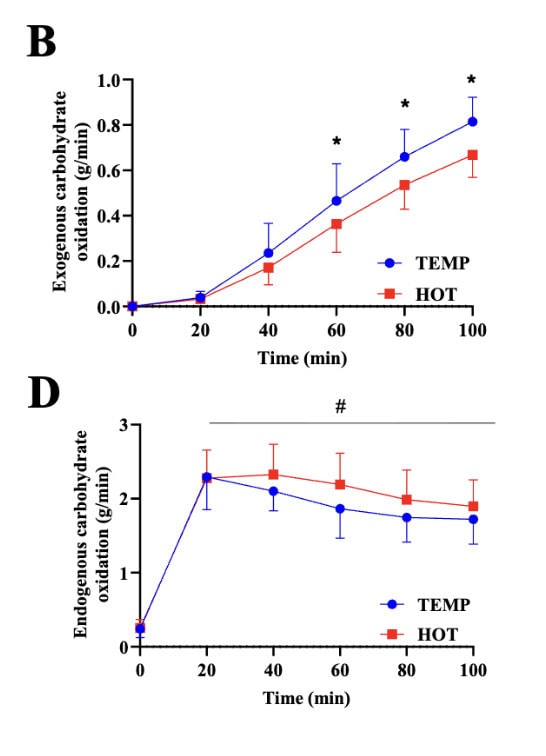
Ten well-trained runners completed two 100-minute treadmill runs at ~65% VO₂peak: one at ~19°C/66℉ (temperate) and one at ~34°C/93℉ (hot). In both, they drank enough water to replace ~90% of sweat loss (so hydration wasn’t the confounder) and took in 60 grams of glucose (20 grams every 20 minutes) labeled with a tracer so the team could track how much of the ingested carbohydrate was actually used by the body. They sampled breath, blood, core, and skin temperature, and measured whole-body carbohydrate and fat use across each run.
Even while maintaining hydration, heat shaved ~20% off the rate at which runners burned the carbs they drank (average exogenous carb oxidation was 0.43 vs 0.54 grams per minute and peak was 0.67 vs 0.81 grams per minute in heat vs temperate). Total carbohydrate use was similar across conditions, but in the heat, more of it came from endogenous sources (i.e., your own glycogen stores, about 13% higher), while fat oxidation dropped by ~27%. Core temperature and heart rate were, unsurprisingly, higher in the heat, and blood lactate and glucose ran higher too, consistent with a shift toward more glycolytic metabolism.
What this means for runners
On hot days, expect your gels/drinks to “work” less, even if you drink enough water. Gut-train specifically in heat, consider multiple-transport carbs (glucose+fructose) at slightly lower per-hour targets than in cool weather, and start earlier with fueling because you’ll lean more on your limited glycogen. As intensity creeps up, GI tolerance drops further, so if possible, keep the effort truly aerobic when it’s hot, and use cooling strategies like ice, shade, and cold sponges when possible.
RELATED ARTICLE: Heat Training for Runners: How To Prepare For Hot Races
Durability Declines Differently Across Terrain For Trail Runners

There’s a lot of talk about physiological durability lately—the ability to hold form and economy as the length of a run or race increases. But most of the research to date had been in road runners. Trail runners live a different version of that story because terrain changes the stress, but we’re not quite sure how. A new study examined what actually fades after a long submaximal trail run and where the slowdown occurs.
Twenty-five recreational trail runners (average VO₂max ~55 mL/kg/min; four women) completed two assessments: a treadmill cost-of-locomotion test (basically a test of how much energy they’re using to run at a given speed) and a 2.4-mile (3.8-kilometer) outdoor time trial on a course with distinct uphill and downhill segments. Then they went out for a 90-minute trail run at a steady aerobic effort (targeted as 66% of the heart-rate range between lactate threshold and lactate turn point—think solid all-day pace). Right after, they repeated the cost of locomotion test and the outdoor time trial. Across tests, the researchers tracked time-trial splits, heart rate, breathing mechanics, blood lactate, and even proxies of their heart function to see how physiology and performance shifted with fatigue.
After the 90-minute run, the overall time-trial performance worsened, with a 7.7% increase in completion time. But that slowdown wasn’t uniform: uphill segments were slower, while downhill performance remained unchanged. In other words, the late-run fade was terrain-specific. Importantly, this slowing on the uphill segments happened even when heart rate stayed stable, a classic example of “decoupling” between external and internal load.
On the treadmill, the metabolic “cost” of running and blood lactate were similar pre- vs post-fatigue, but several physiological markers did drift the wrong way: heart rate rose (~6.5% higher at the same speed), their heart’s stroke volume fell (~7.8% lower), breathing volume decreased (~13.9%), and breathing frequency jumped (~19.9%). In other words, the runners were taking shallower, faster breaths and their hearts were working harder to deliver the same output.
What this means for runners
It may be useful for trail runners to train durability where you lose it the most: on climbs, late in the race. Build long runs that finish with sustained uphill work (e.g., 20–40 minutes continuous climbing after 60–90 minutes of easy trail), and include uphill tempo or hill-repeat blocks with short recoveries. Strengthen the uphill engine (glutes, calves, quads, trunk) with strength training too. During races, watch for decoupling (pace dropping at the same HR), and when you see it, shift early to hike-run on steeper grades to protect the climb legs.
If anything, this study is just a reminder to do your hill work.
RELATED ARTICLE: How To Perform Hill Sprints: Every Runner’s Secret Weapon
Fueling Properly Solves Iron Deficiency and Metabolic Issues in Female Runners

The topic of adequate fueling is all the rage lately as runners begin to realize how important it is for health and performance. Undereating can lead to low iron and ferritin levels, a suppressed metabolic rate, and elevated stress hormones—changes that make workouts feel harder than they should. A new case series took a “feed the work” approach and tracked what changed when female runners started fueling enough.
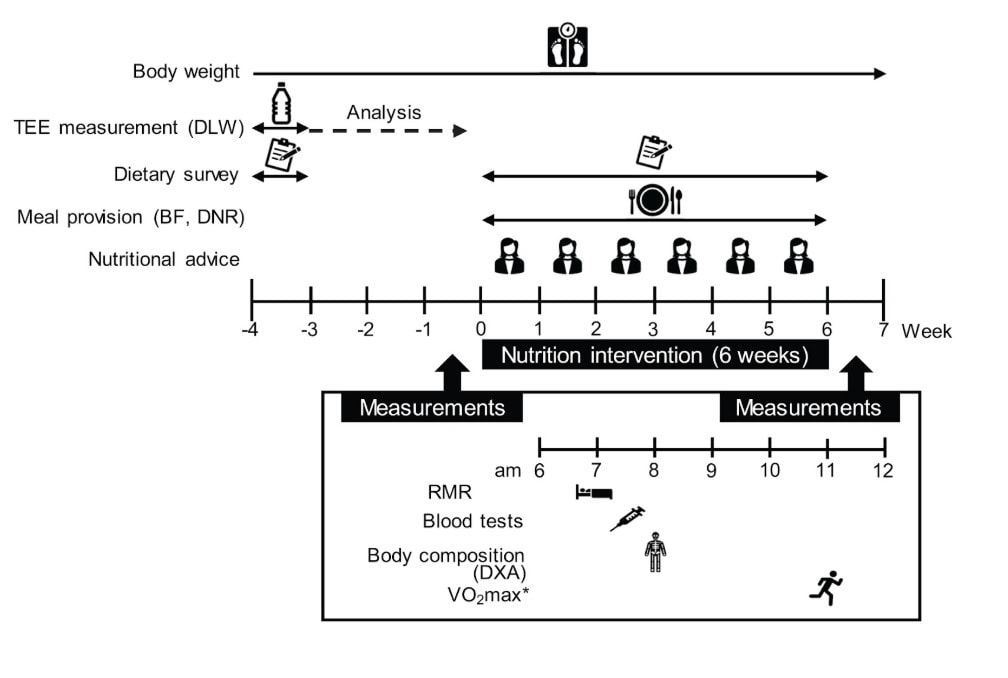
Six Tier-3 female long-distance runners in Japan had their total energy expenditure (TEE) measured in real life using the doubly labeled water technique. Then, for six weeks, dietitians provided breakfast and dinner and gave weekly guidance so that daily energy intake matched each woman’s measured TEE. Carbohydrate targets were set at >7 g/kg/day, with weight and labs checked before/after.
Before the intervention, everyone was in a caloric deficit (−548 kcal/day on average) and eating too few carbs. During the intervention, energy balance improved to roughly neutral (−31 kcal/day on average), and carbohydrate intake hit the >7 g/kg/day target. Weight and fat mass stayed stable—the women didn’t gain weight, they were just fueling their workouts better. Five of six met criteria for Stage-1 iron deficiency at baseline, but after six weeks, four improved or were actively recovering. Two athletes with a suppressed resting metabolic rate returned to the normal range, and one athlete’s elevated cortisol normalized.
What this means for runners
If your training volume is high, “normal” eating can be low for you. Matching energy intake to your true TEE (and pushing carbs past 7 g/kg/day during heavy phases) can correct low ferritin trends and low metabolic rate without adding weight. If you’ve battled low ferritin despite taking supplements, check energy/carbohydrate intake first. Six weeks of targeted fueling can be enough to see meaningful lab changes.
RELATED ARTICLE: Runner’s Anemia: Running And Iron Deficiency