


Sub-45 10K Training Plan
Get this plan free — join RunClub
Create your free RunClub account to download the Sub-45 10K plan as PDFs — miles, km, and the coach guidance notes — plus every other plan in our library, the daily running game, and the community. Takes 20 seconds, no card.
Free forever. No card required.
Why create a free account?
It's genuinely free — and it unlocks more than just this plan:
- Every plan as free PDFs — miles, km + guidance notes, 5K to 100-miler
- The daily running game + weekly quiz
- The runner community — real runners, plus the MH team
- Badges and member perks
Browse the full 10K plan library →
Go further with RunClub Premium
The plans are free. RunClub Premium is for runners who want people in their corner.
- The community + direct access to the MH coaching team — advice and accountability, every day
- Exclusive training videos & support to go deeper than any plan
- The members-only podcast — AMAs and deep-dives you won't hear on the main show
- Editable Google Sheet versions of every plan, so you can tailor them to your life
Try everything — first week $1 →
Then $6/month, billed yearly ($72). Cancel anytime — the whole plan library stays free either way.
The ability to run 10k in 45 minutes or less is one I’ve often envied.
As a long-distance runner, I’ve spent the last few years focusing on distance and stamina rather than speed.
As a result, my shorter-distance times have been pretty slow – embarrassingly slow at times.
I’ve been training at a marathon or ultra-marathon pace, while friends of mine who are relatively new to running have been beating me hands-down in the shorter distances.
I would be happy to run 10k in 55 or 60 minutes while my friends finish in under 50 minutes. So, I decided to work on my short-distance speed – and my first target was to run a 10k in 45 minutes.
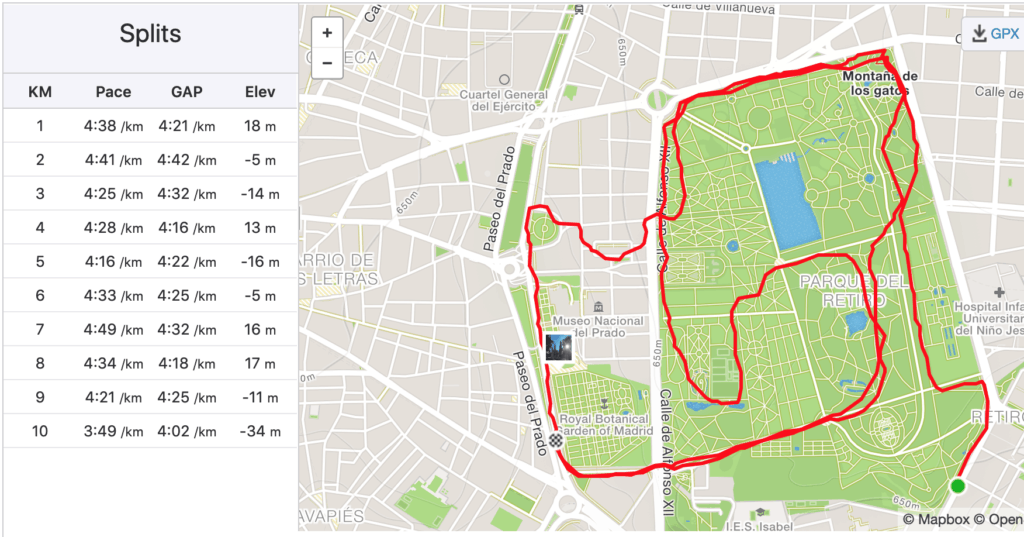
After a few weeks of building up to it, I finally went out and did it – with 25 seconds to spare. (Check it out on Strava).
Now I’ve set the
In this guide, we will cover how to run a 10k in 45 minutes and provide a full training plan to run a sub 45 minute 10k to help you achieve your goals.
Ready, let’s train!
The Honest Truth About Running A Sub-45 10K
A 45-minute 10K is 7:14 per mile (4:30 per kilometre) sustained for 45 continuous minutes. The reason most generic plans don’t deliver it is that they treat the goal as an arithmetic pacing problem when it’s really three physiological systems — aerobic ceiling, lactate buffering, and running economy — that each need a specific stimulus, and one of them is usually the binding constraint for the runner reading the article.
The aerobic ceiling: VO2max and what 7:14 per mile actually costs
At 7:14/mile (roughly 13.3 km/h), the metabolic cost of running for an average-economy runner is about 45–48 ml/kg/min of oxygen, derived from the well-validated linear relationship between speed and VO2 reported by di Prampero 1di Prampero PE. The energy cost of human locomotion on land and in water. Eur J Appl Physiol. 1986;55(3):259-66.. To hold that for 45 minutes you typically need a VO2max above roughly 52–55 ml/kg/min, because race effort over this duration sits at about 90 percent of VO2max for most runners 2Joyner MJ, Coyle EF. Endurance exercise performance: the physiology of champions. J Physiol. 2008;586(1):35-44.. Running economy is the multiplier that lets two people with the same VO2max run different paces — differences of 5–10 percent are common and translate to 30–60 seconds across a 10K 3Jones AM. The physiology of the world record holder for the women’s marathon. Int J Sports Sci Coach. 2006;1(2):101-16.. The practical implication: if your easy-pace heart rate at 9:00–9:30/mile sits already in zone 3, the limiter is aerobic capacity and economy, not race-day pacing.
Lactate threshold and where 45-minute pace actually sits
For a 45-minute 10K, race pace usually sits at or just above lactate threshold — the highest steady-state at which lactate clearance still keeps up with production 4Faude O, Kindermann W, Meyer T. Lactate threshold concepts: how valid are they? Sports Med. 2009;39(6):469-90.. The training stimulus that moves threshold pace fastest is the “tempo” format used in Daniels’ literature: 20–30 minutes at threshold, or 4–6 minute cruise intervals at the same intensity, performed once or twice a week 5Daniels J. Daniels’ Running Formula. 4th ed. Human Kinetics; 2021.. The Seiler 80/20 polarised distribution — 80 percent easy, 20 percent threshold or above — outperformed threshold-only and pyramidal distributions in multiple controlled comparisons of trained distance runners 6Seiler S. What is best practice for training intensity and duration distribution in endurance athletes? Int J Sports Physiol Perform. 2010;5(3):276-91.. The dose-response gets nonlinear past about 90–100 km/wk for most amateur runners; modest gains beyond that scale poorly with the injury risk 7Tanda G. Prediction of marathon performance time on the basis of training indices. J Hum Sport Exerc. 2011;6(3):511-20..
VO2max-specific intervals and economy work
VO2max responds best to sustained efforts at 95–100 percent of VO2max, performed in 3–5 minute repeats at velocity (vVO2max) totalling roughly 20–30 minutes of work per session 8Billat V. Interval training for performance: a scientific and empirical practice. Sports Med. 2001;31(1):13-31.. For a runner targeting sub-45, that’s typically 5x1000m or 6x800m at about 6:50–7:00/mile pace with equal-time recoveries. Running economy — how much oxygen you spend at a given pace — improves with strength training (heavy and plyometric) layered on top of running, with measurable gains in 8–14 weeks 9Beattie K, Kenny IC, Lyons M, Carson BP. The effect of strength training on performance in endurance athletes. Sports Med. 2014;44(6):845-65. and additional improvements from plyometric work specifically 10Saunders PU, Telford RD, Pyne DB, et al. Short-term plyometric training improves running economy in highly trained middle and long distance runners. J Strength Cond Res. 2006;20(4):947-54.. The interaction matters: VO2max and economy improvements compound; plans that hit only one of them plateau.
Pacing on race day and the cost of a hot opening kilometre
The dominant pacing failure at this distance is starting too fast. Even pacing or slight negative splits consistently outperform positive splits in 10K performance modelling 11Foster C, Schrager M, Snyder AC, Thompson NN. Pacing strategy and athletic performance. Sports Med. 1994;17(2):77-85., and a 10–15 second over-pace in kilometre 1 typically costs 30–45 seconds across kilometres 7–10 because lactate accumulation past steady state is non-linear 12Abbiss CR, Laursen PB. Describing and understanding pacing strategies during athletic competition. Sports Med. 2008;38(3):239-52.. The thermoregulatory tax is real too: in conditions above roughly 18–20 °C, finish times degrade about 1–2 percent per 5 °C of additional ambient temperature 13Ely MR, Cheuvront SN, Roberts WO, Montain SJ. Impact of weather on marathon-running performance. Med Sci Sports Exerc. 2007;39(3):487-93., so a sub-45 attempt in 25 °C heat is functionally a sub-46 effort. Caffeine 3–6 mg/kg, 45–60 minutes before the start, gives a small but reliable improvement of about 1–2 percent in trained runners 14Ganio MS, Klau JF, Casa DJ, Armstrong LE, Maresh CM. Effect of caffeine on sport-specific endurance performance: a systematic review. J Strength Cond Res. 2009;23(1):315-24..
When sub-45 is unrealistic in the time you have — and what works instead
If your current 10K is over about 55 minutes, jumping to sub-45 in a single training cycle is a roughly 22 percent pace improvement — rare in trained athletes and unrealistic in 10–12 weeks for most adult amateurs. The more honest framing: VO2max gains plateau within 6–8 weeks of a structured stimulus and continue more slowly thereafter 15Midgley AW, McNaughton LR, Wilkinson M. Is there an optimal training intensity for enhancing the maximal oxygen uptake of distance runners? Sports Med. 2006;36(2):117-32., while running economy and lactate threshold improvements come more linearly across many months 16Bassett DR, Howley ET. Limiting factors for maximum oxygen uptake and determinants of endurance performance. Med Sci Sports Exerc. 2000;32(1):70-84.. A masters runner with established economy and a high VO2max is in better shape to chase sub-45 than a younger runner who has only ever run easy 17Ganse B, Degens H. Current insights in the age-related decline in sports performance of the older athlete. Int J Sports Med. 2021;42(10):879-88.. The realistic version of “sub-45 in 12 weeks” is “30–90 second improvement per training block” for most people, repeated until the goal is in reach — and that’s where the binding-constraint diagnostic above pays off, because it tells you which session matters most this block.
What Pace Per Mile Is Needed To Run A 10k In 45 Minutes?
To run 10k in 45 minutes, you will need to run 7:15 per mile or 4:30 per kilometer.
However, since most people looking to run 10k in 45 minutes want to break 45 minutes as a barrier (running 44:59 or faster), aim to run the race at just under 7:15 pace. This will give you a tiny buffer on race day to cross the finish line in under 45 minutes.
If you are running on a track, 10k in 45 minutes works out to roughly 1:48 per 400 meters and 3:37 for 800 meters.
Here are the pace charts for a 10k in just under 45 minutes:
45 Minute 10k Pace Chart: Miles
| Mile | Split |
| 1 | 7:15 |
| 2 | 14:29 |
| 3 | 21:44 |
| 4 | 28:58 |
| 5 | 36:13 |
| 6 | 43:27 |
| 6.2 | 44:59 |
45 Minute 10k Pace Chart: Kilometers
| Kilometer | Split |
| 1 | 4:30 |
| 2 | 9:00 |
| 3 | 13:30 |
| 4 | 18:00 |
| 5 | 22:30 |
| 6 | 27:00 |
| 7 | 31:30 |
| 8 | 36:00 |
| 9 | 40:30 |
| 10 | 44:59 |

What Is A Sub 45 Minutes For 10K On A Treadmill?
If you are training to run 10k in 45 minutes on the treadmill, your race pace workouts will be run at a treadmill speed of 8.2 mph (13.3 km/hr).
Can I Break A 45 minute 10K?
Running a sub-45-minute 10k race time is an appropriate goal if you’ve run a 10k under 50 minutes or faster or a 5k under 22:30.
You should also be able to run one mile in 7 minutes and 15 seconds (or at least one kilometer in 4:30, though preferable 2-3 without stopping), as this will be your race pace for a 45 minute 10k race.
What Types of Workouts Are Included In a 10K Training Plan?
Our sub 45 minute 10k training plan involves running 4-5 days per week and taking at least one rest day per week.
You should be able to run 5 miles comfortably without stopping and have about 5-12 hours per week to train.
Make sure you have a good aerobic base before you start this training schedule because it is necessary before layering on speed sessions with fast running and VO2 max interval training.
To run 10k in under 45 minutes, you must follow a well-rounded training program with interval workouts, fartleks, tempo runs, hills, distance runs, cross-training, and strength training.

- Distance Run: Base-building training runs to improve your endurance.
- Easy Run: Run at a conversational pace to aid recovery from speed workouts and hard efforts.
- Long Run: Long endurance workouts to improve physical and mental stamina. You should run at a comfortable, conversational pace, at an effort of 6 on a scale of 1-10, where 10 is max effort.
- Threshold Interval Workouts and Tempo Runs: The lactate threshold occurs around 83-88% of your VO2 max, so your threshold run pace would be the pace you are running at 83-88% of your VO2 max according to your lab results or roughly the pace you could hold at max effort for an hour of running. For most runners, the threshold run pace is about 15-20 seconds per mile (9-12 seconds per kilometer), slower than your 10k race pace. Therefore, if you are training to run a sub 45-minute 10K race, your tempo runs and threshold interval workouts should be run around 7:30-7:35 minutes per mile or about 4:39-4:42 minutes per kilometer.
- Cross Training: Non-running aerobic workout. Examples include cycling, swimming, rowing, elliptical, aqua jogging, and hiking.
- Rest Day: No structured exercise. Focus on rest and recovery (stretching, foam rolling, taking it easy).
- Strides: Accelerations where you reach your max sprinting speed by the end of each one.
- Time Trial: Race-pace effort to assess your fitness level and rehearse the race experience.
- Speed work: Trackwork that will involve race pace intervals and VO2 max intervals. These speed workouts get your body used to running fast and build anaerobic fitness, improving VO2 max and running speed.
- Shake Out Run: Very relaxed run to loosen up the day before a race or key workout.
- Warm-up: Easy jog to warm up.
- Cool down: Easy jog to recover.

10km in 45 Minutes Training Plan
This 6-week 10k training plan will help you break 45 minutes in the 10k.
In addition to the workouts listed on your training schedule below, try to add 2-3 days of strength training per week with full-body exercises like lunges, squats, step-ups, and plyometrics.
| Monday | Tuesday | Wednesday | Thursday | Friday | Saturday | Sunday |
| Rest or 30-45 minutes cross-training | Warm up 1 mile 4 x 800 meters in 4:00 with 200 meter jog in between 8 – 10 x 400 meters in 2:00 with 200 meter jog in between Cool down 1 mile | 3 miles easy run | Rest day | Warm up 2 miles 10 x 100 meter or 30-45 second hill sprints 1 mile cool down | 3-4 miles easy run | Long run 5 miles |
| Rest or 30-45 minutes cross-training | Warm up 1 mile 8 x 1,000 meters in 4:30 with 200 meter jog in between Cool down 1 mile | 4 miles easy run | Rest day | Warm up 1 mile 2 x 15 minutes at 7:30-7:35 minutes per mile with 90 seconds in between 4 x 30 seconds at sprint/mile pace with 30 seconds rest Cool down 1 mile | 3-4 miles easy run | Long run 6 miles |
| Rest or 30-45 minutes cross-training | Warm-up 1 mile 3 x 1 mile in 7:00-7:15 with 200 meter jog in between 2 x 800m at 5k pace 2 x 400 at mile race pace Cool down 1 mile | 3-4 miles easy run | Rest day | Warm-up 1 mile 2 x 20 minutes at 7:30-7:35 pace with 90 seconds in between 4 x 30 seconds at sprint/mile pace with 30 seconds rest Cool down 1 mile | 3-4 miles easy run | Long run 7 miles |
| Rest or 30-60 minutes cross-training | Warm up 1 mile 6 x 100m strides 5k time trial in 22:30 or faster (Hit the first mile in 7:15 minutes, and then stay steady or pick up the pace) Cool down 2 miles of easy running | 4-5 miles easy run | Rest day | Warm up 2 miles 10-12 x 100-200 meter or 30-60 second hill sprints 1 mile cool down | 4-5 miles easy run4 x 50-75m strides | Long run 8 miles |
| Rest or 45-60 minutes cross-training | Warm up 1 mile 2 x 2 miles in 14:00 – 14:30 200 meter jog 4 x 400 meters in 1:44 or faster with 90 seconds recovery in between Cool down 1 mile | 5-6 miles easy run | Rest day | Warm up 1 mile 35-40 tempo run (7:30-7:35 min/mile) 1 mile cool down | 4-5 miles easy run 4 x 50-75m strides | Long run 6 miles |
| Rest or 45 minutes cross-training | Warm up 1 mile 3 x 1,000 meters in 4:30 with 200 meter jog in between 4 x 400 meters in 1:46-1:48 with full recovery Cool down 1 mile | 4-5 mile easy run | Rest day | 20 minute easy jog + 4 75m strides | 10k Race | Shake out or active recovery walk |
Sub-45 10K Training Plan
Get this plan free — join RunClub
Create your free RunClub account to download the Sub-45 10K plan as PDFs — miles, km, and the coach guidance notes — plus every other plan in our library, the daily running game, and the community. Takes 20 seconds, no card.
Free forever. No card required.
Why create a free account?
It's genuinely free — and it unlocks more than just this plan:
- Every plan as free PDFs — miles, km + guidance notes, 5K to 100-miler
- The daily running game + weekly quiz
- The runner community — real runners, plus the MH team
- Badges and member perks
Browse the full 10K plan library →
Go further with RunClub Premium
The plans are free. RunClub Premium is for runners who want people in their corner.
- The community + direct access to the MH coaching team — advice and accountability, every day
- Exclusive training videos & support to go deeper than any plan
- The members-only podcast — AMAs and deep-dives you won't hear on the main show
- Editable Google Sheet versions of every plan, so you can tailor them to your life
Try everything — first week $1 →
Then $6/month, billed yearly ($72). Cancel anytime — the whole plan library stays free either way.
After you crush the 45 minute 10k on race day, consider training for a longer distance race like a half marathon!
If you are looking for one-on-one guidance, we have our very own running coach who would be happy to help you out on your journey.


Join the conversation
Brilliant training plan. Took 4 mins off my pb today
Crushed my PR using this. Thanks!
nice work!
Thanks a lot it's working
Excellent advice on how to run a 10k in 45 min, I shall see how that goes over the next few weeks.
Thank you.
[…] I want to be smart when running so I’ve been reading on how I should progress. The key is to build a solid base. It says 4 days per week minimum but the aim should be daily 30 min runs Monday-Friday and a +60 min weekend run. Do two months of base training before adding intervals. […]