


For seven years, the marathon has carried a piece of trivia that does not really make sense to anyone outside the sport. The fastest 26.2 miles ever covered by a human was not, technically, a marathon world record.
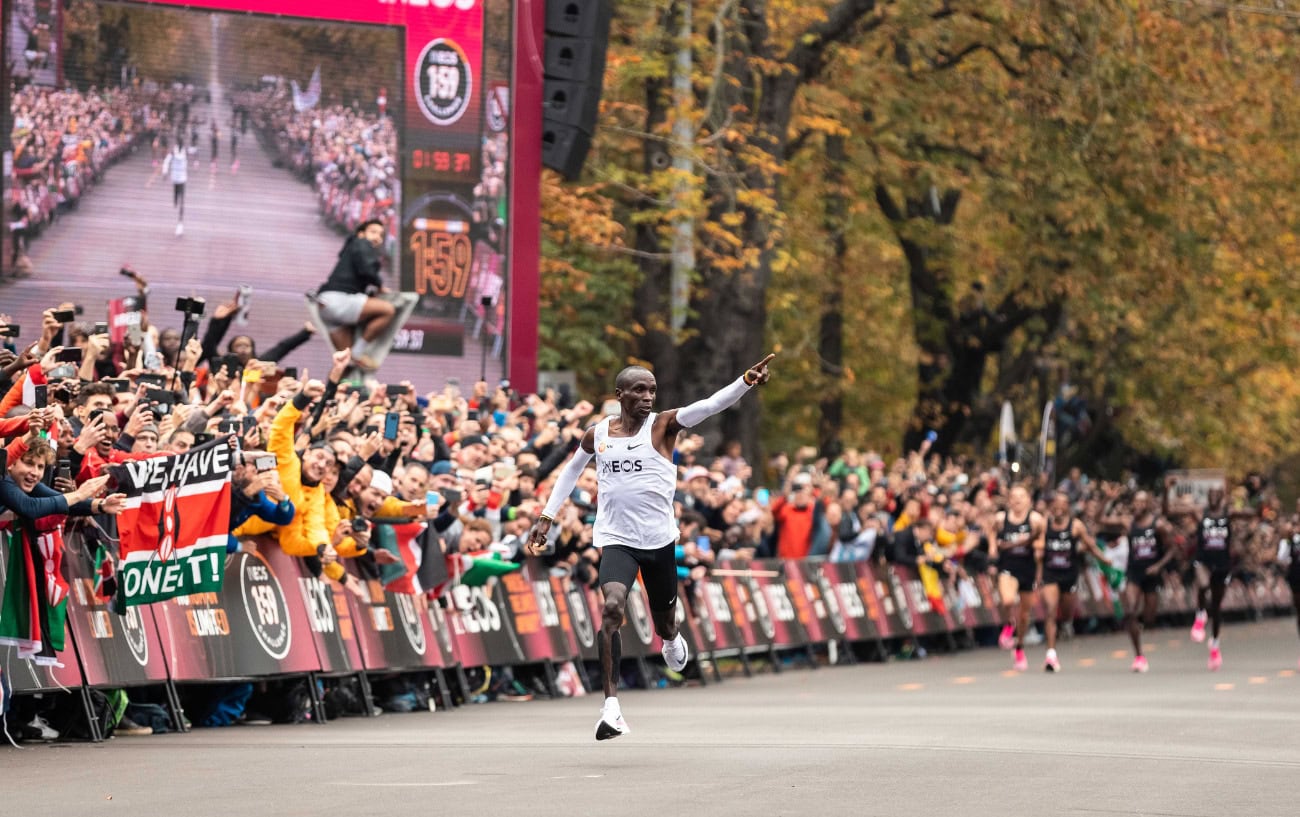
Eliud Kipchoge ran 1:59:40 in a Vienna park in October 2019. World Athletics did not recognize it. The official record sitting in the books on Sunday morning was the late Kelvin Kiptum’s 2:00:35 from Chicago, a full 55 seconds slower than what most people consider the fastest marathon ever run.
Sabastian Sawe closed that gap on Sunday. The 31-year-old Kenyan ran the 2026 London Marathon in 1:59:30, taking the world record outright, going 10 seconds faster than Kipchoge’s unofficial Vienna time, and becoming the first person ever to break two hours in a race the sport actually recognizes.
He was not alone. Yomif Kejelcha of Ethiopia, in his first marathon ever, finished 11 seconds back in 1:59:41. Jacob Kiplimo took third in 2:00:28. The sub-2 club gained two members in roughly two minutes, and a third runner came within half a minute of joining them.
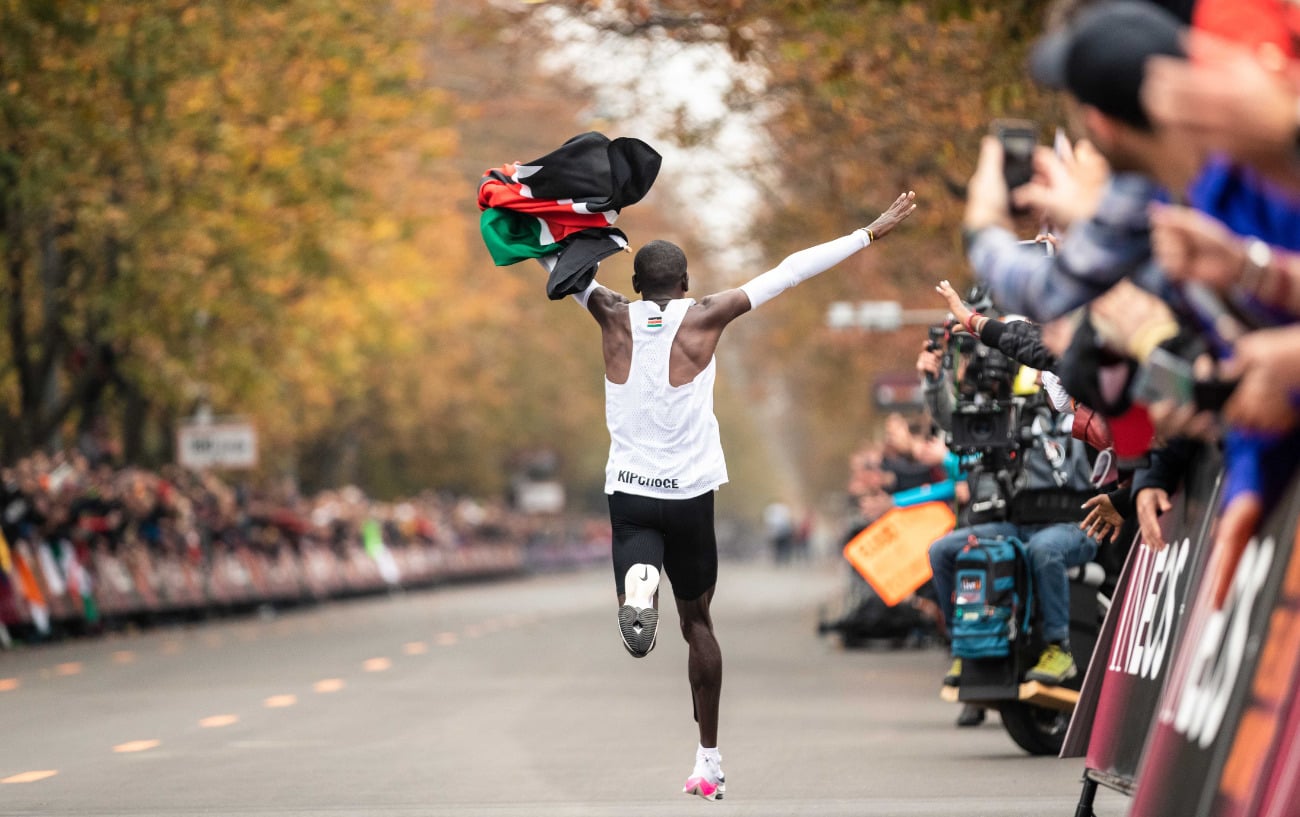
Why Kipchoge’s 1:59:40 in Vienna never counted
The 2019 INEOS 1:59 Challenge was a privately funded event built around one runner. It looked spectacular and it produced a number that broke a barrier most people thought was years away. It also was not, by the rules of the sport, a marathon. World Athletics has a specific rule book that governs what counts as a record-eligible race, and the Vienna event broke several of its requirements.
The biggest issue was the pacemakers. The rule book states that pacemakers in a record-eligible race must be entered as actual competitors. They must start with the elite field, must be timed at every checkpoint along with everyone else, and must be officially ranked at the finish. Vienna used a rotating cohort of pacemakers who were not running their own races. They cycled in and out at fixed intervals, none of them covering the full distance with Kipchoge. Effectively, Kipchoge had a relay team of fresh wind-blockers, which is the kind of advantage no athlete in a real marathon ever gets.
The second issue was hydration. Athletes in a sanctioned race can only take fluids from the official drink stations set up by the race organizer. In Vienna, Kipchoge’s drinks were handed to him by a teammate riding alongside him on a bicycle. The bike timed every bottle to the second. That was useful, and it was also outside the rules.
Vienna had a few other engineered advantages — a flat, sheltered loop chosen for wind protection, a start time picked for the most favourable temperature window, and pacing technology projecting an optimal line on the road. None of those individual elements were necessarily disqualifying on their own, but combined with the pacemaker and hydration violations, the run sat firmly outside what World Athletics would ever certify.
None of this took anything away from what Kipchoge accomplished. He proved a human body could move under two hours for a marathon. The asterisk was procedural, not athletic.
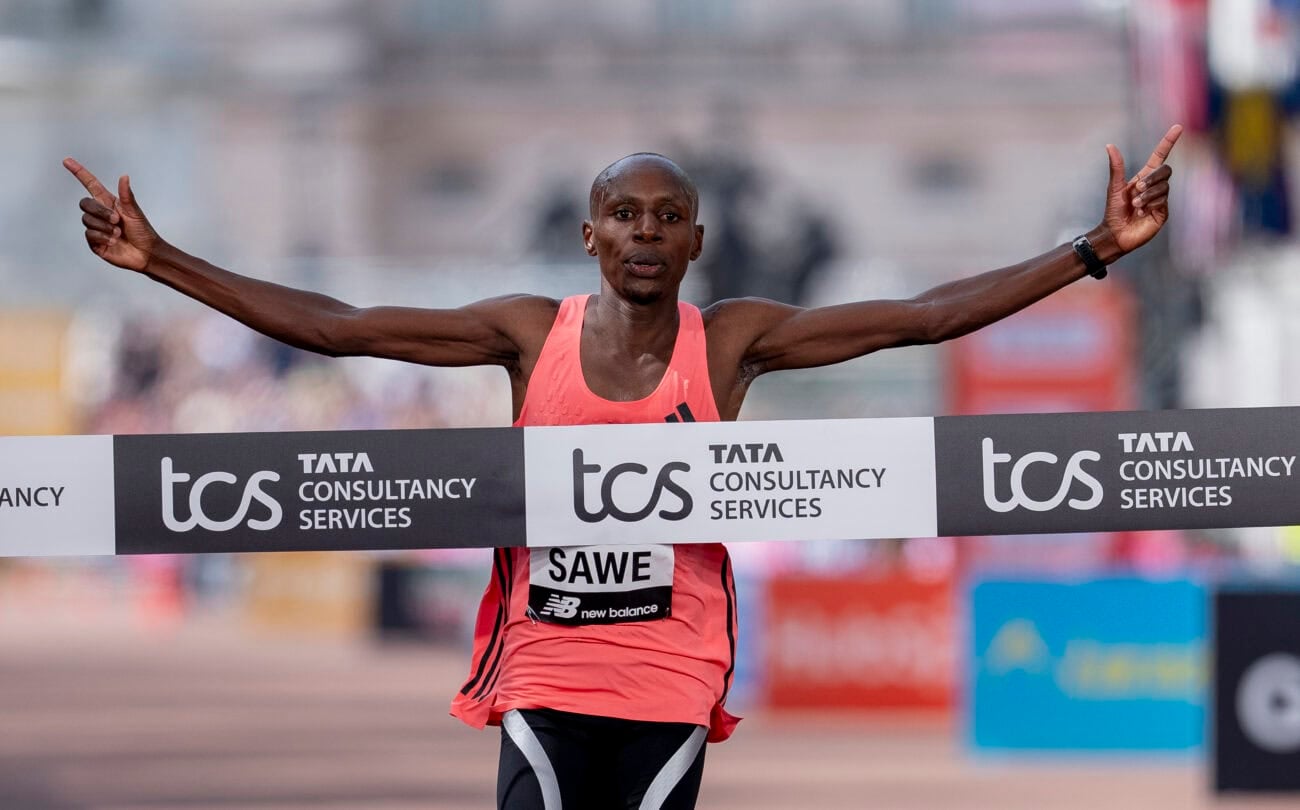
Why Sawe’s 1:59:30 in London does count
The London Marathon is the inverse of a privately staged event. It is one of the World Marathon Majors, an open mass-participation race with tens of thousands of finishers. Its course is certified by World Athletics for records — measured to the centimeter, with start-to-finish separation and net elevation drop both inside the legal limits.
Pacemakers in London are entered into the race as competitors. They are timed at every checkpoint. Drinks come from the official tables. The weather is whatever the weather is. There is no swap-out crew, no support bike, no engineered shelter from the wind. Anything fast that happens on that course goes on the books.
Sawe’s 1:59:30 was not just under two hours. It took 1 minute and 5 seconds off Kelvin Kiptum’s official world record from the 2023 Chicago Marathon, and 10 seconds off Kipchoge’s Vienna time, on a course where the asterisk does not exist.
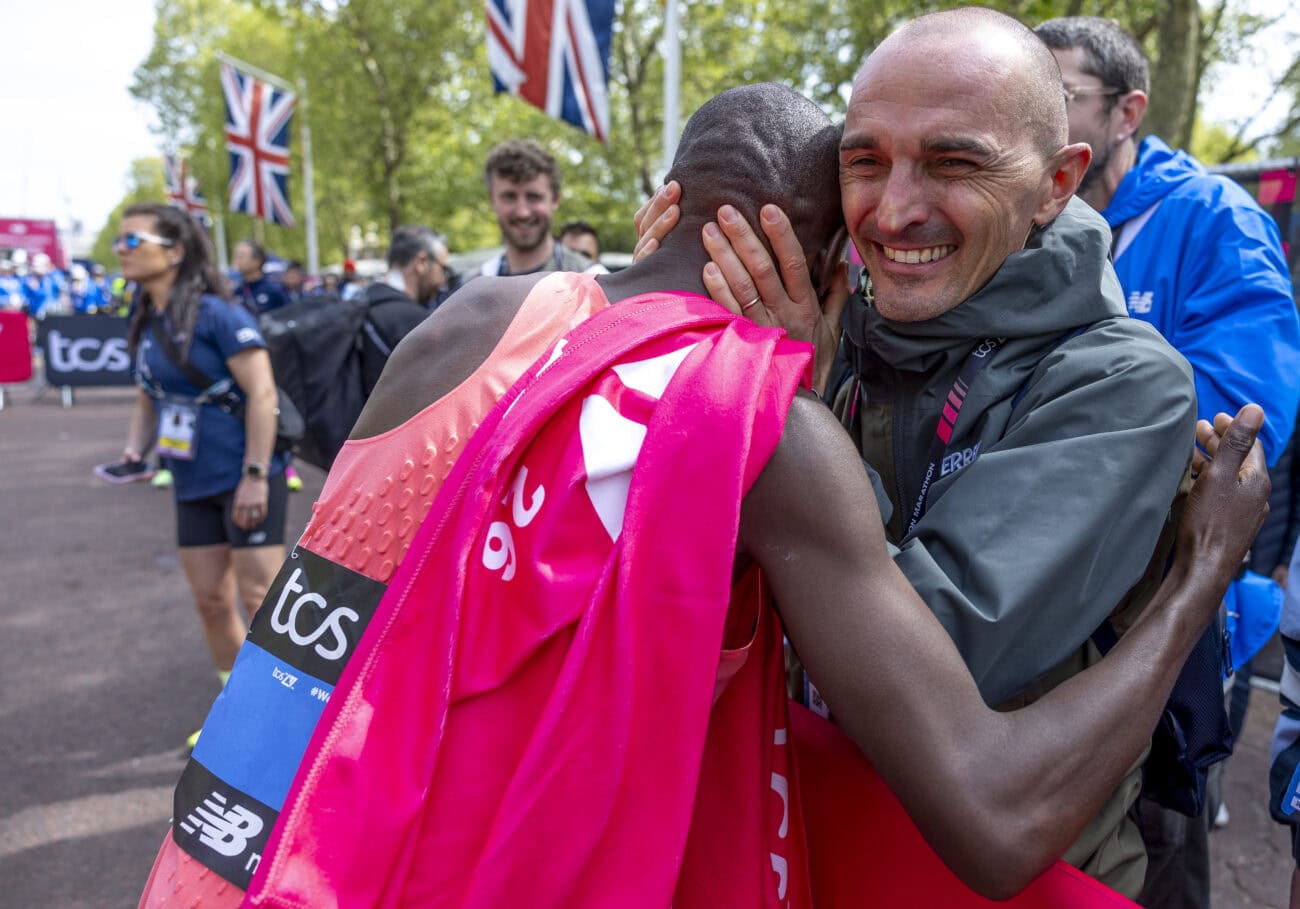
How Sunday’s race actually unfolded
The conditions cooperated. London started at 11°C with light winds and dry pavement, with afternoon temperatures topping out around 17°C. That is roughly perfect marathon weather, and it was the kind of day Sawe did not get the last time he chased sub-2.
The race plan was patient. A sub-2 attempt requires average splits of roughly 59:59 per half marathon. Sawe came through halfway in 1:00:29, slightly off pace. He came back in 59:01, a closing half so fast it would put him among the world’s best in a stand-alone half marathon — and he ran it after already running a 1:00:29.
The strategy was a textbook negative split at a pace almost no one had managed in a real race before. Kejelcha was alongside him for nearly the entire race. The two ran together over Tower Bridge, past the Tower of London on cobblestones, and along the Embankment. With roughly three miles to go, Sawe pushed. Kejelcha could not quite go with him.
“Nothing is impossible,” Sawe told reporters at the post-race press conference. He gave Kejelcha equal billing. “We helped each other. He was pushing to win the race and, in my mind, I was also fighting to defend my title. In the end I won, and I ran a world record, so I give credit to him.”
To the BBC, immediately after he crossed the line: “Reaching the finish line I saw the time and I was so excited to run a world record today.”
Sawe’s road to a world record
Sawe was not a stranger to the front of an elite field before Sunday. He won the inaugural World Athletics Half Marathon Championships in Riga in 2023 and has run as fast as 58:02 over 13.1 miles, putting him among the best in the world at the half before he ever stepped to a marathon start line.
His marathon debut came at Valencia in December 2024, where he won in 2:02:05, the second-fastest debut performance in history at the time. He followed that with a London victory in April 2025 in 2:02:27.
He arrived at the 2025 Berlin Marathon in September with sub-2 ambitions and ran 2:02:15 in muggy conditions that did not allow for it. London on Sunday was the rematch with the calendar, and the calendar cooperated.
RunClub
Get more running stories — join RunClub
Daily running news, a community of 300,000+ runners, free training plans for every distance, and a daily running game. Free to join — no card.
Already a member? Log in →










Start the conversation