


Air pollution rarely gets the same attention as heat, humidity, wind, and hills. But if you are racing through a large city, the air you breathe may be another environmental stressor working against you.

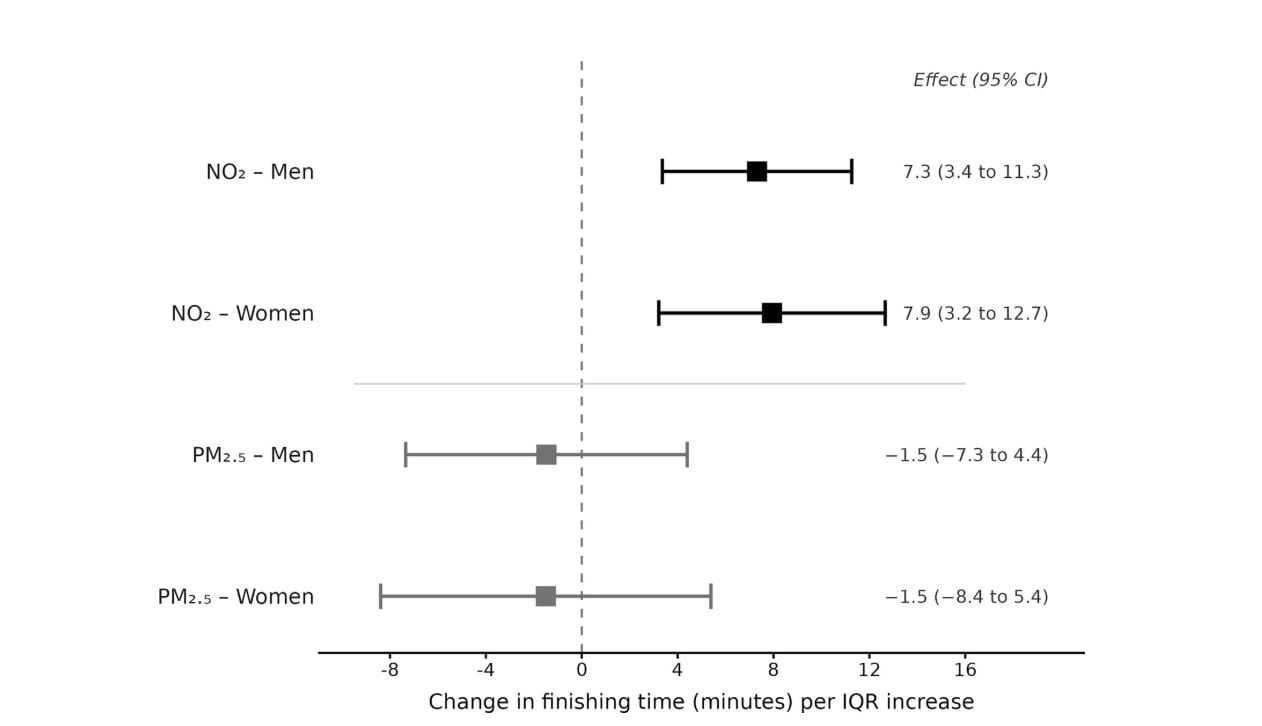
A massive cross-sectional study examined 2,756,553 finish times from 75 editions of the six World Marathon Majors between 2010 and 2024. The researchers paired each race with race-day concentrations of nitrogen dioxide (NO₂), a traffic-related pollutant, and fine particulate matter (PM₂.₅). They then estimated how those pollutants were associated with finish time after accounting for heat index, wind, and year.1Donaldson, J. A., Cai, S., Hey, J. V., Hansell, A. L., Yates, T., Ng, G. A., & O’Driscoll, J. (2026). Air Pollution Impairs Marathon Performance: A Cross-Sectional Analysis of 2.7 Million Finishers Across Six World Marathon Majors. In Sports medicine – open (Vol. 12, Issue 1, p. 128). PubMed. https://doi.org/10.1186/s40798-026-01099-6
- A 5.1-microgram-per-cubic-meter increase in NO₂ was associated with a 7.3-minute slower finish in men and a 7.9-minute slower finish in women.
- PM₂.₅ was not associated with slower times.
- The NO₂ association was also larger among recreational runners than elites: 2.12 versus 0.34 additional minutes per 1-microgram-per-cubic-meter increase.
What this means for runners
Air quality deserves a place beside temperature, humidity, and wind in your pre-race check. On high-pollution training days, running earlier, choosing a route away from heavy traffic, or moving a hard workout indoors may reduce exposure. If race-day air is poor, a slightly more conservative start may be sensible (especially for runners with asthma or other respiratory conditions).
But this study does not establish a performance threshold at which every runner should change plans. Treat air quality as one piece of the environmental puzzle, not a prediction about whether or not you’ll automatically run slower.
References
RunClub — Free
Join 300,000+ runners in RunClub
Free training plans for every distance, a daily running game, exclusive coaching content, and a real community of runners. Create your free account in 20 seconds — no card.
Already a member? Log in →









Start the conversation