


The first miles of a marathon often feel suspiciously easy. That is precisely what makes them dangerous: the pace that feels relaxed at mile three can become very… “unrelaxed” at mile 23.
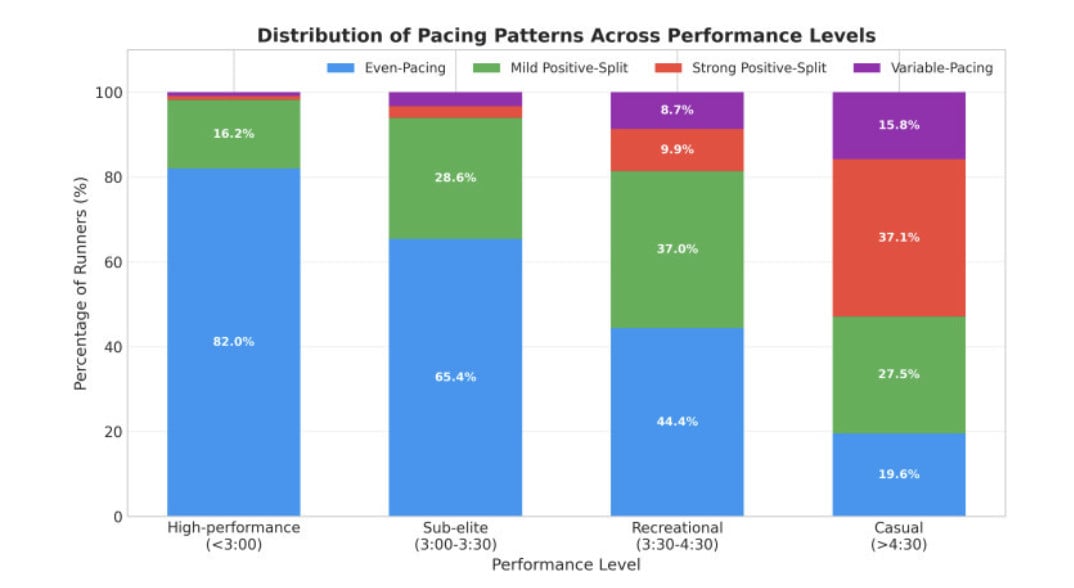
A large observational study analyzed 78,912 finishers from the 2015 through 2017 Boston Marathons. The runners were 18 to 84 years old, and 45.5% were women. Using split times from nine checkpoints, the researchers grouped pacing profiles into four patterns: even pacing, mild positive splitting, strong positive splitting, and variable pacing.

Nearly half of the runners, 47.9%, landed in the even-pacing cluster. Another 31.9% showed a mild positive split, 12.2% a strong positive split, and 8.0% a highly variable pattern. “Even” did not mean metronomic: runners in that cluster generally stayed within about 5% of their average pace and still had a modestly faster first half.
- Even pacing was associated with the fastest average finish time, 216.9 minutes, compared with roughly 276 minutes in the strong-positive-split group.
- Variable pacers finished about 39.7 minutes slower than even pacers on average.
- The pattern also appeared within performance bands: even pacing was associated with a 4.6-minute advantage over strong positive splitting among sub-three-hour runners and a roughly 13-minute advantage among recreational and slower runners.
The most dramatic result involved “hitting the wall,” defined here as running the final segment more than 20% slower than the average pace through 22 miles (35 kilometers). Overall, 15.2% of runners met that threshold. It occurred in only 0.2% of the even-pacing group but 85.4% of the variable-pacing group. Runners whose opening 10K was more than 5% faster than their eventual average pace hit the wall 26.6% of the time, compared with 1.5% among those who opened near their average.
What this means for runners
Base your opening pace on training, tune-up races, course demands, and conditions—not on how comfortable the first 10K feels. On a hilly course, aim for even effort rather than mechanically identical splits.
My advice is to practice that restraint during long runs. A pacing plan becomes much easier to follow when you have repeatedly felt the difference between sustainable marathon effort and the slightly-too-fast pace that only reveals its cost late in the race.
RunClub — Free
Join 300,000+ runners in RunClub
Free training plans for every distance, a daily running game, exclusive coaching content, and a real community of runners. Create your free account in 20 seconds — no card.
Already a member? Log in →











Join the conversation
Surely even pacing is fine if the course is flat. What if it is undulating? I suppose what you mean by even pacing is the key.
I believe that even pacing helps. But I also believe that even pacing and a correct goal are both done by people that are better runners. I tried even pacing but at the wrong pace for my condition and it appeared that I went out too fast, but I was right on my selected pace for 16 miles. The more long runs I get in, the closer I feel that I am getting to knowing my number.