


Add ten miles to a training week, and it is tempting to assume that your daily energy expenditure rises by exactly the calories burned on those runs. Human physiology (unfortunately) is not always that additive.

A recent small study measured energy expenditure in 20 highly trained Japanese female middle- and long-distance runners—10 with amenorrhea (an absence of a regular menstrual cycle) and 10 without it (i.e., those with a regular cycle). Total daily energy expenditure was measured over seven days. Resting and sleeping metabolism were measured during an overnight stay in a metabolic chamber, while activity trackers and training logs helped estimate their exercise energy expenditure and non-exercise activity.1Uchizawa, A., Kondo, E., Enomoto, Y., Yajima, K., Tamai, S., Watanabe, K., Ito, A., Kosugi, M., Higaki, Y., & Sagayama, H. (2026). Running Distance Is Associated With Components of Total Energy Expenditure in Amenorrhoeic and Non‐Amenorrhoeic Endurance Runners. Scandinavian Journal of Medicine & Science in Sports, 36(9). https://doi.org/10.1111/sms.70362
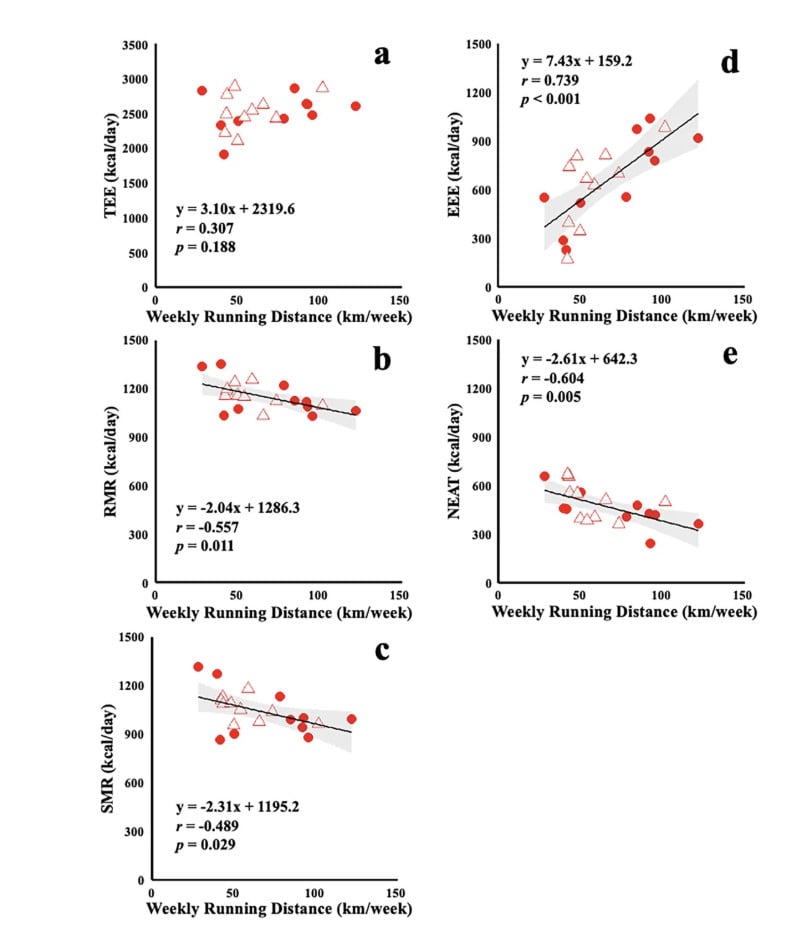
- Weekly running distance was not significantly associated with total daily energy expenditure, but it was strongly associated with greater exercise energy expenditure, as expected, and also with lower non-exercise activity thermogenesis—the energy spent walking, standing, fidgeting, and otherwise moving outside training.
- Greater running distance was also related to a lower resting and sleeping metabolic rate.
- Total expenditure and its components did not differ significantly between the amenorrheic and non-amenorrheic groups.
What this means for runners
Do not assume that every calorie recorded during a run adds one-for-one to your daily energy needs. When mileage climbs, some runners may unconsciously spend less energy during the rest of the day. That compensation can make a watch-based estimate of “calories burned” look more precise than it is.
Fueling decisions should incorporate your training load, appetite, recovery, performance, sleep, injury history, and menstrual function—not mileage alone. For women, the absence of a significant energy-expenditure difference between the groups here does not make amenorrhea benign; menstrual disruption remains an important clinical signal that deserves attention.
References
RunClub — Free
Join 300,000+ runners in RunClub
Free training plans for every distance, a daily running game, exclusive coaching content, and a real community of runners. Create your free account in 20 seconds — no card.
Already a member? Log in →












Start the conversation