


Elite marathoners, pro cyclists, triathletes, and ultrarunners are pushing carbohydrate intake higher than what most sports nutrition guidelines have traditionally recommended. The old 30-60 grams per hour advice gave way to 90 grams per hour. And now the cutting edge of endurance fueling has moved even further to 100, 110, or 120 grams per hour… sometimes more (though I find some claims by athletes somewhat dubious).
This has become one of the most interesting shifts in nutrition in endurance sport. I’ve felt it personally, too. A few years ago, I would have considered even 40 grams per hour a solid fueling plan for a long run or marathon workout. Now, for long runs and race-specific sessions, I’m often thinking in the 70-90g range, and I know many runners who are experimenting with amounts above that.
But are athletes actually performing better because they are taking in ultra-high amounts of carbohydrate, or have we started confusing “more advanced” with “more”?
That’s the question asked in a new commentary article, titled “Fuelled or Fooled? Examining the Evidence and Mechanisms Behind Ultra-High Carbohydrate Intake in Endurance Athletes.” It takes a critical look at this new carbohydrate revolution.
And the authors’ argument is not anti-carb. Far from it. The case for carbohydrates during prolonged endurance exercise is strong. The question is whether pushing beyond 90 grams per hour is broadly supported by the evidence.
Their answer: not yet.

What Counts as Ultra-High Fueling?
The authors define ultra-high carbohydrate intake as anything above 90 grams per hour during endurance exercise. That’s important because 90 grams per hour has long been treated as something like the upper evidence-based range, especially when using multiple transportable carbohydrates like glucose and fructose.
The logic is straightforward. Glucose and fructose use different intestinal transporters, so combining them allows athletes to absorb and oxidize more carbohydrate than glucose alone. This is why modern gels and drink mixes often use glucose-to-fructose ratios such as 2:1, 1:0.8, or 1:1. The goal is to get more carbohydrate from the gut into the blood and then into working muscle. That part is well supported.
Where things get murkier is the jump from “carbs help performance” to “more carbs always help.”
The authors point out that ultra-high-carb fueling has gained momentum largely due to elite athletes’ practices, anecdotes, and impressive race performances. We see athletes breaking records while reportedly consuming huge amounts of carbohydrate, and it is tempting to connect the dots: more carbs must be one of the secrets.
But controlled studies have not consistently shown that consuming more than 90 grams per hour yields additional performance benefits. In fact, much of the research suggests that carbohydrate ingestion improves performance compared with little or no carbohydrate, but the dose-response curve flattens out somewhere below the ultra-high range.
The Glycogen-Sparing Myth
One of the classic arguments for fueling during endurance exercise is that taking in carbohydrate “spares” your stored carbohydrate, especially muscle glycogen. Since glycogen depletion is one of the major contributors to fatigue during long races, the idea makes intuitive sense: eat more carbs, burn more external fuel, preserve more internal fuel, run stronger late. But the evidence does not cleanly support that idea at ultra-high intakes.
- The authors highlight studies showing that increasing intake from 90 to 120 grams per hour can increase exogenous carbohydrate oxidation, meaning you burn more of the carbohydrate you consume.
- However, that extra oxidation does not necessarily reduce endogenous carbohydrate oxidation, meaning it does not reliably spare muscle glycogen.
If an athlete takes in 120 grams per hour and oxidizes more external carbohydrate, but their muscles keep burning stored carbohydrate at the same rate, then the main benefit is not glycogen sparing. The extra carbohydrate may simply be replacing some fat oxidation rather than preserving precious muscle glycogen.
This matters because a lot of the practical messaging around high-carb fueling still rests on the idea that higher intake protects your internal carbohydrate stores. According to this commentary, that explanation is probably too simple, and possibly even wrong at the highest intake levels.
The authors also point out that oxidation efficiency drops as intake rises.
- In one cited study, oxidation efficiency fell from about 86% at 90 grams per hour to about 76% at 120 grams per hour. As you increase intake, a larger fraction of what you consume may not be immediately burned for energy.
That unoxidized carbohydrate has to go somewhere. Some may remain in the gut. Some may be retained in the liver. Some may contribute to better recovery after the race or workout. But it may not be directly powering your legs in the moment.
And for runners, the gut piece is not trivial. It is one thing to tolerate 120 grams per hour on the bike or in a controlled lab session. It is another thing to do it at marathon pace, late in a race, with heat, jostling, dehydration, and rising sympathetic stress.
The paper notes that laboratory trials may be too short to capture the point at which gastrointestinal distress often appears in long events. Anyone who has raced a marathon knows that the stomach can be perfectly fine at mile 10 and stage a rebellion by mile 22.
What the Studies Actually Show
The authors argue that, while carbohydrate ingestion reliably improves endurance performance compared with placebo or no fuel, the evidence for a clear dose-response benefit above 90 grams per hour is weak.
- In one study discussed in the paper, cyclists completed two hours of cycling followed by a 20-kilometer time trial while consuming carbohydrate at rates ranging from 0 to 120 grams per hour. The performance benefit appeared to rise up to around 78 grams per hour, but beyond that, the curve flattened and possibly even trended in the wrong direction.
- In another study, carbohydrate improved performance compared with placebo, but there were no clear differences between 60, 75, 90, and 112.5 grams per hour.
This is a reminder that endurance performance is not just a fuel math equation. You can measure exogenous carbohydrate oxidation in a lab and still not know whether an athlete will run faster over 26.2 miles. Racing includes pacing, heat management, mechanical damage, gut tolerance, perceived effort, neuromuscular fatigue, hydration, psychology, and the simple fact that the body is not a combustion engine.
The paper’s argument is that we should separate three things that are often conflated: whether you can consume a lot of carbohydrate, whether you can oxidize a lot of carbohydrate, and whether doing so improves performance.
Why might ultra-high carbs still help some athletes?
The authors propose several possible mechanisms that could explain why some athletes may benefit from ultra-high carbohydrate intake, even though traditional explanations remain incomplete.
The first possibility is a shift in substrate use.
Carbohydrates produce slightly more energy per liter of oxygen consumed than fat. In other words, burning carbohydrate is more oxygen-efficient than burning fat. This is one reason low-carbohydrate, high-fat diets can increase fat oxidation but sometimes worsen exercise economy at race-like intensities (it’s more “costly” to burn fat).
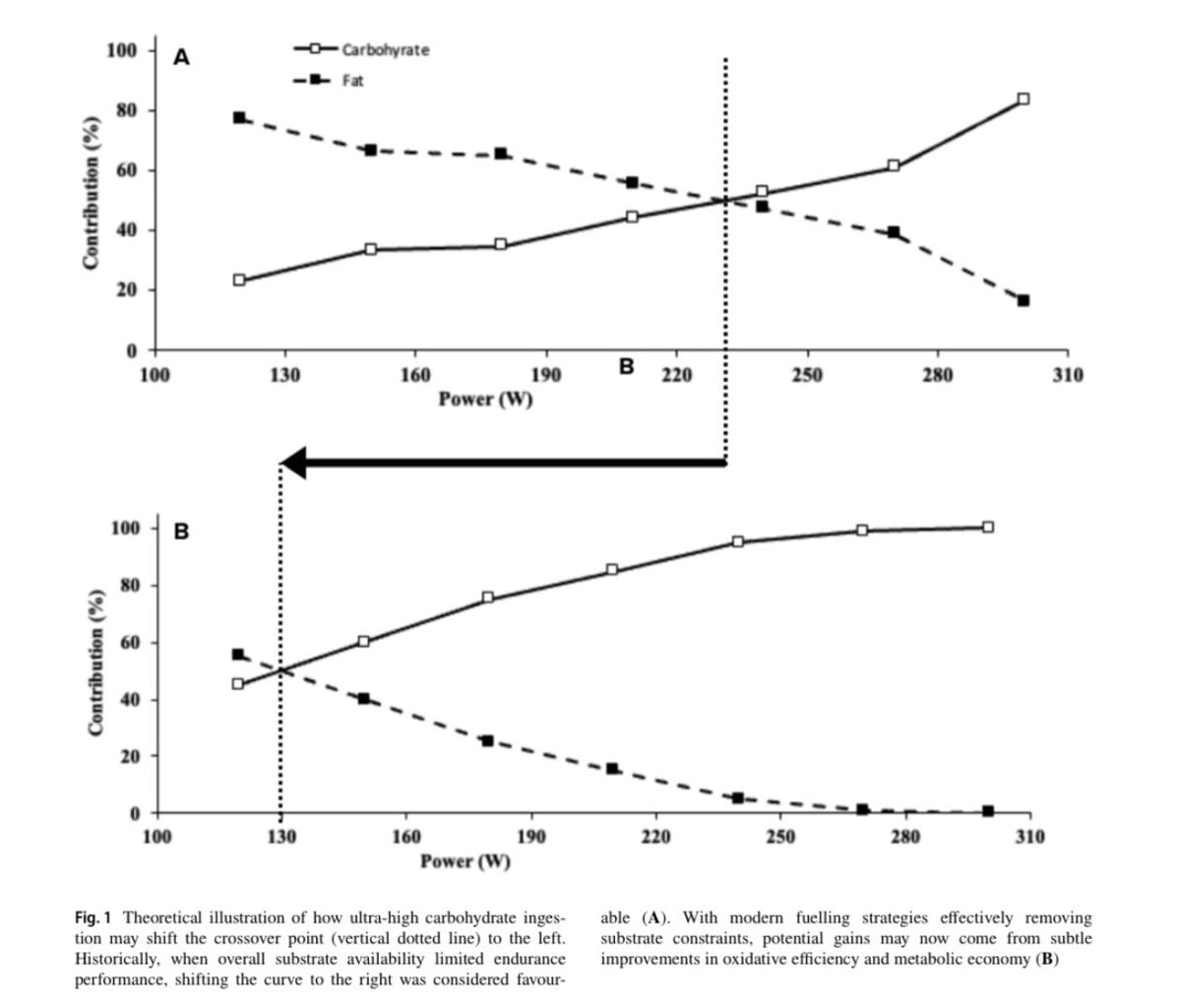
So, one hypothesis is that ultra-high carb fueling may intentionally shift metabolism toward greater carbohydrate use and lower fat oxidation, potentially improving oxygen efficiency. This is a fascinating idea because it flips the older endurance paradigm on its head. Historically, athletes often wanted to become better fat burners to preserve glycogen. But if modern fueling can largely prevent carbohydrate depletion in some events, then the goal for elite performance may become maximizing carbohydrate-based energy production, as it is more economical at high speeds.
The paper includes a theoretical figure (see below) illustrating this idea as a shift in the “crossover point,” where carbohydrate begins to contribute more than fat. Traditionally, endurance athletes sought to shift that point to the right, relying more on fat at higher intensities. The ultra-high-carb model suggests that, under certain circumstances, shifting it left might be useful if carbohydrate availability is no longer the limiting factor.
The second possible mechanism involves lactate.
When athletes consume glucose-fructose mixtures, fructose can be converted by the liver into glucose and lactate. Lactate is not just a waste product; it is an important fuel that can be shuttled between tissues and oxidized by highly aerobic muscle fibers and the heart. Elite endurance athletes may be especially good at this because they tend to have greater mitochondrial capacity and enhanced lactate transport.
This raises the possibility that some highly trained athletes are not simply “burning sugar.” They may be using carbohydrate intake to support a broader carbohydrate-lactate energy network that helps sustain high outputs. But again, this is a plausible mechanism, not yet a proven reason to recommend 120 grams per hour to everyone.
The third possible mechanism is central, meaning brain-related.
Carbohydrate in the mouth and gut may influence reward, motor output, perceived effort, and central fatigue. We already have evidence from carbohydrate mouth-rinse studies that the presence of carbohydrate in the mouth can improve performance in certain situations, even without swallowing. During long events, continuous carbohydrate availability might help lower perceived effort or support motivation and pacing.
Sometimes a gel changes how the effort feels before it could meaningfully change muscle glycogen. There may be a perceptual component that matters.
Still, we do not yet know whether ultra-high-carb intake produces a greater central effect than more moderate intake.
Not Everyone Oxidizes Carbs the Same Way
Some athletes appear capable of oxidizing very high amounts of carbohydrate. Others are not.
- In one study discussed by the authors, athletes consuming 120 grams per hour showed wide variation in oxidation rates, ranging from about 1.3 to 1.9 grams per minute. That means one athlete might be oxidizing around 114 grams per hour, nearly matching intake, while another might be oxidizing only about 78 grams per hour. For the first athlete, 120 grams per hour may be a rational strategy. For the second, it may mostly mean more carbohydrate sitting unoxidized, potentially increasing gut burden without adding much performance benefit.
This is why I think the “elite athletes are doing it” argument needs to be handled carefully. Elite athletes are not just recreational athletes who train more. Some are physiological outliers. They may have unusual gut tolerance, higher absolute energy expenditure, larger body size, greater capacity for carbohydrate oxidation, better lactate shuttling, and years of practice consuming fuel during hard exercise.
The fact that an elite cyclist or world-class marathoner can tolerate and potentially benefit from 120 grams per hour does not mean we should all copy it.
- The authors also discuss a recent personalized fueling study where carbohydrate intake was adjusted based on individual glucose oxidation rates. Athletes achieved similar carbohydrate utilization while consuming 28% less carbohydrate, with lower perceived exertion and reduced gastrointestinal fullness and discomfort.
Of course, most runners do not have access to lab testing that measures carbohydrate oxidation. So in the real world, we still need practical guidelines (and some personal experimentation).
Gut training is useful (but not magic)
Gut training has become another major part of this conversation. The idea is that by practicing carbohydrate intake during training, you can improve tolerance, reduce gastrointestinal symptoms, and potentially increase absorption.
The commentary supports part of this, but not all of it.
Gut training may improve subjective tolerance and reduce symptoms, especially when athletes repeatedly practice the exact fueling strategy they plan to use on race day. That is practically important. You do not want race day to be the first time you attempt 80, 90, or 100 grams per hour.
But the evidence that gut training dramatically increases exogenous carbohydrate oxidation capacity is limited. In other words, you may be able to train yourself to tolerate more carbohydrate, but that does not necessarily mean your body will burn all of that extra carbohydrate for performance.
If you train your gut to handle 110 grams per hour but your body only oxidizes the equivalent of 80 or 90 grams per hour during the race, the extra carbohydrate may not help much. And depending on the context, it could hurt.
What About Long-Term Health?
The paper also raises a more uncomfortable question: what are the long-term consequences of athletes chronically increasing their carbohydrate intake to support ultra-high fueling strategies?
This is tricky. Eating carbohydrates during exercise is not the same as eating a high-carbohydrate diet while sedentary. During exercise, working muscle is highly insulin-sensitive, glucose uptake is elevated, and carbohydrate is used to support performance. So we should not overreact and treat race-fueling like a metabolic health risk.
But the authors are right that gut training and high-carb fueling often spill into daily eating patterns. Some recreational athletes may start over-fueling easy sessions, adding unnecessary carbohydrate before, during, and after workouts that do not require it. If the training demand is not high enough and total energy intake creeps up, the strategy can become mismatched for the athlete.
Carbohydrates are not bad. Under-fueling is a major problem for endurance athletes. But “fuel the work required” still matters.
What this means for runners
The practical carb target is still probably somewhere in the 60-90 grams per hour range for long races and key long workouts, with lower amounts for shorter or easier sessions and potentially higher amounts only after careful practice.
If you are racing a marathon, ultra, or long-course triathlon, carbohydrate fueling is absolutely worth taking seriously, but I would not jump straight to 120 grams per hour because that is what the pros are reportedly doing. Build up gradually, use glucose-fructose mixtures, practice at race intensity, and judge the strategy by performance, gut comfort, and how you feel late in the race—not just by whether you hit a trendy number.
Some athletes may thrive above 90 grams per hour, especially larger athletes, highly trained athletes, or those with exceptional gut tolerance and high energy expenditure, but for many runners, ultra-high intake may exceed what they can actually use.
My Take
The high-carb fueling movement is mostly a good thing. Better carbohydrate availability can improve training quality, race execution, and recovery, and may reduce some of the downstream issues that arise from chronic low energy availability. I’ve seen and experienced it myself.
But endurance athletes are very good at turning a useful idea into a competition, and this commentary is a reminder that physiology does not always reward escalation.
The evidence supports carbohydrate intake during prolonged endurance exercise. But it does not yet support blanket recommendations for ultra-high carbohydrate intake across the running population.
That may change. The authors are clear that ultra-high carb fueling may hold promise in specific scenarios: elite athletes, very long events, multi-stage races, heavy training blocks, or recovery-focused contexts where maintaining energy availability during exercise helps preserve training quality. There may also be mechanisms we do not yet fully understand, including substrate shifts, lactate metabolism, and central effects on perceived effort.
“More is better.” That applies (sometimes) to miles. It also applies (sometimes) to carbohydrates.
Now, excuse me while I go devour a loaf of sourdough bread.
RunClub — Free
Join 300,000+ runners in RunClub
Free training plans for every distance, a daily running game, exclusive coaching content, and a real community of runners. Create your free account in 20 seconds — no card.
Already a member? Log in →












Join the conversation
A fascinating and extremely well-written article. I admire (and require) such direct, clear delivery of what could be some seriously convoluted and dense scientific research, and am glad to have come across your work here, Mr. Holmer. Thank you so much!
Agreed!