


There’s been a growing push to fuel marathons with up to 120 grams of carbohydrate per hour, but until now, there’s been limited physiological evidence showing whether that’s truly better for improving performance, or just for stomach troubles.
A new study put the idea to the test in eight elite male marathoners (average age 29, VO₂max 70.6 mL/kg/min, average marathon PR 2:22:54), who each completed three separate 2-hour treadmill runs under controlled conditions, with different fueling strategies: 60, 90, or 120 grams of carbohydrate per hour.
Before each run, participants consumed a high-carbohydrate diet (8 g/kg/day) and a pre-run breakfast (2 g/kg carbs). During the runs, they received drinks every 15 minutes that delivered their assigned carbohydrate dose using either maltodextrin alone (60 g/h) or maltodextrin: fructose blends (2:1 ratio for the 90 g/h condition and 1:1 for the 120 g/h condition). The drinks also contained sugar labeled with a special “tag”, allowing the researchers to directly track how much of the ingested carbohydrate was oxidized (burned) during the run.
All runs followed a structured protocol: 15 minutes at 95% of lactate threshold, 90 minutes at 94% of lactate turnpoint (just below marathon pace), and a final 15-minute block at 95% again. The researchers measured total and exogenous carb oxidation, fat oxidation, VO₂ (for running economy), and collected detailed gastrointestinal symptom reports.
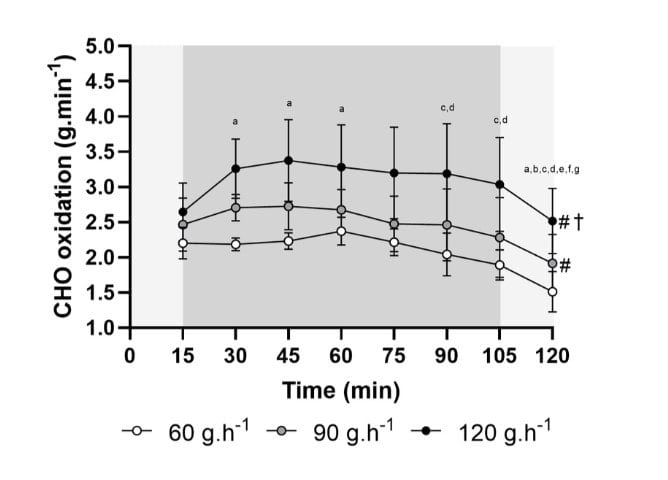
The more carbohydrate athletes consumed, the more they used. Exogenous carbohydrate oxidation increased from 0.89 g/min at 60 g/hour, to 1.31 g/min at 90 g/hour, and 1.68 g/min at 120 g/hour, with a peak value of 1.77 g/min—very high for running. Whole-body carbohydrate oxidation was also significantly higher at 120 g/hour (3.06 g/min) compared to 90 g/hour (2.46 g/min) and 60 g/hour (2.08 g/min). Notably, running economy improved with higher intake, with oxygen cost reduced by 2.6% at 120 g/hour vs 60 g/hour—suggesting athletes could sustain the same pace with slightly less metabolic strain.
But not all of the results were favorable for the higher carb intake. Every runner reported at least one moderate or severe GI symptom in every condition, but severity and frequency were highest at 120 g/hour (not surprising). Nausea, bloating, and stomach fullness were common.
What this means for runners
This study supports the physiological case for higher carbohydrate intake—especially 90 g/h or more—in long races run near marathon intensity. Elite runners burned more ingested carbs and became more metabolically efficient at 120 g/h, even though GI distress was common. For most athletes, a fueling target of 70–90 g/h strikes a better balance between performance and tolerability, especially when backed by consistent gut training. If you’re going to experiment with 100+ grams per hour, test it in race-specific workouts first—and be ready to dial back if your gut doesn’t cooperate. It might take more time to build up to be able to handle this amount during your next race.
RunClub — Free
Join 300,000+ runners in RunClub
Free training plans for every distance, a daily running game, exclusive coaching content, and a real community of runners. Create your free account in 20 seconds — no card.
Already a member? Log in →












Join the conversation
New? We did this in the 70s and 80s...it's about time someone "caught up"- funny