


Carbohydrates are usually framed as fuel. You eat or drink them, they get absorbed, they help maintain blood glucose and carbohydrate availability, and you perform better.
But carbohydrates can also act before they become fuel.

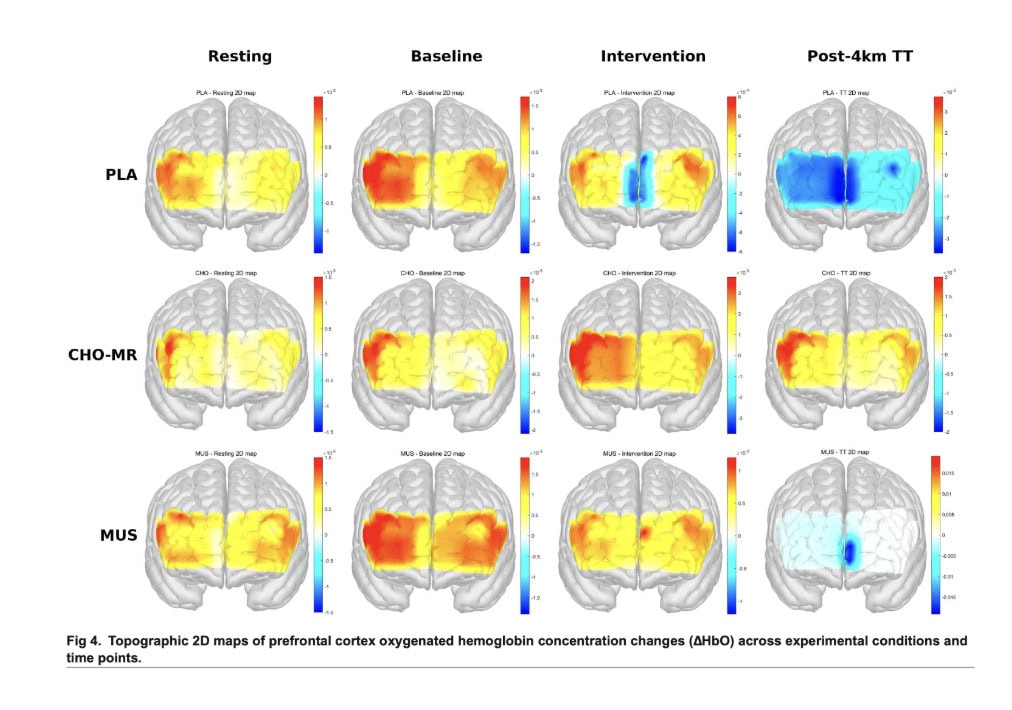
A recent randomized trial1Park, S.-B., Oh, K., Yang, G., Kim, T., Lee, J. W., Jeon, H.-J., & Han, D. H. (2026). Oral carbohydrate sensing enhances prefrontal cortex oxygenation, reduces perceived exertion, and improves high-intensity cycling performance: A randomized crossover trial. PloS One, 21(5), e0349067. https://doi.org/10.1371/journal.pone.0349067 tested carbohydrate mouth rinsing against music listening and a placebo mouth rinse during a hard 4-kilometer cycling time trial.
Eleven trained cyclists completed all three conditions. In the carbohydrate condition, they rinsed with a 6.4% maltodextrin solution—five 25 mL rinses, each swished for 10 seconds and spat out. The researchers measured prefrontal cortex oxygenation (essentially how much oxygen is in this particular brain region), executive function, perceived exertion every 500 meters, time-trial performance, heart rate, and blood lactate.
- The carbohydrate rinse increased oxygenation in both sides of the prefrontal cortex after the intervention and after the time trial compared with music and placebo.
- Executive function was also better after the time trial in the carbohydrate condition.
- Perceived exertion was lower with carbohydrate mouth rinsing than placebo at every distance interval, and lower than music through the middle of the trial.
- Performance improved modestly: completion time averaged 336.64 seconds with carbohydrate mouth rinsing, compared with 339.36 seconds with placebo and 339.43 seconds with music.
- Heart rate and lactate did not differ between conditions.
What this means for runners
For short, hard efforts—5Ks, final surges, hill reps, hard track sessions, or moments when your stomach does not want more fuel—carbohydrate mouth rinsing is a low-risk tool worth testing. It should not replace actual carbohydrate intake in longer races where metabolic fueling matters. But as a perceptual tool, especially late in a hard effort, swishing a carb drink and then spitting or swallowing, depending on the context, may help reduce effort just enough to hold pace. Treat it like you would any race strategy: practice it before race day.
References
RunClub — Free
Join 300,000+ runners in RunClub
Free training plans for every distance, a daily running game, exclusive coaching content, and a real community of runners. Create your free account in 20 seconds — no card.
Already a member? Log in →







Join the conversation
I\'m wondering how these results might (or might not) differ in fat-adapted athletes on a ketogenic diet with typically extremely low carb intake. I\'m assuming the athletes in the study are primarily carb-fueled, since most still are and there\'s no mention of the athletes\' diet in this article. Any insight on this or other relevant articles you know of?
I had already found this to be true in my own experience. As a result I found using cloff blocks as perfeect dosing. They come in a tube of six. I cut them in half and then I can quickly dispense a block or two and I found the boost to be almost immediate with chewing. I always thought it was psychological from the treat! Brian in NY