


The appeal of advanced footwear technology is easy to understand. Put on the shoe, spend less energy to run at the same pace, and… at least in theory… run faster.
The frustrating part is that the response varies. Some runners receive a large metabolic benefit, while others get little or none. A new study asked whether we can identify those runners before they buy the shoe.
Researchers recruited 64 runners—32 women and 32 men—aged 14 to 72. Each runner completed two six-minute treadmill trials in a carbon-plated racing shoe and two in a non-plated control shoe, all at 70% of the speed associated with their VO2 peak. The researchers also measured lower-leg strength, Achilles tendon stiffness, hamstring stiffness, foot posture, arch flexibility, and several other anatomical and neuromuscular characteristics.
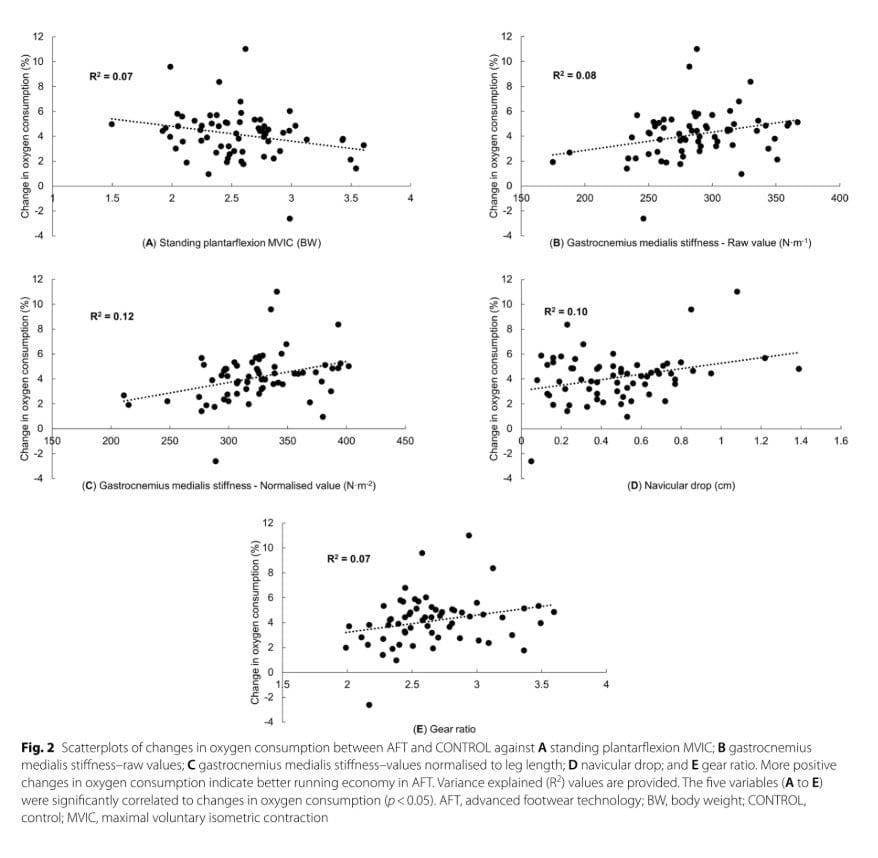
- On average, the advanced shoe improved running economy by 4.13%. The individual responses ranged from a 2.62% worsening to an 11.01% improvement, and 53 of the 64 runners improved by at least 2.5%.
That is an impressive average response. But the prediction part was much less impressive.
Runners who cleared the 2.5% threshold had greater hamstring stiffness. And calf-muscle stiffness and navicular drop—a measure of how much the arch of the foot lowers under load—were significant predictors of the shoe response.
But together, nearly four-fifths of the runner-to-runner response could not be explained by their individual characteristics or the researchers’ model.
What this means for runners
The reassuring finding is that most runners in this study did receive a meaningful running-economy benefit. The less satisfying finding is that a calf-stiffness test or arch measurement cannot yet tell you which shoe will work best for you.
So for now, treat anatomy as an interesting research clue, not a shopping rule. If the decision matters, compare shoes under repeatable conditions at a pace relevant to your racing. A lab test is the cleanest option, but even repeated, controlled workouts—paired with comfort, stability, and perceived effort—will tell you more than a single static foot measurement. The shoe that works for the average runner is not automatically the shoe that works for you.
RunClub — Free
Join 300,000+ runners in RunClub
Free training plans for every distance, a daily running game, exclusive coaching content, and a real community of runners. Create your free account in 20 seconds — no card.
Already a member? Log in →












Start the conversation