


For decades, the two-hour marathon was the running world’s defining ceiling. On Sunday, in front of an estimated 800,000 spectators in central London, Sabastian Sawe ran through it. The 31-year-old Kenyan finished the London Marathon in 1:59:30, becoming the first man to break the barrier in an official, record-eligible race.
Eliud Kipchoge already showed in 2019 that the human body could cover 26.2 miles under two hours, but his 1:59:40 in Vienna ran outside record conditions. Sawe’s run on Sunday is the one that counts on the books. The bigger question for everyone watching is what produced it. Details of his preparation, drawn from interviews his coach gave to The Guardian after the race, fill in most of the picture.
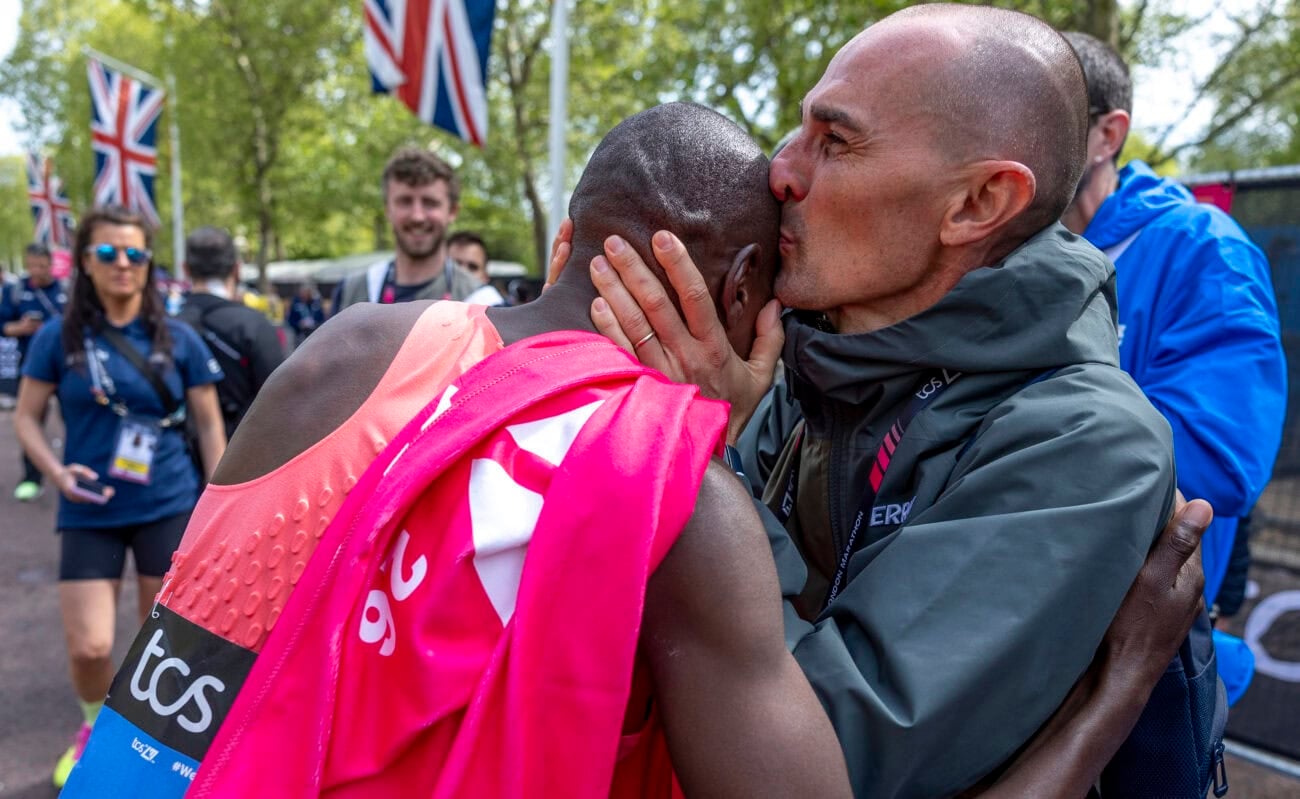
A training block built on volume
The most striking number from Sawe’s build-up is the weekly mileage. According to comments his coach Claudio Berardelli made to The Guardian, Sawe averaged more than 200 kilometres a week — about 125 miles — across the six weeks leading into London, and peaked at 241 kilometres, or roughly 150 miles, in his heaviest training week.
For context, that sits at the very top of the published range for elite marathon training. Eliud Kipchoge‘s coach Patrick Sang has spoken in past interviews about peak weeks of 200 to 220 kilometres for his athletes. The late Kelvin Kiptum was reported to be training at similar volumes before his death in February 2024. Sawe’s 241-kilometre peak puts him at, and arguably above, that ceiling.
It is also worth noting how new Sawe is to the distance. London was his fourth career marathon. Berardelli has suggested to The Guardian that the long-term physiological adaptations to the marathon take time, and that Sawe is still building toward his ceiling rather than racing at it. Whether or not that proves true, it is consistent with what exercise physiology says about marathon development: the aerobic adaptations from years of high-volume work tend to compound, not plateau.
For amateur runners reading the 150-mile-per-week figure, the takeaway is not to chase that number. Weekly mileage scales sharply with goal time, and most marathoners hit diminishing returns somewhere between 50 and 70 miles a week. The lesson is structural: the elite end of the sport still rests on a deep aerobic base, built over years rather than weeks.
A simple breakfast, modern in-race fueling
Sawe’s pre-race meal, his team confirmed to The Guardian, was bread and honey.
That detail caught attention because it is so unremarkable. Honey provides fast-digesting fructose and glucose. Bread supplies easily processed starch. Together they form a breakfast that costs almost nothing and sits well in the stomach. It is also broadly in line with the kind of pre-race meal coaches recommend to amateur runners — light, carbohydrate-heavy, and rehearsed.
The more interesting nutrition story is what happened on the course. Sawe used carbohydrate gels from Maurten, the Swedish brand whose hydrogel format is designed to carry sugar through the stomach with less GI distress than traditional gels. In-race carbohydrate intake at the elite level has climbed sharply over the past five years. Athletes who once consumed 30 to 60 grams per hour now routinely target 100 grams or more, and research suggests that higher number is well tolerated when the carbohydrate source is engineered for absorption.
That shift is the larger trend behind elite marathon times falling. The breakfast plate is more or less what it has always been. The race-day fueling, on the road, has changed substantially.

A 97-gram super shoe
On his feet, Sawe wore the Adidas Adizero Adios Pro Evo 3, the latest iteration of the brand’s flagship racer. According to Adidas’s own product description, the shoe is the first super shoe to come in under 100 grams.
That number is worth sitting with. A standard daily training shoe weighs between 240 and 290 grams. Most carbon-plated racers sit between 180 and 230 grams. Even the marathon spike of decades past was heavier than 100 grams. Adidas has effectively built a road shoe that approaches the weight of a track spike.
The performance case for lighter shoes is well-established. Each gram cut from a shoe is a gram the runner does not have to swing through roughly 40,000 footstrikes over a marathon. Research on carbon-plated super shoes generally shows running-economy improvements of around four to six percent — translated to time, that’s a couple of minutes over 26.2 miles for an elite. The Pro Evo 3 stacks a weight reduction on top of that effect.
The trade-off, well-documented in earlier Pro Evo models, is durability. The shoe is designed for a small number of races, not a training cycle. At Sawe’s level, that’s an acceptable cost. For most runners, it would not be.
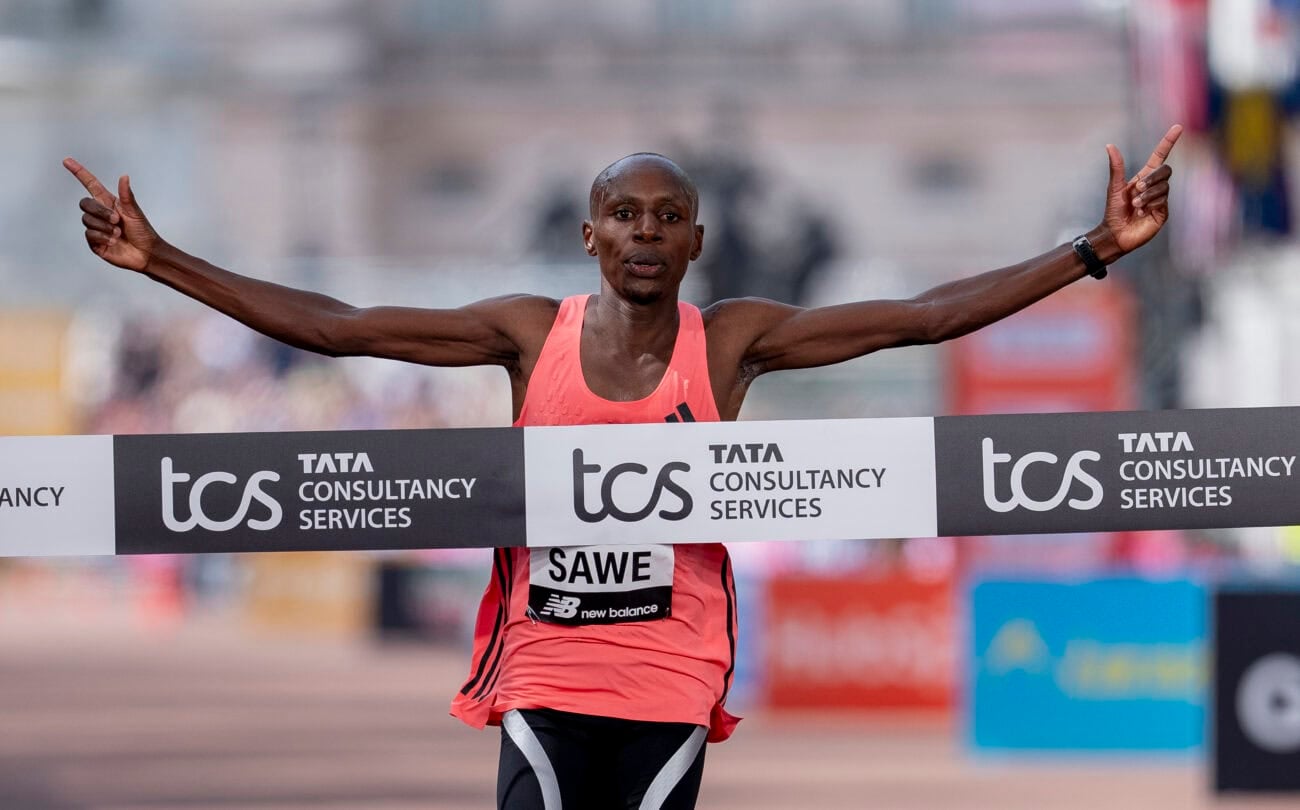
What Sawe said, and what comes next
Sawe’s first words after crossing the finish line, captured by reporters at the Mall, were a short statement that has already been quoted across the sport. “I have shown that nothing is not possible,” he said.
His coach has indicated to The Guardian that Sawe has not yet hit his ceiling, and that a flatter, faster course such as Berlin or Chicago could produce a quicker time still. That is the kind of claim coaches often make in the immediate aftermath of a record. Whether it holds up will depend on how Sawe’s body absorbs another full marathon block. London was, again, only his fourth attempt at the distance.
Steve Cram, the former 1500-metre world champion, called Sawe’s run a Bannister moment on BBC commentary, comparing it to Sir Roger Bannister’s first sub-four-minute mile in 1954. The comparison is not perfect — Kipchoge’s Vienna run already proved the physiological possibility — but it captures what Sunday meant. The first official sub-two marathon will be a reference point in the sport for as long as anyone is reading the record book.
RunClub
Get more running stories — join RunClub
Daily running news, a community of 300,000+ runners, free training plans for every distance, and a daily running game. Free to join — no card.
Already a member? Log in →












Start the conversation