


The ability to resist deterioration in running economy and other performance variables is increasingly referred to as durability or physiological resilience. A new study in the Scandinavian Journal of Medicine & Science in Sports asked what predicts it among recreational and competitive runners.1Malinen, T., Matomäki, P., Uusitalo, A., Kyröläinen, H., & Nuuttila, O. P. (2026). Determinants of Physiological Resilience Among Recreational‐To‐Competitive Endurance Runners. Scandinavian Journal of Medicine & Science in Sports, 36(7). https://doi.org/10.1111/sms.70349

Thirty-three recreational-to-competitive runners completed a long treadmill run near their first ventilatory threshold (the point where breathing rate starts to spike), surrounded by tests of running economy, VO2 max, peak speed, ventilatory thresholds, strength, jumping, fat oxidation, and maximal lactate production. The investigators then calculated how much each performance variable deteriorated.
Resilience depended on the outcome.
- Runners with higher VO2 max and faster threshold or peak speeds tended to preserve their first ventilatory threshold and peak speed better.
- Greater leg-press strength was associated with a smaller decline in running economy.
- Higher maximal lactate production was associated with a larger loss of peak speed.
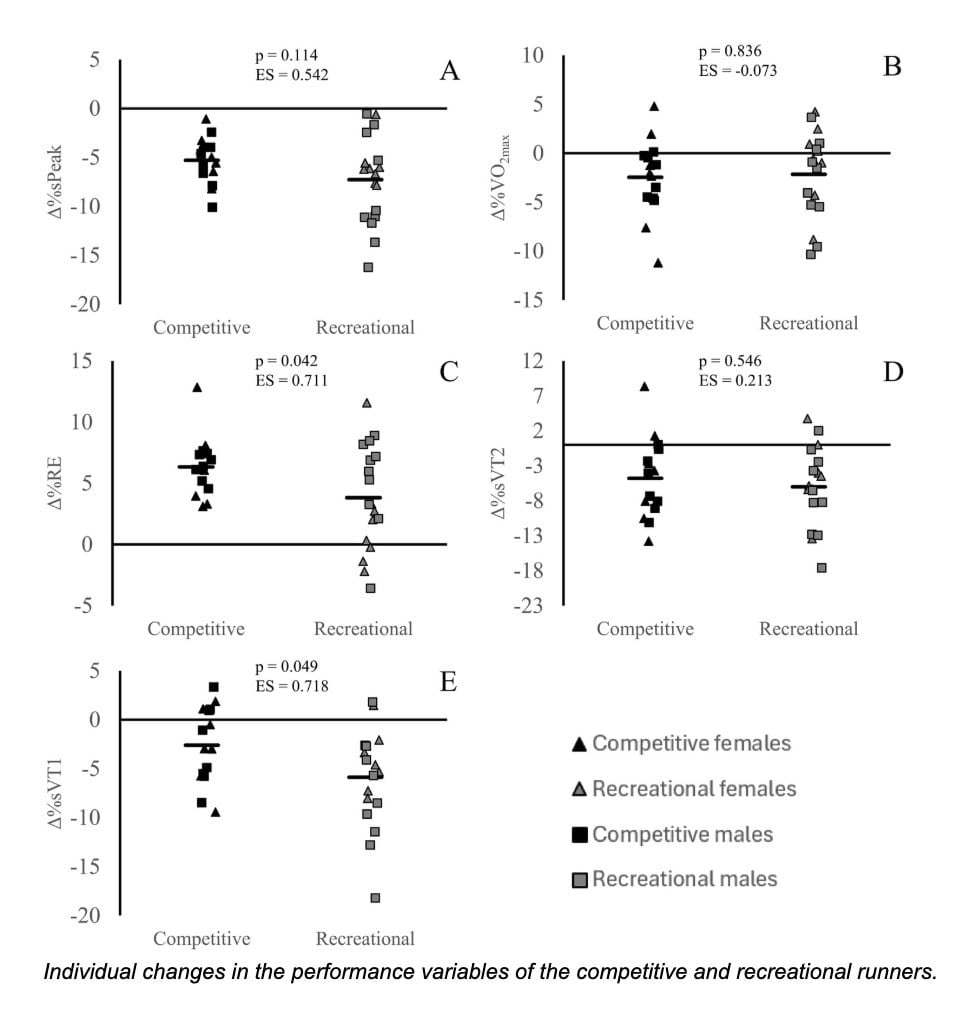
Competitive runners preserved their first ventilatory threshold better than recreational runners, yet recreational runners appeared to preserve running economy better. That last result needs care, though, because it seems that runners with worse economy at baseline had less deterioration, which may partly reflect less room to worsen.
What this means for runners
There may be no single “durability score.” Aerobic fitness, threshold speed, muscle strength, and carbohydrate-burning characteristics may protect different parts of your physiology.
For training, the safest inference is to build your aerobic ceiling, raise the speeds you can sustain below it (your threshold pace), and maintain strength. Those were the key variables here associated with better durability. Then occasionally evaluate those qualities after a long but controlled run, not only when fresh. This was a small correlational study, so it identifies candidates for durability training; it does not prove that improving any one variable will make you more durable.
References
RunClub — Free
Join 300,000+ runners in RunClub
Free training plans for every distance, a daily running game, exclusive coaching content, and a real community of runners. Create your free account in 20 seconds — no card.
Already a member? Log in →







Start the conversation