


For the last few decades, endurance runners have been told that performance comes down to three primary “pillars”: VO₂ max, threshold, and running economy.
VO₂ max is your aerobic ceiling. Threshold is how much of that ceiling you can use before things start getting ugly. Running economy is how much oxygen it costs you to hold a given pace. Put those three together, and you get a pretty good picture of why one runner can cruise at a 6:00 pace while another runner is hanging on for dear life.
This framework is often associated with Dr. Michael Joyner’s classic 1991 model of marathon performance, which estimated the limits of human marathon running based on these three physiological determinants. Since then, the model has become one of the foundational ways scientists, coaches, and endurance nerds think about performance.

A new study takes Joyner’s model1Mougin, L., Bailey, S. J., Jones, A. M., Joyner, M. J., Mears, S. A., Pearce, R., & Zanini, M. (2026). 35 Years of Joyner’s Endurance Performance Model: Assessing the Contribution of Physiological Determinants of Performance Proxies in 888 Individuals from Recreational to World Class. Sports Medicine. https://doi.org/10.1007/s40279-026-02439-y and asks what happens when you apply it to a large group of real runners and cyclists, ranging from recreational athletes to world-class performers. How much does each factor actually matter?
Researchers used a large dataset comprising 888 endurance athletes, including 495 runners and 393 cyclists. They examined how VO₂ max, exercise economy, and fractional utilization of VO₂ max related to the athletes’ speed or power at lactate threshold and lactate turnpoint. They wanted to know which physiological traits best explain why some athletes can sustain faster speeds or higher power outputs than others.
VO₂ max still matters… a lot. Economy matters a lot, too. But fractional utilization—the percentage of VO₂ max you can sustain at threshold—may not be as useful for separating faster and slower athletes as we often assume.
The classic endurance model
Before getting to the study, let’s review the three “pillars” from Joyner’s model. It’s so elegant because it breaks endurance performance down into three key components.
First, there is VO₂ max, the maximum amount of oxygen your body can take in, deliver, and use during intense exercise. For runners, this is usually expressed relative to body mass, like milliliters of oxygen per kilogram per minute. A bigger aerobic engine gives you more room to work with.
Second, there is fractional utilization of VO₂ max. This is the percentage of your VO₂ max you can sustain at a key threshold. Two runners might both have a VO₂ max of 60 ml/kg/min, but if one can run near threshold at 85% of VO₂ max and the other can only sustain 75% of VO₂ max, that matters.
Third, there is exercise economy. For running, this is basically the oxygen cost of running at a given speed. A more economical runner uses less oxygen at the same pace. This is why some athletes can run fast without looking like they’re working very hard. They are not necessarily tougher; they may simply be spending less energy to produce the same output.
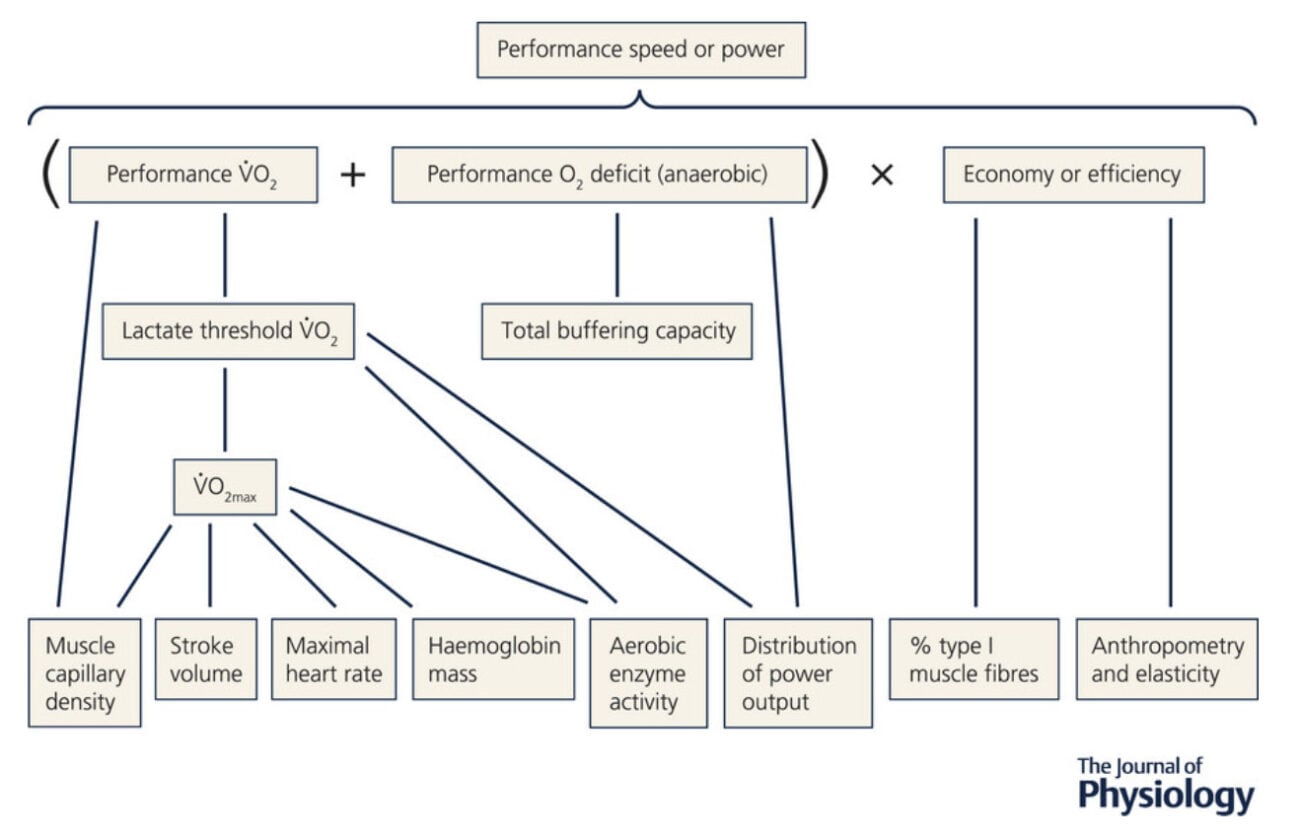
Together, these three factors can be used to estimate the speed or power an athlete can sustain at lactate threshold or lactate turnpoint. Lactate threshold is defined as the first rise in blood lactate above baseline, while lactate turnpoint represents a more rapid and sustained increase in lactate. The researchers used speed at these points for runners and power at these points for cyclists as performance proxies. That’s an important point—this study did not directly test marathon times, 5K times, or race outcomes. It measured physiological markers strongly related to endurance performance.
The study included 495 runners, 105 of whom were female, and 393 cyclists, 42 of whom were female. The participants ranged widely in ability, from recreational athletes to world-class performers.
Everyone completed lab-based incremental exercise testing. For runners, the test was performed on a treadmill. They ran in four-minute stages, with short rests for blood lactate sampling, while researchers measured oxygen uptake and ventilation. After the submaximal test, participants rested for 15–20 minutes and then completed a separate ramp test to exhaustion to determine VO₂ max. For cyclists, the protocol was similar but performed on a smart trainer or cycle ergometer. They completed four-minute stages with increasing power, blood lactate sampling, and gas exchange measurements, followed by a ramp test to exhaustion.
From these tests, the researchers calculated:
- VO₂ max, either relative to body mass for runners or absolute for cyclists.
- Exercise economy, meaning oxygen cost per running speed or cycling power.
- Fractional utilization at lactate threshold and lactate turnpoint.
- Speed or power at lactate threshold and lactate turnpoint.
They then asked two big questions. First, how strongly does each physiological trait relate to threshold speed or power? Second, how much does each trait contribute to the overall prediction of performance proxies?
VO₂ max is still the heavyweight
VO₂ max was the strongest predictor of performance proxies in both runners and cyclists.
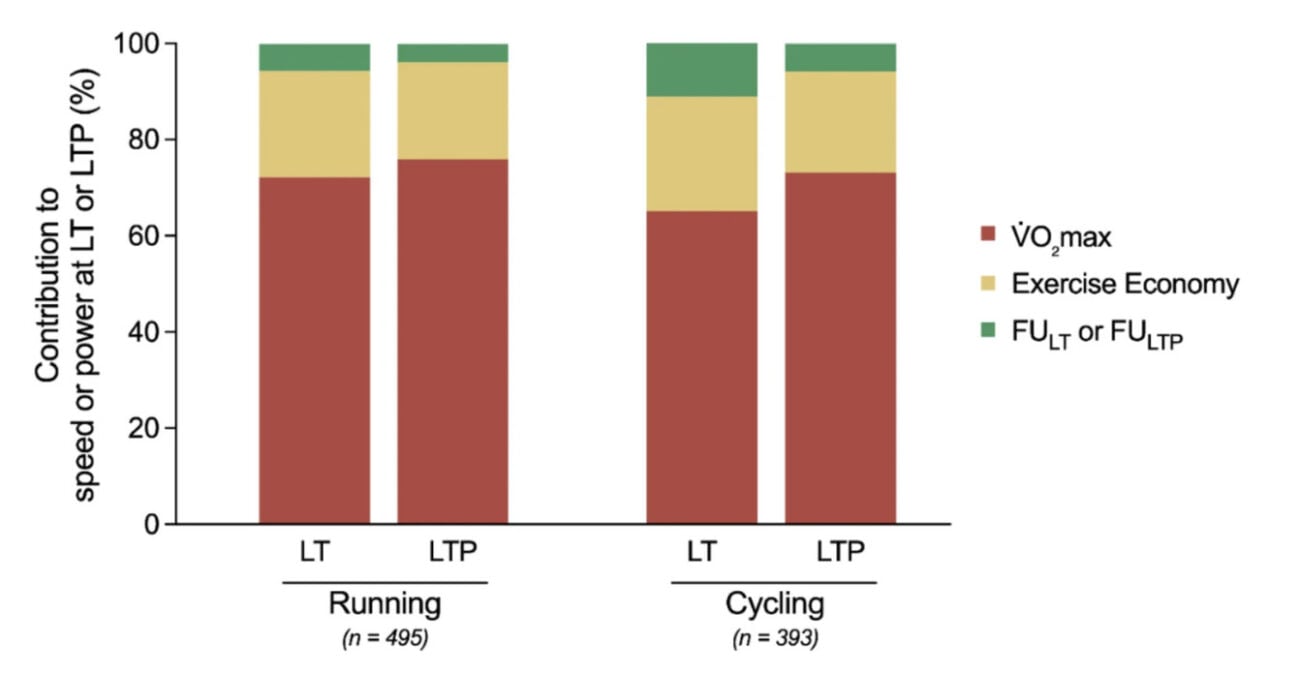
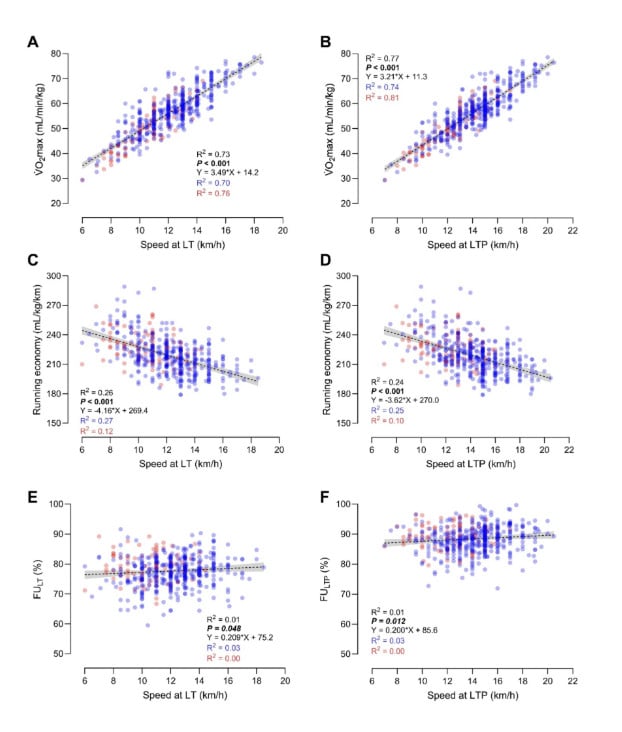
- In runners, VO₂ max explained about 73% of the variation in speed at lactate threshold and 77% of the variation in speed at lactate turnpoint.
- In cyclists, VO₂ max explained about 65% of the variation in power at lactate threshold and 71% at lactate turnpoint.
This means that when you look across a broad range of athletes, those with larger aerobic engines tend to be faster. There are exceptions, of course, and exceptions are often the most interesting cases. But at the population level, VO₂ max remains the physiological variable that most clearly separates lower-performing from higher-performing endurance athletes.
This is where I think endurance discussions sometimes overcorrect. Because VO₂ max is not everything, people sometimes talk as if it’s almost nothing. That’s wrong. VO₂ max is not destiny, but it is still one of the biggest determinants of endurance potential.
The key nuance is that VO₂ max becomes less useful when you compare athletes who are already very similar. If you take a group of elite runners with VO₂ max values clustered in a narrow range, economy, durability, fueling, biomechanics, tactics, and threshold characteristics may explain more of the difference. But if you compare recreational runners, competitive amateurs, sub-elites, and elite athletes (as this study did), VO₂ max will do a lot of explanatory work.
The second big contributor was exercise economy.
- For runners, economy accounted for about 20–22% of the contribution to speed at the lactate threshold and lactate turnpoint.
- For cyclists, cycling economy contributed about 21–24%.
This is especially important because economy is trainable. And for runners, it reinforces something I think is underappreciated—you can become faster without dramatically changing your VO₂ max. If your oxygen cost at a given pace decreases, your sustainable speed improves even if your aerobic ceiling stays the same.
That’s one reason long-term development matters. Years of mileage, workouts, strength, hills, and strides may gradually make paces feel “cheaper.”
Fractional utilization of VO₂ max—the percentage of VO₂ max used at lactate threshold or lactate turnpoint—contributed far less to performance differences than VO₂ max or economy.
- In runners, fractional utilization contributed about 5.6% to speed at lactate threshold and 3.8% to speed at lactate turnpoint.
- In cyclists, it contributed about 11% at lactate threshold and 5.8% at lactate turnpoint.
That does not mean threshold does not matter. It absolutely does.
But it does suggest that when you look across a broad range of athletes, fractional utilization is not very good at distinguishing who is faster. A recreational runner with a relatively low VO₂ max might operate at a high percentage of that VO₂ max at threshold (i.e., they have a higher fractional utilization). Meanwhile, a better-trained runner with a much higher VO₂ max might have a similar or even lower fractional utilization but still run much faster because the aerobic engine is much larger.
Here’s a simple way to think about it.
Runner A has a VO₂ max of 45 and can sustain 85% of it.
Runner B has a VO₂ max of 65 and can sustain 78% of it.
Runner A may look better if you only focus on fractional utilization. But Runner B is almost certainly faster because 78% of a much larger engine is still a bigger absolute output.
This is why “threshold as a percentage of VO₂ max” can be misleading. What matters most in performance is not just the fraction. It is the actual speed or power you can produce at threshold.
That distinction is huge for runners. We often talk about improving lactate threshold as if the goal is to push threshold closer and closer to VO₂ max. But from a practical standpoint, the goal is to run faster at threshold. That can happen because VO₂ max improves, economy improves, fractional utilization improves, or some combination of all three.
The lactate threshold and lactate turnpoint relationship
Another useful finding was that the lactate threshold and the lactate turnpoint were strongly related.
In runners, speed at lactate threshold and speed at lactate turnpoint were almost perfectly correlated. The same was true for cyclists using power. The researchers also found that the ratio between LT and LTP was fairly consistent.
For runners, lactate threshold occurred at about 86% of lactate turnpoint speed. For cyclists, lactate threshold occurred at about 79% of lactate turnpoint power.
This could have practical value. If an athlete knows one marker, it may be possible to roughly estimate the other. That does not replace lab testing, and it does not solve all the messy problems of threshold definitions, but it gives coaches and athletes a useful anchor.
The heart rate data were also interesting. In runners, lactate threshold occurred around 85–86% of maximum heart rate, while lactate turnpoint occurred around 93–94%. In cyclists, lactate threshold was around 79–80% of maximum heart rate, while lactate turnpoint was around 89–90%.
I would be careful not to turn these into rigid universal zones. Heart rate is influenced by heat, fatigue, hydration, caffeine, altitude, sleep, and stress. But for runners without lab access, these values are at least a reasonable starting point for thinking about intensity.
The biggest strength of this study is the sample size.
Many endurance physiology studies include 10, 15, or 20 participants. This study included 888 athletes. That gives the researchers a much better chance of seeing broad patterns across ability levels.
The study also included both runners and cyclists, both males and females, and athletes ranging from recreational to world-class. That makes the findings more useful than studies limited to a tiny group of homogeneous athletes.
The main limitation is that this study did not directly measure race performance. It used speed or power at lactate threshold and lactate turnpoint as performance proxies.
Those are meaningful proxies, but racing is messier. A marathon is not just a lab test stretched over 26.2 miles. Real-world performance includes pacing, fueling, weather, terrain, muscle damage, psychology, tactics, biomechanics, and durability. In fact, durability may be the biggest missing piece here.
The classic Joyner model focuses on VO₂ max, fractional utilization, and economy, but endurance performance is increasingly being understood through a fourth lens: how well these variables hold up under fatigue. A runner’s economy at mile 3 of a marathon-pace workout is useful. Their economy at mile 23 of a marathon is probably more important.
Two runners may have identical VO₂ max, threshold, and economy when fresh, but one may maintain those traits after two hours of running while the other deteriorates. That is performance durability, and it may help explain why some athletes are much better racers than their lab values suggest.
What this means for runners
This study is a nice reminder that endurance performance is both simple and complicated.
The simple version is that faster runners usually have a bigger aerobic engine and better economy. That was true 35 years ago, and it is still true now.
The more complicated version is that athletes can achieve similar performances through different physiological routes. One runner wins with a giant VO₂ max. Another survives with beautiful economy. Another has an excellent threshold. Another is unusually durable late in long races. The best runners often have several of these traits stacked together, but the combination is not identical for everyone.
That’s why I think the most useful takeaway from this paper is not “VO₂ max is everything” or “threshold doesn’t matter.” Both of those interpretations miss the point.
The point is that physiology gives us a map. VO₂ max tells us how big the engine is. Economy tells us the cost of movement. Fractional utilization tells us how much of the engine can be used sustainably. Durability tells us whether those traits withstand fatigue.
For runners, the art is figuring out which part of the map needs the most attention right now.
Sometimes you need to build the engine.
Sometimes you need to become more economical.
Sometimes you need to raise the speed you can sustain.
And sometimes you need to stop chasing better lab numbers and learn how to hold your form, fuel your body, and stay strong.
References
RunClub — Free
Join 300,000+ runners in RunClub
Free training plans for every distance, a daily running game, exclusive coaching content, and a real community of runners. Create your free account in 20 seconds — no card.
Already a member? Log in →










Start the conversation