


Endurance training is often associated with building, literally, a bigger heart. And that’s often used to explain why training improves aerobic fitness and performance. A new Open Heart study emphasizes the other half of the oxygen-delivery equation: what the working muscles remove from the blood, and why this might lead to better “efficiency” among runners.

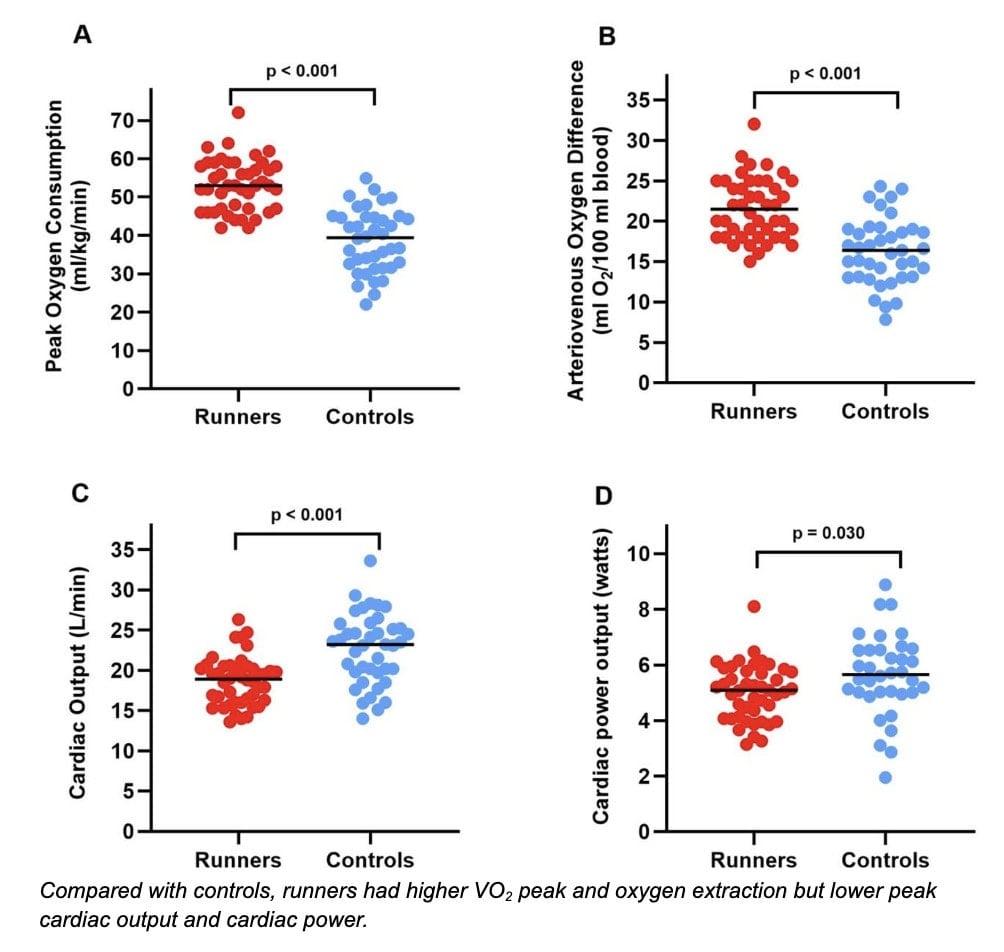
Researchers compared 44 male recreational half- and full-marathon runners with 41 untrained men during maximal cycling exercise. The runners reached a much higher VO2 peak—53.2 versus 38.7 mL/kg/min—and produced more peak power. Yet their peak cardiac output (the volume of blood leaving the heart each minute) was lower: 18.7 versus 22.6 L/min.
The difference was in peripheral oxygen extraction. The runners’ estimated arterial–venous oxygen difference (reflecting how much oxygen is taken up by working muscles) reached 21.6 versus 15.9 mL of oxygen per 100 mL of blood, about 30% higher. The trained group achieved greater whole-body oxygen consumption while extracting more oxygen from each unit of blood and producing less peak flow from the heart. The authors describe this as reduced cardiac workload and potentially cardioprotective.
What this means for runners
Fitness is not only about pumping more blood. Capillaries, mitochondria, enzymes, and oxygen diffusion inside muscle determine how much useful work each liter of blood can support. That is one reason consistent aerobic volume matters. This study shows us that (unsurprisingly), the hearts of endurance-trained individuals may not have to work as hard to accomplish the same, or greater, amounts of oxygen delivery.
RunClub — Free
Join 300,000+ runners in RunClub
Free training plans for every distance, a daily running game, exclusive coaching content, and a real community of runners. Create your free account in 20 seconds — no card.
Already a member? Log in →












Start the conversation