


Marathon running is good for you. Marathon running is also a massive physiological stressor. Both things can be true.
A new systematic review and meta-analysis1Laily, I., van Steijn, N., Rizki, P., de Vries, R., Liastuti, L. D., Zwinderman, A. H., Verhagen, E., Bakermans, A. J., & Jorstad, H. T. (2026). Acute effects of marathon running on the heart: a systematic review and meta-analysis. BMJ Open Sport & Exercise Medicine, 12(2), e003201. https://doi.org/10.1136/bmjsem-2026-003201 looked at the acute (short-term) effects of marathon running on the heart. The researchers included studies of healthy adults who completed a road marathon and had cardiac measurements before and after the race.

In total, 69 studies were included in the systematic review, covering 3,274 participants, mostly men, generally aged 30 to 55 years. Forty-nine studies were included in the meta-analysis. The researchers looked at cardiac biomarkers, echocardiography, and cardiac MRI.
Marathon running consistently increased circulating markers associated with cardiac stress or injury.
- Troponin T increased by about 42.4 ng/L.
- Troponin I rose by about 74.5 ng/L.
- NT-proBNP increased by about 113.8 ng/L.
Troponins are used clinically when evaluating possible heart injury. But context matters. In endurance athletes, post-race biomarker elevations are common, often transient, and do not automatically mean pathological damage.
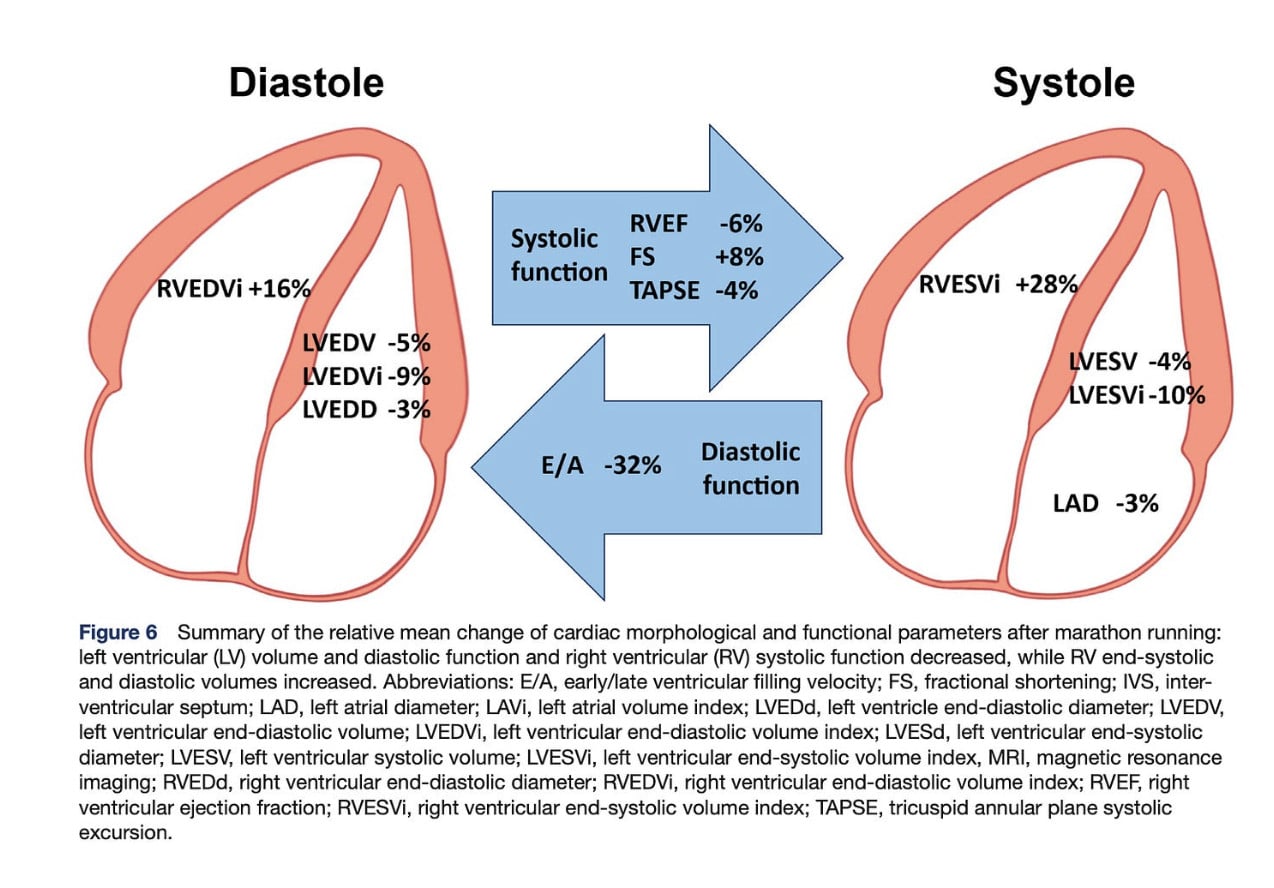
The imaging data helps make sense of what was happening inside the heart after the marathon. Broadly, the heart looked like it had just done a very hard workout—which, of course, it had. The left ventricle, the main chamber that pumps oxygen-rich blood to the body, held slightly less blood at the end of filling, with left ventricular end-diastolic volume dropping by about 6.5 mL, or roughly 5%. That suggests the heart was filling a little less completely after the race.
The bigger pattern was a temporary shift in how the heart relaxed, filled, and pumped after 26.2 miles. Measures of left ventricular diastolic function—basically how well the heart relaxes and fills between beats—decreased. Early filling velocity dropped by 12.7 cm/s, while late filling velocity increased by 13.1 cm/s, meaning the heart appeared to rely more on the final “push” from the atria to fill the ventricle. The E/A ratio, a common marker of this filling pattern, fell by about 33 percent.
The right side of the heart also showed signs of strain. The right ventricle, which pumps blood to the lungs, had larger end-diastolic and end-systolic volumes after the marathon. In simple terms, it was holding more blood before and after contraction. Right ventricular ejection fraction dropped by about 3.5 percentage points, and TAPSE—a measure of how strongly the right ventricle contracts—declined slightly.
Together, these changes suggest that after a marathon, the heart may pump a bit less efficiently for a short period, especially on the right side, while also showing signs of altered filling on the left side.
The authors emphasize that the magnitude of these changes was generally modest and often remained within normal, physiological ranges. Cardiac MRI, which is better for structural assessment, showed a small increase in left ventricular ejection fraction and no clear signs of clinically meaningful structural heart muscle injury in the available data.
The marathon appears to produce acute cardiac stress, but the meaning of that stress depends on the runner. Responses varied by age, sex, training status, and finish time. NT-proBNP increased more in studies with longer marathon finish times, older participants, and a higher proportion of women. Troponin I tended to be higher in less-trained cohorts.
That does not mean slower runners are damaging their hearts. But it does suggest that preparation matters. A marathon is not just 26.2 miles on race day. It is the cardiovascular load of the race layered on top of your training history, age, health status, heat exposure, pacing, hydration, and recovery.
What this means for runners
This study should not scare healthy runners away from marathons. But it should make us respect the distance. A marathon is an acute cardiac stress test, especially for underprepared runners, older athletes, and anyone with symptoms or known cardiovascular risk. Train progressively, do not race marathons off chaotic preparation, and take post-race recovery seriously. And of course, consult a healthcare professional if you’re ever unsure about your personal risk.
References
RunClub — Free
Join 300,000+ runners in RunClub
Free training plans for every distance, a daily running game, exclusive coaching content, and a real community of runners. Create your free account in 20 seconds — no card.
Already a member? Log in →












Start the conversation