


Runners talk about discipline and consistency as if they were mostly a character trait. Some people have it, others do not.
But a new study suggests1Blacket, C. T., Skejø, S., Nielsen, R. Ø., Fuller, J. T., Bennett, H., Crozier, A. J., & Arnold, J. B. (2026). Why do we run? A cross-sectional analysis of motivation profiles and training characteristics in the Garmin-RUNSAFE Running Health Cohort Study. Journal of Science and Medicine in Sport, S1440-2440(26)00235-5. https://doi.org/10.1016/j.jsams.2026.06.004 consistency may depend partly on the quality of your motivation.

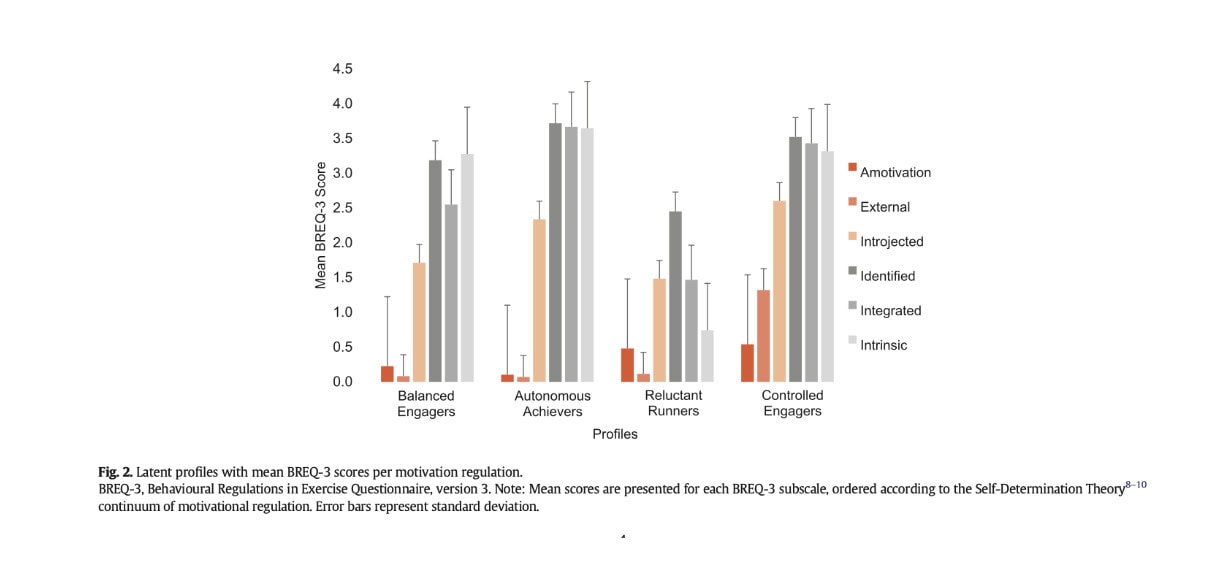
Researchers analyzed data from 2,278 runners in the Garmin-RUNSAFE Running Health Study. Participants completed the BREQ-3 questionnaire, which assesses different types of exercise motivation along the self-determination theory continuum: from amotivation to external pressure to more autonomous forms such as identified, integrated, and intrinsic motivation. The researchers then compared these motivation profiles with GPS-derived running data from the previous four weeks.
They identified four profiles.
- “Autonomous achievers” made up the largest group, at 1,379 runners, or 60.5% of the sample. These runners had high levels of identified, integrated, and intrinsic motivation, with low levels of controlled motivation.
- “Balanced engagers” made up 620 runners.
- “Reluctant runners” were the smallest group, with 117 runners, and had higher amotivation and lower autonomous motivation.
- “Controlled engagers,” at 162 runners, had moderate autonomous motivation but higher external and amotivation scores.
The training differences were meaningful. Autonomous achievers ran a median of 3.0 times per week, 161.5 minutes per week, and 17 miles (27 kilometers) per week. Reluctant runners ran 1.5 times per week, for 57.8 minutes per week, and 6 miles (9 kilometers) per week. Controlled and balanced engagers sat in the middle, with around 2.5 runs per week and about 12 miles (19 kilometers) per week.
What this means for runners
You can’t wait until you feel perfectly motivated to go for a run or workout. The key is to build a training life that makes autonomous motivation more likely. Choose goals that actually matter to you, not just goals that look impressive online. Keep some runs social, some exploratory, and some performance-focused. Give yourself enough structure to progress, but enough flexibility that running still feels like something you get to do rather than something you are failing to keep up with.
For coaches, this is a reminder that adherence is not just about prescribing the right mileage. It is about helping runners connect the work to values, identity, enjoyment, and ownership.
References
RunClub — Free
Join 300,000+ runners in RunClub
Free training plans for every distance, a daily running game, exclusive coaching content, and a real community of runners. Create your free account in 20 seconds — no card.
Already a member? Log in →











Start the conversation