


I love a good study that uncovers a new training technique, supplement, or tip to prevent injury. But as an exercise scientist, there’s nothing I enjoy writing about more than “classic” physiology studies. That’s what you’re getting today…
This one deals with one of the oldest ideas in exercise physiology: that exercise falls neatly into “aerobic” (with oxygen) or “anaerobic” (without oxygen) buckets. Sprinting is anaerobic. Distance running is aerobic. Simple, clean… and mostly wrong.

A new review paper1Gastin, P. B., & Suppiah, H. T. (2026). Anaerobic and Aerobic Energy System Contribution During Maximal Exercise: A Systematic Review. Sports Medicine. https://doi.org/10.1007/s40279-026-02414-7 makes it clear that the body has never cared much for our tidy categories. From the first few seconds of hard exercise, all of the major energy pathways are already contributing. The only thing that changes is which one is doing more of the work.
A little history helps here. The review traces how this conversation began more than a century ago, when early physiologists began measuring oxygen uptake during and after exercise.
Those early studies led to the concept of “oxygen deficit,” essentially the gap between how much oxygen an effort would theoretically require and how much oxygen the body had actually consumed up to that point. That gap became a way to estimate the anaerobic contribution.
Later, in 1965, researchers introduced the critical power concept, which provided the field with another framework for thinking about sustainable exercise intensity versus the finite amount of effort you can expend above it.
Then, in 2001, a researcher named Paul Gastin published a review that became the classic reference on energy system contributions during maximal exercise. This new paper is basically an update to that older framework.
At the center of all of this is ATP, the immediate energy currency for muscle contraction. ATP stores in muscles are limited, so the body has to continuously produce it through three main pathways: the phosphagen system, glycolytic metabolism, and oxidative phosphorylation.
- The phosphagen system is the fastest and most explosive. It relies heavily on phosphocreatine and is perfect for the opening seconds of an all-out effort.
- Glycolysis is also fast, using carbohydrates without requiring oxygen, but it comes with a more limited capacity and greater metabolic disruption (lactate production being one such consequence).
- Oxidative phosphorylation ramps up more slowly, but it has a huge capacity and can supply energy for a long time (as long as oxygen delivery and mitochondrial metabolism can keep up).
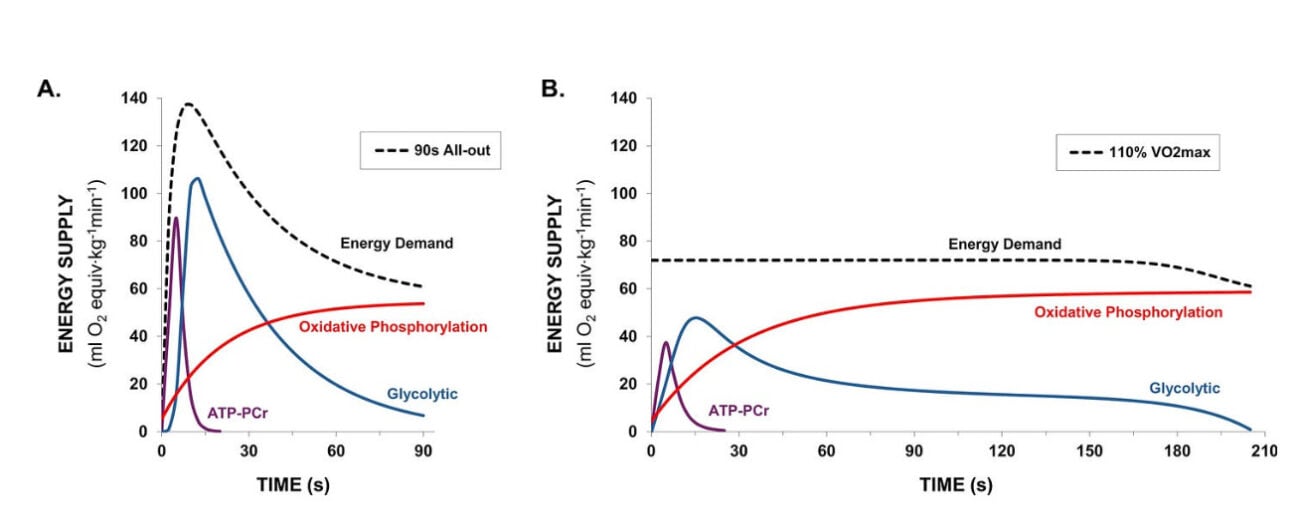
The important point is that these systems do not take turns. They overlap from the start.
The authors explicitly argue that no single system is responsible for exercise beyond the first few contractions. A predominant system emerges depending on intensity and duration, but all three pathways are engaged together. That matters because a lot of running language (and exercise language in general) still treats the 400-meter run as “anaerobic,” the 5K as “aerobic,” and the mile as some weird in-between purgatory. Physiologically, that framing is too crude to be useful.
Updating the science
So what did the researchers actually do for this update? They systematically searched seven databases from 1984 through January 2020 and identified 102 studies and 311 data points. Most of the data came from running and cycling, with smaller amounts from swimming, kayaking, skiing, rowing, climbing, and arm-crank exercise. Participants were mostly trained adults, mostly male, and the exercise bouts ranged from 6 seconds to 1,686 seconds. They then modeled how aerobic and anaerobic contributions to energy production changed over the duration of maximal-intensity exercise.
The authors’ model estimated that:
- A maximal 10-second effort is about 91% anaerobic and 9% aerobic.
- At 20 seconds, it is 82% anaerobic and 18% aerobic.
- At 30 seconds, 75% anaerobic and 25% aerobic.
- At 60 seconds, already 58% anaerobic and 42% aerobic.
Then comes the number that should make every runner stop and think: equal contribution from aerobic and anaerobic systems occurred at 78.6 seconds (scientists love to be precise).
- By 90 seconds, the balance had already tipped to 54% aerobic and 46% anaerobic.
- At 2 minutes, the model landed at 62% aerobic.
- At 3 minutes, 72% aerobic.
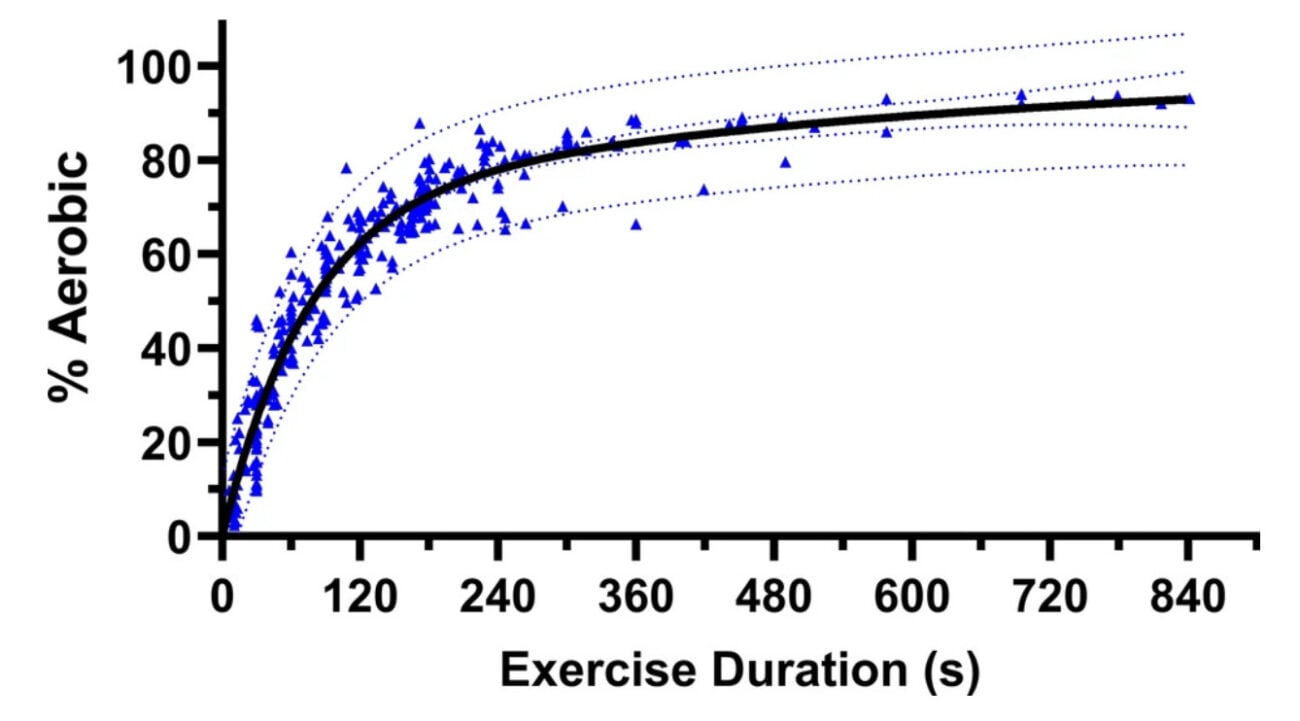
That is the real headline. The aerobic system becomes important much earlier than most people assume. The review also notes that oxygen uptake increases more rapidly during high-intensity exercise than traditionally appreciated, and that faster oxygen kinetics can improve speed-endurance and delay fatigue.
That should perk up your ears because it suggests a potential race-day strategy. All-out or fast-start efforts appear to accelerate oxygen uptake compared with constant-pace efforts, which may help spare a bit of finite anaerobic capacity early in the effort.
In other words, how fast you can get your aerobic system “online” matters even in events that people love to call “anaerobic.” It also means that starting your primarily aerobic marathon with a faster start can “rev the engine” of sorts.
The main limitation is that the precision of the exact percentages should not be overstated. The paper reports a prediction error of around 12-14%, and the estimates combine studies with very different exercise modes, pacing strategies, assumptions, and measurement methods. So I would not treat 78.6 seconds like some magical law of nature. But as a trend, the message is extremely convincing: aerobic metabolism is not the late-arriving backup generator that we’ve spoken about for so long. It is involved early, ramps fast, and becomes dominant sooner than many runners think.
What this means for runners
This review is a good correction to the way we often talk about training. The 400-, 600-, and 800-meter hard hill reps, and even a lot of mile-paced work, are not just tests of anaerobic grit or lactate tolerance. They are heavily shaped by aerobic fitness, especially how fast you can ramp oxygen use at the start of the rep (or intensify your warmup to ramp it up before the workout starts) and how well you can spare your finite anaerobic capacity.
Your aerobic base is not just for long races. It supports almost everything. So pacing matters more than people think. An effort that starts too aggressively can burn through limited anaerobic reserves before the aerobic system has fully ramped, while smart fast-start work in training may teach the body to engage oxygen delivery more quickly. The practical takeaway is that if you want to race hard from 1 minute to several minutes, do not think in either-or terms. Train the engine and the matchbook.
And let’s stop using “aerobic” and “anaerobic”… it’s just not really correct.
References
RunClub — Free
Join 300,000+ runners in RunClub
Free training plans for every distance, a daily running game, exclusive coaching content, and a real community of runners. Create your free account in 20 seconds — no card.
Already a member? Log in →












Join the conversation
Welcome to the 21st century. Coaches who have done any bit of coaching education have known this for a while now. The idea that the 400 is primarly aerobic has been known since Tom Tellez. And that all the systems work together…no one really thinks there’s an on/off switch. This is such a strawman argument and the author is so credulous to the latest scientific study. He hasn’t bothered to check what real coaches are doing, and have been doing for years.
It also doesn’t matter that much that people use aerobic or anaerobic as a shorthand for different types of training. The actual training doesn’t change: you still have to run some short fast stuff and some longer, steady stuff, and sometimes long fast stuff.
The sports science required to understand distance running is taught in high school phys ed. It’s not complicated and it’s not that important unless and until there’s some study that suggests training in a different way will result in performance increases. Even double threshold isn’t new…it’s from the 80s!