


Sometimes, sleeping after hard training is weird. You feel wrecked, yet you don’t necessarily sleep better. That can be especially true if the workout has additional stressors like heat.
A new study1Keefe, M. S., Dunn, R. A., Appell, C. R., Jiwan, N. C., Luk, H.-Y., Rolloque, J.-J. S., & Sekiguchi, Y. (2026). The Effect of Muscle-Damaging Exercise in the Heat on Sleep. Sports Health, 19417381261423565. https://doi.org/10.1177/19417381261423565 asks what happens when you combine muscle-damaging exercise with heat. Does the extra thermal stress make sleep worse, as you might expect? Or does it simply make you more tired and increase sleep?
The researchers took 10 healthy, physically active young men and had them complete two downhill running trials in a randomized crossover design. One trial was done in a control environment at 68℉/20°C and 20% humidity, and the other in a hot environment at 95℉/35°C and 40% humidity. The workout itself was 30 minutes of downhill running at a -10% gradient at each participant’s lactate-threshold speed, which is a pretty efficient way to create eccentric muscle damage. Then, seven days later, they also completed a 45-minute flat run in the heat. Sleep was tracked with a WHOOP device the night after the downhill run, for the following six nights, and again after the later flat run.
The heat trial clearly created more physiological strain during the downhill run.
- Heart rate, core temperature, and skin temperature were all higher in the hot condition than in the control condition.
But the key result is that sleep did not get worse after the hot, muscle-damaging run. It actually got longer.
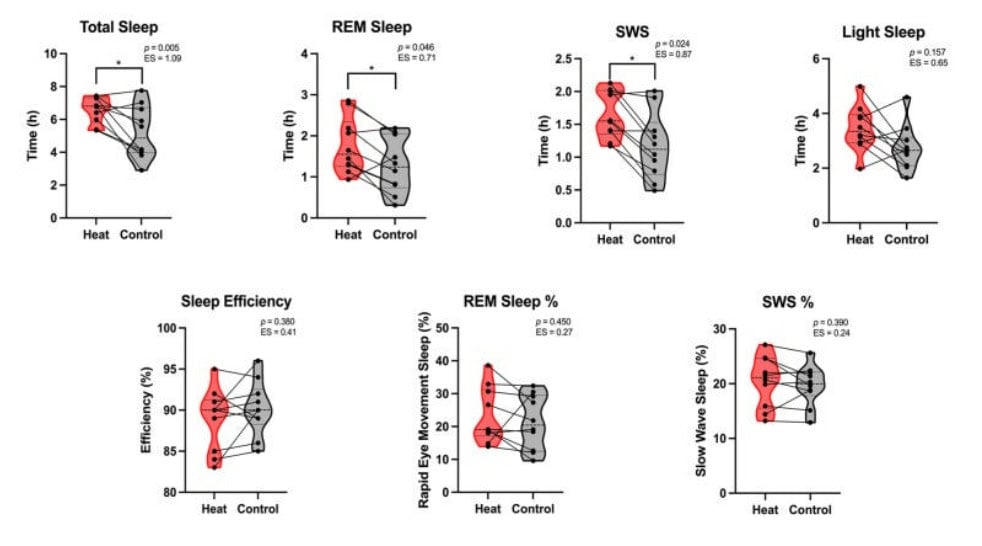
- On the night after downhill running in the heat, total sleep time was about 6.7 hours versus 5.2 hours in the control.
- REM sleep was also greater, about 1.7 versus 1.2 hours
- Slow-wave sleep increased too, from about 1.2 to 1.6 hours.
That sounds, at first glance, like the hot condition improved recovery sleep in a meaningful way. But there is an important catch: the percentages of REM and slow-wave sleep did not change. Sleep efficiency did not change either. In other words, the runners were not getting “better-quality” sleep in the sense of a different sleep architecture. They just slept longer, and because they slept longer, they accumulated more REM and more slow-wave sleep in absolute terms.
Over the next six nights after the downhill run, there were no meaningful differences in any sleep variable between conditions. There were also no differences after the later 45-minute flat run in the heat. So whatever happened here was really a one-night effect, not a lasting disruption or lasting enhancement.
What this means for runners
If you do a hard downhill workout, a hilly race, or a muscle-damaging long run in the heat, don’t assume your sleep will automatically be worse that night. This study suggests you may actually sleep longer, likely because the combined training stress increases your need for recovery. The practical move is to make room for that recovery rather than fight it. Give yourself a longer sleep window after especially demanding sessions in the heat, and do not misinterpret feeling unusually sleepy as a bad sign. At the same time, do not overread this as proof that heat boosts recovery. The bigger lesson is that hot, eccentric sessions increase overall strain, and one smart response is simply allowing more time in bed that night instead of trying to cram recovery into the same schedule you’d use after a normal workout.











Start the conversation