


What’s the best way to organize your training throughout the year?
This is a common question among runners—how to properly periodize training—second only to how we should distribute our training across low-, medium-, and high-intensity training zones (known as training intensity distribution).
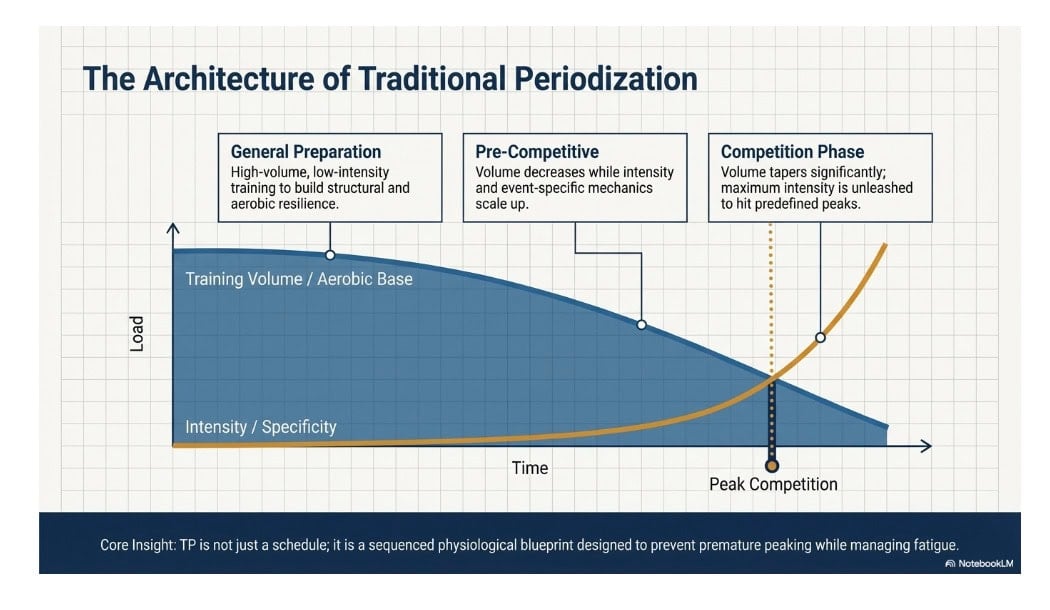
Traditional periodization is the classic model. Training usually starts with higher volume and lower intensity, then gradually shifts toward lower volume, higher intensity, and more race-specific work as competition approaches. It is the most widely used model in endurance sport because it is structured, predictable, and easy to organize across a full season.
But every few years, a different training model is positioned as the smarter, more modern alternative to what came before. Block periodization. Flexible periodization. More individualized planning. More responsive training. And to be clear, those ideas matter. But a new paper asks why, if newer models are so compelling, traditional periodization still dominates elite endurance sport (see below for an overview of the different approaches).

That’s the central theme of a new paper. The authors are not arguing that traditional periodization is perfect, or that it should replace every other model. They argue that traditional periodization still shapes modern sport because it remains practical, intuitive, adaptable, and deeply embedded in the way coaches think about building a season. In other words, it has survived not because coaches are blindly loyal to the past, but because it continues to solve real problems of coaches and athletes.
Before we get to the paper, it is worth noting what kind of paper this is. This is an invited commentary, not a new experimental study. So it’s more about synthesizing existing evidence and asking why one model still has so much staying power.
An overview of training periodization models
Traditional Periodization
Traditional periodization, as mentioned above, is the classic model. Training usually starts with higher-volume, lower-intensity work before gradually shifting toward lower-volume, higher-intensity, and more race-specific work as athletes get closer to competition.
Block Periodization
Block periodization is organized into concentrated blocks that target a smaller number of qualities at a time, like VO2 max, threshold, or race-specific speed. The idea is to create a strong, focused stimulus over shorter periods, which can be useful for driving a particular adaptation or managing multiple peaks in a season.
Flexible Periodization
Flexible periodization is less rigid and more responsive to the athlete’s readiness, schedule, and context. Instead of following a fixed sequence no matter what, training can shift based on fatigue, competition demands, illness, travel, or recovery. It is often framed as a way to better reflect the messiness of real life and real adaptation.
Reverse Periodization
Reverse periodization is a less common approach in which higher-intensity work is emphasized earlier and volume is built later. It shows up in some endurance settings, but more as an alternative strategy than the dominant model.
Hybrid Periodization
Hybrid or mixed models are probably the most realistic description of how many good coaches actually work. They may use a traditional structure for the year’s big picture, then plug in blocks, flexible adjustments, or different weekly patterns within that broader framework.
Historical and cultural aspects of periodization
Traditional periodization has been part of coaching education for decades. It is often the first framework a coach learns. And once something becomes the default language of training, it’s hard to dislodge. It becomes the lens through which athletes, coaches, and support staff interpret progression, readiness, and peaking.
The authors point out that traditional periodization has the benefit of accumulated success. Olympic champions, world champions, and generations of endurance athletes have trained within some version of this framework. That does not automatically make it superior, but it does make it credible. Coaches are understandably reluctant to ditch a model that has repeatedly worked in practice, especially in sports where consistency matters (like marathon running!)
There is also a practical appeal. Traditional periodization is easy to understand and easy to communicate. Base phase, pre-competition phase, competition phase. Volume starts high, intensity becomes more specific and more important later. That kind of structure helps coaches organize long seasons and helps athletes understand why their training changes throughout the year.
The paper also suggests, more anecdotally than definitively, that this structure may help athletes return more smoothly after interruptions such as illness or injury and may reduce the risk of peaking too early. That second point especially stood out to me, because plenty of runners do exactly that—they start training like it is race week in the middle of a build and then wonder why they feel flat when the real goal race finally arrives. We’ve all done it…
At the same time, the paper does not ignore the criticisms. Traditional periodization has long been challenged for being too rigid, too phase-based, and too confident that physiological adaptations occur in neat sequences on predictable timelines (spoiler alert… they don’t). That criticism is fair. Real athletes are messy. Life is messy. Adaptation is messy. The authors acknowledge that. But they also argue that many coaches still trust traditional periodization because, in practice, it provides a stable framework that can be adjusted to accommodate real-world variability.
How elite endurance athletes periodize their training
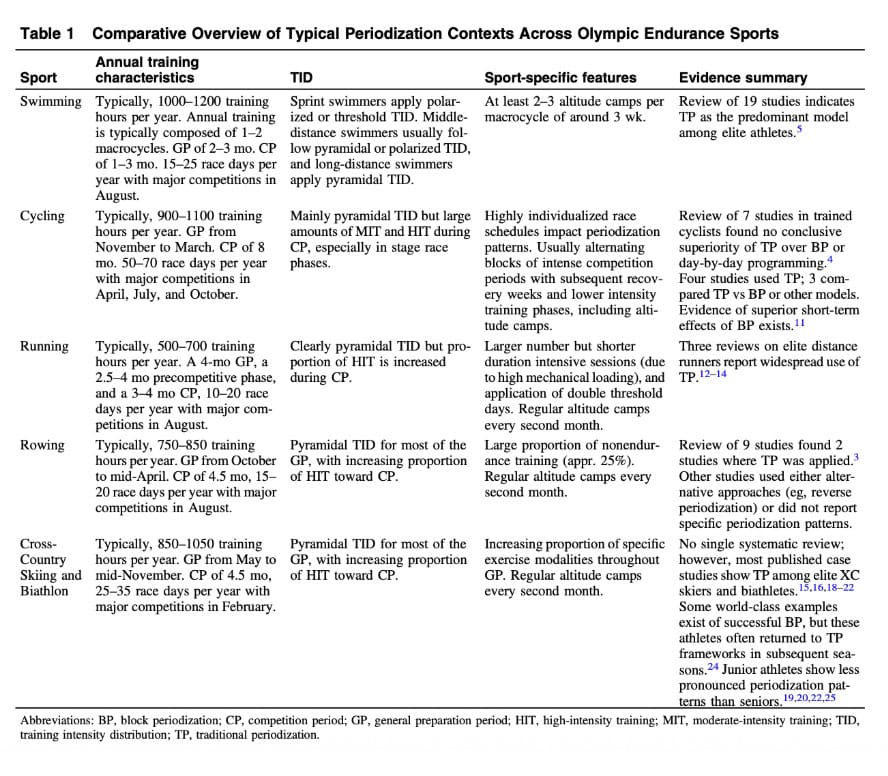
This section is the heart of the paper and, for runners, the most relevant part. The authors walk through endurance sports one by one, and the overall pattern is pretty consistent: traditional periodization still shows up everywhere, even when newer approaches are layered in around it.
- Swimming appears to rely heavily on traditional periodization, with athletes building a broad base before gradually increasing intensity and specificity.
- Cycling is a little more mixed. The authors cite a review that found no clear winner between traditional and block models, and there is some evidence that block periodization may produce better short-term effects in certain contexts. But even there, many elite cyclists still use a traditional structure because it is practical and easy to organize across a long season.
- Rowing and cross-country skiing tell a similar story: traditional periodization remains the most common framework, even though athletes sometimes use reverse- or block-oriented phases for specific purposes.
- For runners, the article discusses how highly trained, elite middle- and long-distance runners generally follow a traditional, linear model throughout the season. Training volume tends to be highest early in the preparation period, then declines as competition approaches. Meanwhile, the intensity profile becomes more race-specific, often shifting from more pyramidal earlier on toward a more polarized feel as key races approach. They also cite evidence that world-class distance runners typically maintain more than 80% of their total training volume at low intensity throughout the year, while strategically adjusting the smaller amount of moderate- and high-intensity work depending on the phase of the season.
- Elite running typically includes roughly 500 to 700 training hours per year, about a 4-month general preparation period, followed by a 2.5- to 4-month precompetitive phase, then a 3- to 4-month competition phase. The overall intensity distribution is clearly pyramidal, but the proportion of high-intensity work increases during the competition period. But elite training also involves shorter, intensive sessions due to the mechanical cost of running, the use of altitude camps, and even double-threshold days, all of which are mentioned as part of the modern endurance running landscape. In practice, modern endurance programs often look traditional at the macro level and highly evolved at the session level.
Elite coaches’ perspectives on periodization
The article also reviews what coaches say they actually do. In one cited study, Norwegian world-class coaches across eight Olympic endurance sports all described using a traditional model at the seasonal level: high volume and lower intensity earlier, then gradually more intense and competition-specific work later. But they were not using it rigidly. They adjusted for altitude camps, illness, injury, travel, and dense blocks of competition.
This gets at a point I think runners often miss. The real debate is not “traditional” versus “individualized.” Good traditional periodization is individualized. The best coaches use a stable framework and then modify it based on the athlete in front of them. This paper makes that point well. Even in sprinting and swimming, where coaches sometimes prefer block or hybrid models, many still cite traditional periodization’s predictability and logical progression as major strengths. And even when they choose something else, they often end up borrowing heavily from traditional principles anyway.
So, in practice, coaches are not really picking a single pure model and rejecting the rest. More often, they use traditional periodization as the backbone and then plug in other strategies where they make sense.
What this means for runners
For runners, this paper is a good reminder that the annual structure of your training probably matters more than whether you can attach a trendy label to it. A season that starts by building volume, durability, and an aerobic base, then gradually shifts toward more race-specific intensity as key events approach, is still how many elite runners train.
That does not mean your plan should be rigid or blindly linear. It means your year should have a logical arc. You should not be trying to race in January shape all the way to October, and you probably should not confuse flexibility with “randomness.” The smartest approach for most runners is a traditional backbone with enough room to adjust for fatigue, life stress, interruptions, and individual response. Remember—you’re human, after all.
That is not the flashiest answer, but after reading this paper, I think it is probably the most honest one.
RunClub — Free
Join 300,000+ runners in RunClub
Free training plans for every distance, a daily running game, exclusive coaching content, and a real community of runners. Create your free account in 20 seconds — no card.
Already a member? Log in →












Start the conversation