


Ice baths have one of the best reputations in endurance sports and one of the messiest evidence bases. They feel like recovery. They look like recovery. But there’s always been a bigger question of whether they’re actually helping adaptation, or just making you feel like you’re recovering better?
To answer this question, a new study1Malta, E. S., Neto, J. C. R., Beck, W. R., Cornachione, A. S., de Poli, R. A. B., Sigoli, E., & Zagatto, A. M. (2026). Regular Cold‐Water Immersion Following HIIT Does Not Affect Intramuscular Adaptation Markers, Inflammatory Profile or Endurance Performance. Scandinavian Journal of Medicine & Science in Sports, 36(3). https://doi.org/10.1111/sms.70241 looked at what is happening inside the muscle after five weeks of interval training plus regular cold water immersion.
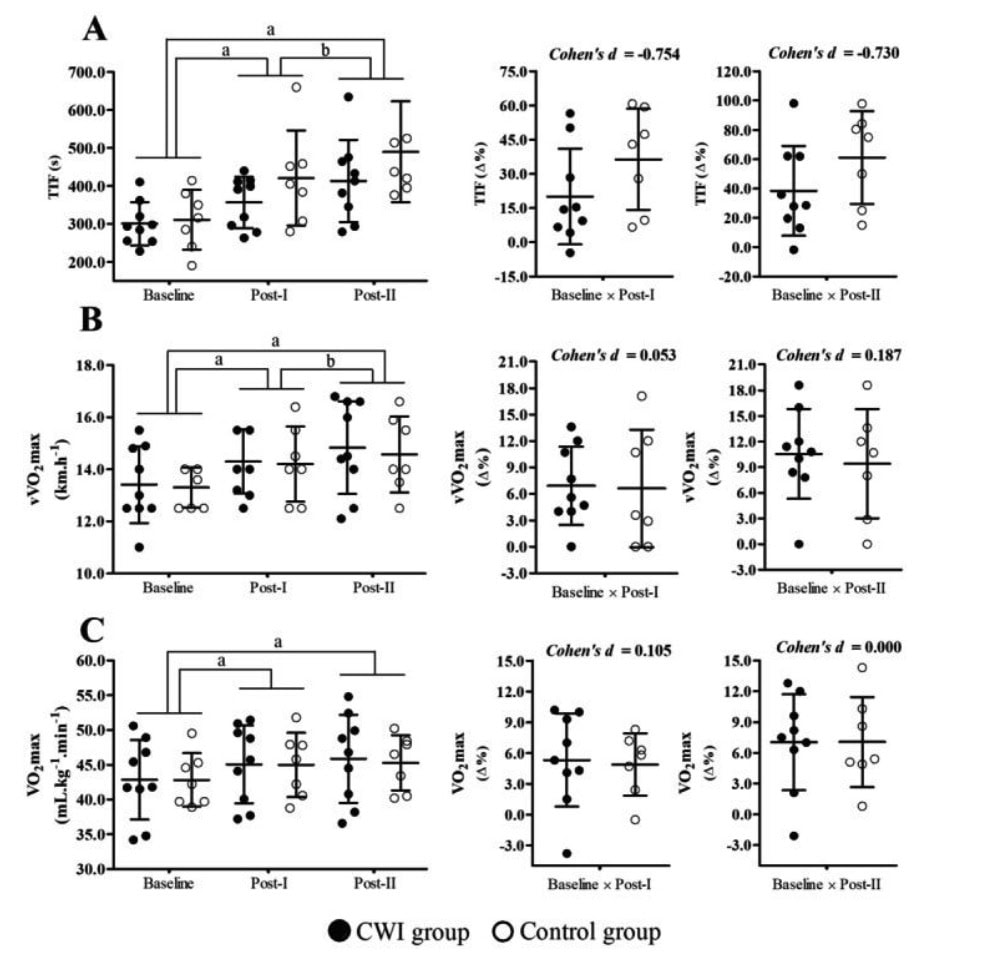
The researchers recruited 16 healthy young men and split them into two groups. Both groups completed the same five-week high-intensity interval training (HIIT) program on a treadmill: three sessions per week of 2-minute intervals at 95% of the runner’s VO2 max speed, progressing from 5 to 8 reps before tapering down at the end. One group did 11 minutes of cold-water immersion at about 52℉/11°C immediately after each session, while the control group just sat passively at room temperature. Before training, after week 4, and again after week 5, the researchers measured VO2 max, maximal aerobic speed, and time to exhaustion in a run at a constant speed. They also took muscle samples from the runners to examine satellite cells, markers of mitochondrial growth, and inflammatory markers.
The main finding was that the ice baths did not meaningfully change anything that mattered. Both groups improved over time, and they improved to a similar extent.
- VO2 max went up.
- Speed at VO2 max went up.
- Time to exhaustion improved.
On the muscle side, satellite cell content increased, and a marker of mitochondrial growth known as PGC-1α also rose, which is what you’d hope to see with a solid block of interval training. But none of those changes were different between the cold-water immersion group and the control group. The inflammatory markers in muscle also did not meaningfully shift with cold-water immersion. The training worked, and the post-workout ice baths neither boosted nor blunted the main endurance adaptations they measured.
What this means for runners
If you use cold-water immersion after hard workouts because it helps you feel fresher, less sore, or more mentally ready for the next session, this study suggests that habit probably is not harming your endurance adaptations. But it probably also isn’t giving you a secret fitness edge. That makes ice baths more of a recovery management tool than a performance-enhancing one. I would view them as optional, context-dependent, and most useful during heavy training blocks, races with short turnarounds, or periods when soreness interferes with consistency.
The bigger levers are still the obvious ones: good training, enough easy running, enough fuel, enough sleep, and recovery practices you can actually stick with.
References
RunClub — Free
Join 300,000+ runners in RunClub
Free training plans for every distance, a daily running game, exclusive coaching content, and a real community of runners. Create your free account in 20 seconds — no card.
Already a member? Log in →







Start the conversation