


If you want to get faster, you need more intensity. At least that’s the thinking among most runners. But that runs into a practical problem pretty quickly, because distance runners also know that much of their aerobic development still comes from steady, controlled mileage. So, which one matters more for running economy: hard intervals or moderate continuous running?

A new meta-analysis (a large study that compiles results of several smaller studies) tries to answer exactly that.1Feng, Y., Li, D., Liu, Y., & Tang, D. (2025). High-Intensity Interval Training and Moderate-Intensity Continuous Training Affect Running Economy in Endurance Runners: A Systematic Review and Meta-Analysis of Randomized Controlled Trials. Journal of Human Kinetics. https://doi.org/10.5114/jhk/205427
The researchers pooled nine randomized controlled trials comparing high-intensity interval training, or HIIT, with moderate-intensity continuous training, or MICT, in endurance runners. In total, the analysis included 168 runners, mostly moderately trained or recreational, with interventions lasting at least four weeks. The main outcome was running economy, essentially how much oxygen a runner uses at a given pace. They also looked at VO2 max and blood lactate responses. To make the analysis more practical, they split running economy into three intensity zones: below the first threshold (Zone 1), around the threshold range (Zone 2), and above the second threshold (Zone 3).
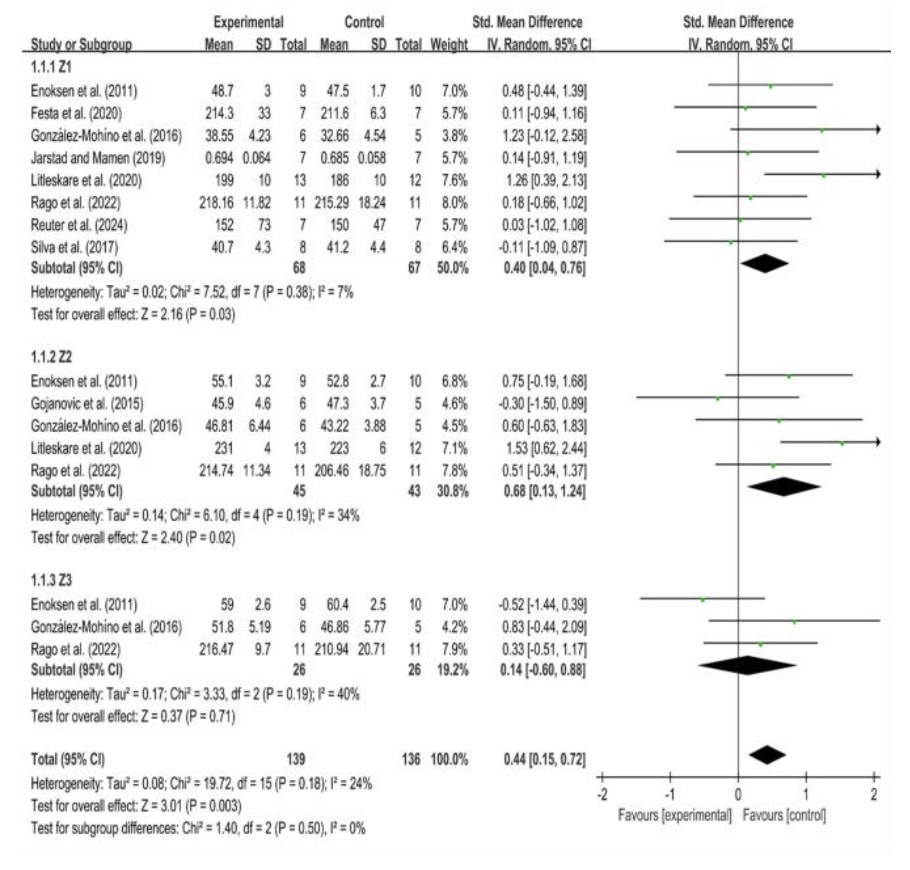
HIIT came out ahead for running economy overall. It produced a modest but significant advantage over MICT for improving economy, meaning runners generally used less oxygen at the same speed after interval-based training.
- The effect was strongest in Zone 2, which roughly corresponds to work around the lactate threshold, and it was also significant in Zone 1.
- But once speeds exceeded the second threshold and entered Zone 3, that advantage disappeared. In other words, HIIT seemed to help runners become more economical at submaximal and threshold-like intensities, but not necessarily at very hard intensities above threshold.
But the paper did not find that HIIT wins at everything. In fact, MICT had the clearer edge for VO2 max. The pooled analysis showed greater improvement in maximal oxygen uptake with moderate-intensity continuous training than with HIIT. That is a useful reminder that running economy and VO2 max are not the same thing, and the best way to improve one is not always the best way to improve the other. If you are building aerobic capacity broadly, a lot of steady running still looks very important.
The third interesting finding involved lactate. In the subset of studies that measured it, HIIT reduced blood lactate more than MICT at the same intensity after training, suggesting better lactate handling or delayed accumulation.
What this means for runners
If your goal is to improve running economy, especially at paces that matter for longer races, threshold-style interval work appears to be a very smart tool. This study suggests that HIIT, particularly when performed at or just below the lactate threshold rather than all-out, may improve the oxygen cost of running more than steady moderate running alone. But steady aerobic work still matters, especially if your bigger goal is raising VO2 max and building the engine underneath everything else. So the practical takeaway is not to choose one camp. It is important to appreciate that these methods do slightly different jobs. For most runners, the sweet spot is probably a strong aerobic base built through continuous running, plus well-placed threshold-level interval sessions to improve efficiency where it counts.
References
RunClub — Free
Join 300,000+ runners in RunClub
Free training plans for every distance, a daily running game, exclusive coaching content, and a real community of runners. Create your free account in 20 seconds — no card.
Already a member? Log in →












Start the conversation