


Caffeine is one of the few legal supplements that reliably improves endurance performance. But anyone who has used caffeine before a workout knows the response is not uniform.
Some runners feel sharp, focused, and powerful. Others feel anxious and jittery.
One reason researchers keep investigating this variability is genetics. The CYP1A2 gene influences caffeine metabolism. The AA genotype is often described as “fast,” AC as “slow,” and CC as “ultra-slow.” The theory is that fast metabolizers might get more performance benefit from caffeine.
A new study tested that idea1Masters, C., Ali, A., Badenhorst, C., Dickens, M., & Rutherfurd-Markwick, K. (2026). The Effect of CYP1A2 Gene Polymorphisms on Caffeine Pharmacokinetics and Exercise Performance in Male Recreational Athletes. European Journal of Sport Science, 26(7), e70203. https://doi.org/10.1002/ejsc.70203 by merging data from two randomized, double-blind, placebo-controlled crossover experiments: a 10-km running time trial and a 40-km cycling time trial. The study included 38 recreationally active men, with an average age of ~32 years. Half were AA genotype carriers, and half were AC. No participants had the CC genotype.

Participants consumed either 6 mg/kg caffeine or a placebo 60 minutes before exercise. That is a real dose. For a ~150-lb/70-kg runner, that’s 450 mg of caffeine (roughly four to five cups of coffee, depending on the coffee).
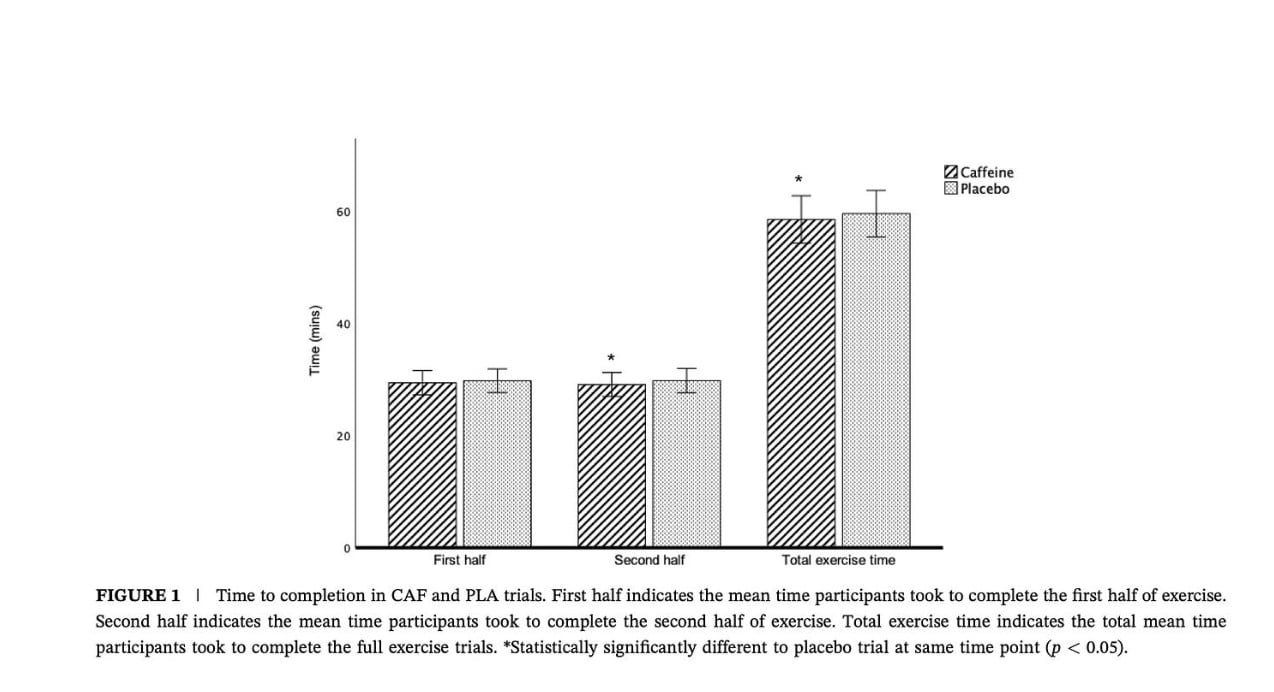
Caffeine improved performance.
- Across the combined sample, time to completion improved by about one minute, or 1.8 percent (58.5 minutes with caffeine versus 59.5 minutes with placebo).
- The effect was more obvious later in the effort. The first half was 1.2 percent faster with caffeine, while the second half was 2.4 percent faster.
- Of the 34 participants included in the time-trial analysis, 24 were faster with caffeine. The effect was observed in both modalities: cycling improved from 72.4 to 70.7 minutes, and running from 52.2 to 50.7 minutes.
- Heart rate was also higher with caffeine, 165 versus 161 beats per minute.
Now for the gene piece. AA carriers (“fast metabolizers”) had higher caffeine concentrations in their blood than AC carriers. At the start of the exercise, 60 minutes after ingestion, AA carriers had caffeine concentrations nearly 4x higher than those of AC carriers.
But there was no caffeine-gene interaction for performance. In other words, genotype affected caffeine levels in the body, but it did not clearly determine who improved and who did not.
What this means for runners
Caffeine still looks useful, especially for efforts around an hour where fatigue builds and you need to maintain pace late. But I would not base your caffeine strategy on CYP1A2 alone. Test caffeine in workouts, not on race day. Pay attention to dose, timing, gut comfort, anxiety, heart rate, and sleep disruption. A 6 mg/kg dose can work, but it is also high. Many runners may get most of the benefit with less and fewer side effects. The goal is not to blindly copy the study dose—it is to find the smallest effective dose that helps you run better without wrecking your race (or your night of sleep).
References
RunClub — Free
Join 300,000+ runners in RunClub
Free training plans for every distance, a daily running game, exclusive coaching content, and a real community of runners. Create your free account in 20 seconds — no card.
Already a member? Log in →


Start the conversation