


Warmups are meant to raise core temperature, loosen the hips, wake up the calves, and they might even include a few strides so race pace doesn’t feel like a shock. But a new study asks whether a warm-up is also about getting the brain ready.1Mortimer, H., Dallaway, N., Díaz‐García, J., & Ring, C. (2026). Warming Up Body and Mind: Combined Cognitive and Exercise Priming Improves 1‐Mile Time Trial Performance in Recreational Runners. European Journal of Sport Science, 26(5). https://doi.org/10.1002/ejsc.70163

Researchers tested whether combining cognitive tasks with a standard physical warm-up could improve 1-mile performance in recreational runners. The participants were 25 experienced recreational runners, 11 men and 14 women, with an average 5K personal best of about 23:31 and weekly mileage of around 20 miles/30 kilometers. Each runner completed three separate testing sessions:
- One with a physical-only warm-up.
- One with a physical warm-up plus low-load cognitive tasks.
- One with a physical warm-up plus high-load cognitive tasks.
After each warm-up, they ran four laps of a 400-meter track as fast as possible, with their watch face covered so they had to rely on feel rather than constant pace feedback.
- The physical warm-up included a 1200-meter easy jog, 800 meters alternating 100-meter jogs and 100-meter strides, and three minutes of active stretching drills.
- In the cognitive warm-up conditions, runners completed four three-minute cognitive tasks before and between the physical warm-up components. These tasks targeted mental functions like switching between tasks, inhibiting responses to stimuli, decision-making, and memory—they were doing short bursts of focused mental work designed to activate the brain without exhausting it.
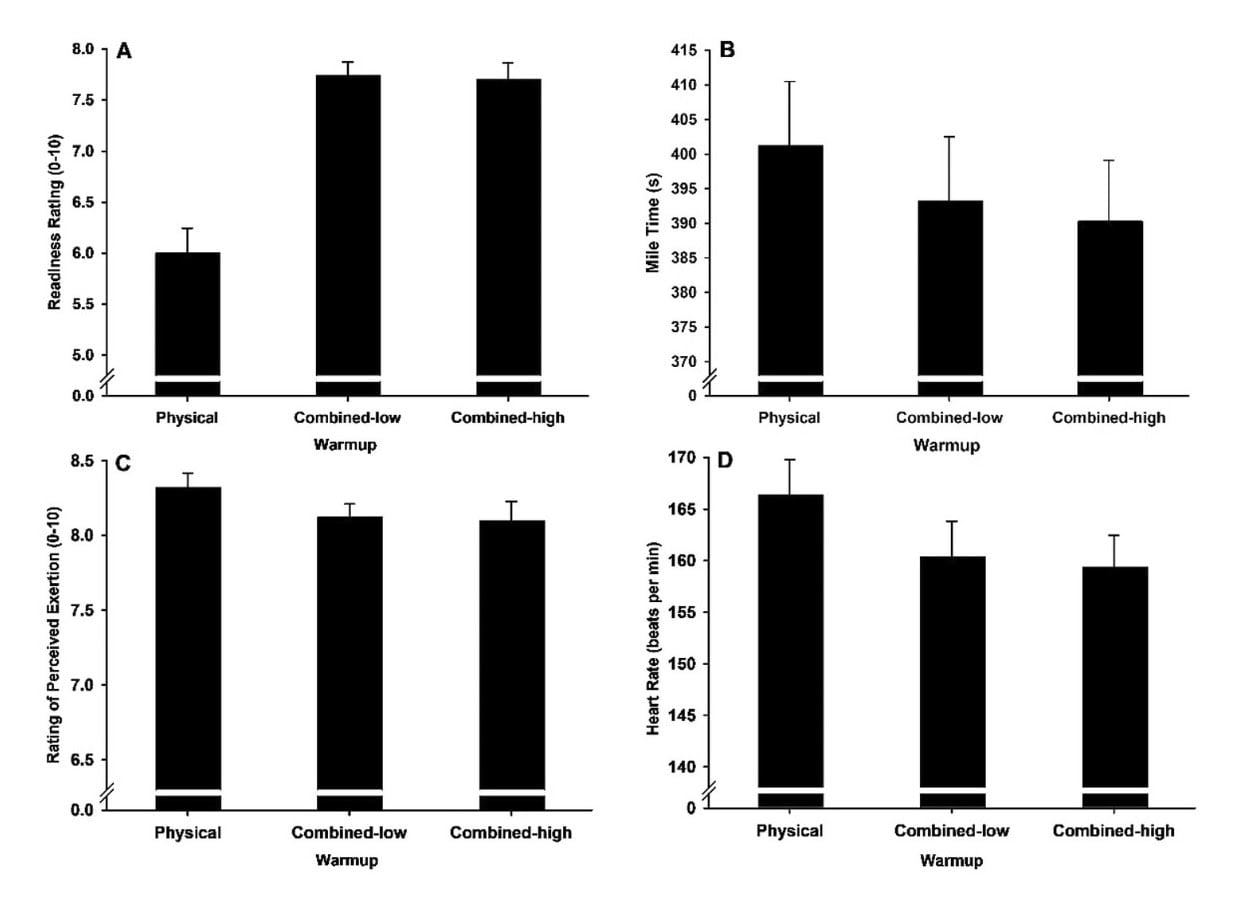
Compared with the physical-only warm-up, runners were faster after both cognitive-plus-physical warm-ups. The low cognitive-load condition improved 1-mile time by about 8 seconds (2.03%), while the high cognitive-load condition improved performance by about 11 seconds (2.80%).
Even more interesting, the runners did not appear to be simply muscling their way to faster times.
- Their perceived effort was lower after the combined warm-ups, and their average heart rate during the time trial was lower as well.
- Readiness to perform was higher, meaning runners felt more prepared to run hard.
- Cadence and stride length did not change meaningfully, suggesting the performance boost was not attributable to obvious mechanical changes.
What this means for runners
The practical takeaway is not that you need to download a cognitive testing app and start doing mental arithmetic before every workout. But this study does suggest that the best warm-up may prepare both the body and the mind.
Before short, hard efforts like mile repeats, 3K/5K races, track sessions, or time trials, it may be useful to add a small cognitive “activation” layer that includes short reaction tasks, quick decision-making drills, coordination games, fast feet with visual cues, or even structured focus routines that force you to engage attention before you start running hard.
The important point is dose. A few short mental tasks intermixed with jogging, strides, and drills may help you feel sharper and more ready, but a long, mentally draining task probably does the opposite. For most runners, I’d think of this as sharpening the nervous system rather than “training the brain.” Keep it brief, keep it engaging, and test it in workouts before trying it on race day (as with all things).
References
RunClub — Free
Join 300,000+ runners in RunClub
Free training plans for every distance, a daily running game, exclusive coaching content, and a real community of runners. Create your free account in 20 seconds — no card.
Already a member? Log in →












Start the conversation