


Strava is not simply a fitness-tracking app. It is part training log, part social network, part scoreboard, part identity machine. A new study suggests that, for competitive female runners, that combination can be both motivating and psychologically messy.1Russell, Hayley C., et al. “Strava Use in Competitive Female Runners: A Qualitative Exploration of Perceived Utility and Psychosocial Implications.” Psychology of Sport and Exercise, vol. 85, July 2026, p. 103136, https://doi.org/10.1016/j.psychsport.2026.103136. Accessed 22 Apr. 2026.
The researchers wanted to understand why competitive female runners use Strava and how they perceive its effects on motivation, self-image, comparison, pressure, and well-being. Rather than implementing an intervention or collecting performance data, they conducted a qualitative study in which 19 competitive female runners participated in semi-structured interviews, and the researchers analyzed the resulting conversations. The participants included professional runners, Olympic Trials qualifiers, and athletes actively trying to qualify. They ranged in age from 25 to 42 years, had an average of about 16 years of running experience, and reported running nearly 47 miles per week in the month before the interview.
The big finding was that Strava carried three overlapping meanings for these runners.
First, Strava helped define their “running self.”
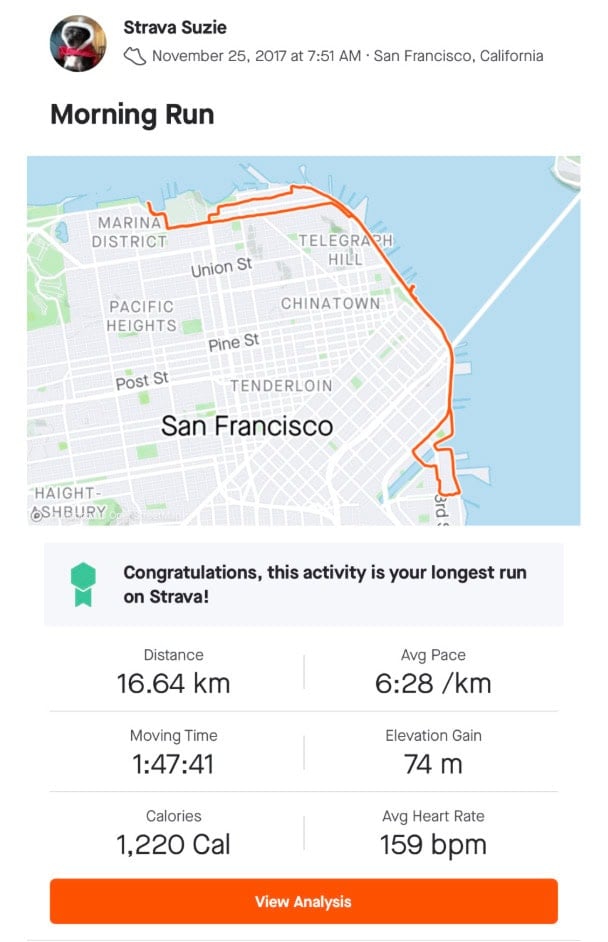
The athletes described the app as a kind of digital training diary, a place to document progress, reflect on workouts, track shoes and mileage, and look back before races for evidence that the work had been done.
Second, Strava created the experience of “being seen and seeing others.”
Participants described the platform as a meaningful way to stay connected to teammates, friends, competitors, and the broader running community. Kudos and comments were small forms of validation, and Strava sometimes prompted offline support, like texting a teammate after a big workout. But because everyone can see the run, the workout, the pace, the distance, and sometimes the heart rate, runners felt exposed. Several participants described worrying about what others would think if they struggled, ran slowly, took downtime, or appeared less fit.
The third theme may be the most interesting: runners curated the image of the “good runner.”
Even though many participants described Strava as more authentic than other social media platforms, they still admitted to managing what others saw. Some hid heart rate data if it looked too high for an easy run. Some made captions explaining why a run was slow. Some separated warm-ups and workouts or avoided posting certain runs altogether.
What this means for runners
Strava can be a great tool, but it needs boundaries. Use it as a training log, confidence file, and connection point, but be honest about when it starts making decisions for you.
If seeing other people’s workouts pushes you to run when you’re sick, injured, exhausted, or supposed to be recovering, the app is no longer serving your training. It is hijacking it. I’d encourage runners to periodically ask: “Would I still do this run if nobody could see it?” and “Am I posting this to reflect my training or to manage how people perceive me?” (These are questions I’ve asked myself as of late).
There’s nothing wrong with sharing big workouts, race breakthroughs, or even the occasional humblebrag. But the healthiest runners are usually the ones who can keep the private purpose of training louder than the public performance of training.
References
RunClub — Free
Join 300,000+ runners in RunClub
Free training plans for every distance, a daily running game, exclusive coaching content, and a real community of runners. Create your free account in 20 seconds — no card.
Already a member? Log in →







Start the conversation