


Every marathon runner knows the body feels different after 26.2 miles. The legs are trashed, the stairs become personal enemies, and the appetite can turn feral. A new study asks what happens to the brain.
This is not just a metaphorical “marathon brain” question. The authors had previously shown that marathon running was associated with reversible reductions in myelin content in specific brain regions (I covered the study in a previous RLRH newsletter). Myelin is the fatty insulation around nerve fibers that helps signals travel efficiently. That earlier finding naturally raised a big concern—if myelin temporarily decreases after a marathon, does brain function suffer?
The researchers studied marathon runners and non-running controls before the race, within 48 hours after the race, and again one month later. They combined neurophysiological testing, which looks at how quickly and strongly nerve signals travel, with cognitive testing across several domains.
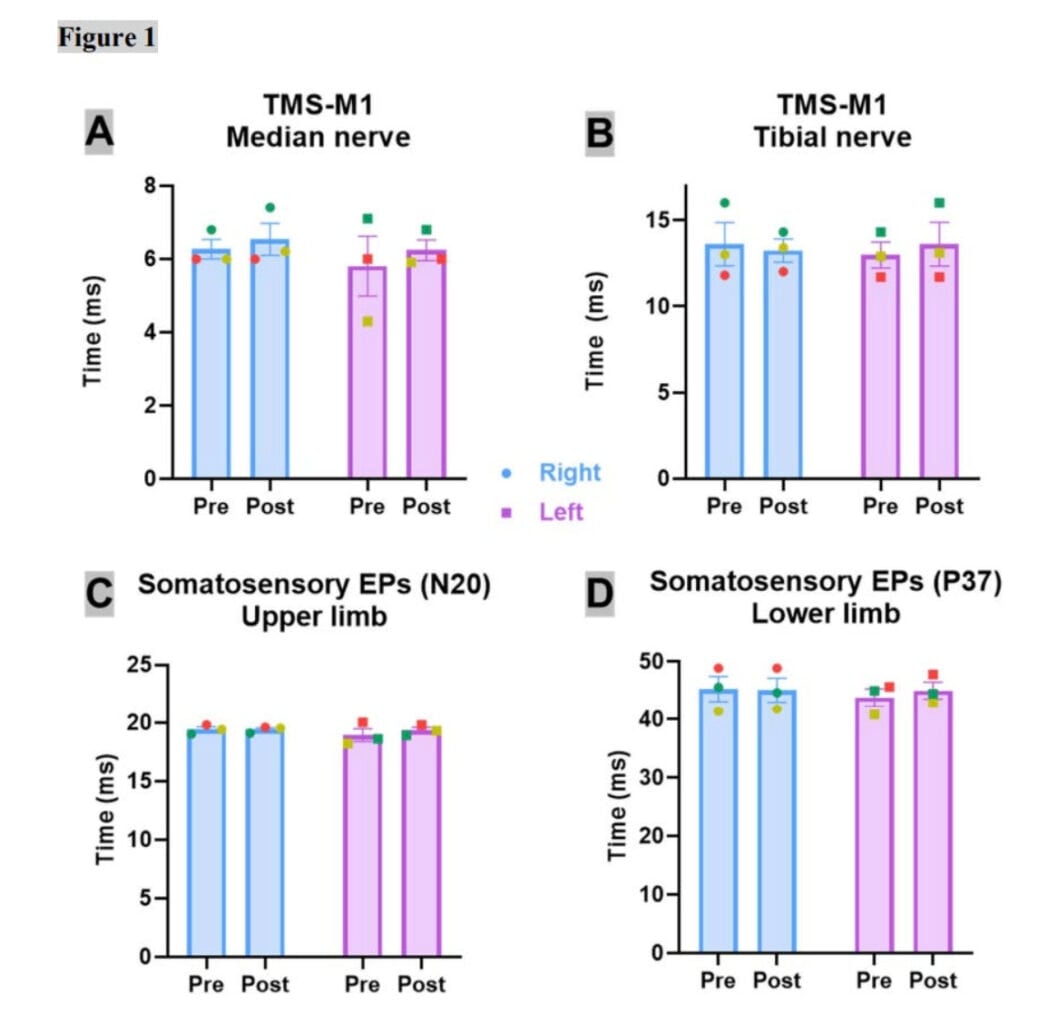
The first major finding was that neural signal transmission appeared preserved. The researchers checked whether signals still moved normally through the motor, sensory, visual, and auditory pathways after the marathon. The answer was yes.
The cognitive results were more nuanced. Marathon runners did not show global “cognitive collapse” after the race. But they did show selective, temporary changes. On a test of processing speed, non-runners improved after repeated testing (due to practice), but runners showed a smaller immediate improvement after the race, suggesting that the marathon blunted normal practice-related gains.
On a test that measures your ability to suppress an automatic response and stay focused on the correct one, non-runners again improved after repeated testing, while runners showed a temporary increase in interference after the marathon (they got a worse test score). By one month, the effect had normalized. Meanwhile, visuomotor speed, attention, and cognitive flexibility were all largely preserved after the race.
What this means for runners
A marathon does not appear to cause broad short-term brain dysfunction, but it may temporarily reduce your highest-level sharpness.
After a marathon or ultra, it is probably wise to treat the brain like the legs—functional, but not fully recovered. Don’t schedule your hardest work presentation, most complex decision-making, or emotionally charged life admin for the day after a major race if you can avoid it. Prioritize sleep, carbohydrates, hydration, and recovery because your brain has just helped coordinate an enormous metabolic event. This study also reinforces that endurance performance is a whole-body challenge, and the brain is not just along for the ride.
RunClub — Free
Join 300,000+ runners in RunClub
Free training plans for every distance, a daily running game, exclusive coaching content, and a real community of runners. Create your free account in 20 seconds — no card.
Already a member? Log in →











Start the conversation