There is always a certain allure to blood biomarkers in endurance sports. They promise to tell us something deeper than pace, heart rate, or even VO2 max. Maybe they can reveal the hidden physiology behind why one runner turns fitness into performance better than another. Maybe they can sharpen race prediction beyond what a field test alone can do.
That is the idea behind a new study, and I’ll admit, it is a compelling one. Because most runners have had the experience of running a solid workout or test, plugging the number into a calculator, and still feeling like the prediction misses something important. Maybe adding some more data to the equation could improve its ability to predict future performance.1Dvorski, M., Rakovac, M., Kelava, T., Kovačić, N., Flegar, D., Aničić, S., Krešić, I., Ćulibrk, L., Koražija, F., Dimnjaković, D., & Šućur, A. (2026). Can Non-Conventional Blood Biomarkers Improve Running Performance Prediction? A Proof of Concept. Life (Basel, Switzerland), 16(2), 320. https://doi.org/10.3390/life16020320
This was a proof-of-concept study in 33 runners, mostly recreational but with a wide mix of backgrounds. They completed a 2.4-kilometer Cooper test on an outdoor track, and the researchers took blood samples before the warm-up and again within 10 minutes after the test. They looked at four non-conventional biomarkers:
- Decorin – Think of decorin as part of your body’s structural support system. It’s a protein found in connective tissue (like tendons, ligaments, and muscle) that helps organize and strengthen the “scaffolding” around your muscles. Higher levels may reflect better tissue resilience—basically, how well your body can handle the pounding of running.
- Hypoxanthine – This is a byproduct of energy use. When your muscles are working hard and burning through energy (ATP), hypoxanthine levels rise. So you can think of it as a marker of how much metabolic stress your body is under during hard exercise.
- NT-proBNP – This one comes from the heart. It’s released when the heart muscle is under stress or strain, especially when it’s working hard to pump blood. In clinical settings, it’s used to assess heart health, but during exercise, it can reflect the cardiovascular load you’re placing on your system.
- BDNF (Brain-Derived Neurotrophic Factor) – This is often called a “brain health” molecule. It supports brain function, learning, and adaptation, and it tends to increase with exercise. You can think of it as part of why running can improve mood, focus, and mental resilience.
Then, two weeks later, 24 of those runners completed an official 10k race, which provided the researchers with a real-world performance outcome to compare with the blood data and the Cooper test results. The main question was simple: do these biomarkers tell us anything useful that a standard field test does not?
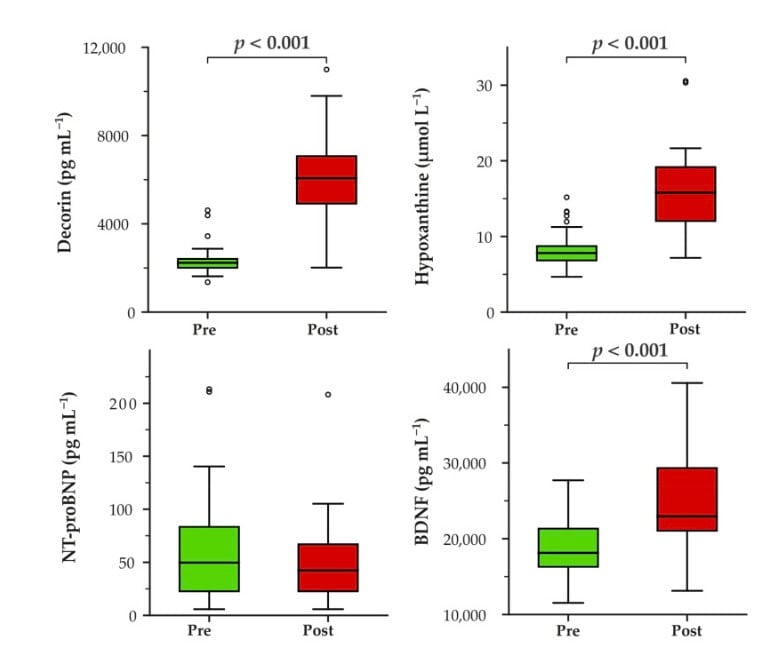
The first answer was yes, at least in the sense that the Cooper test clearly moved the biology. Decorin, hypoxanthine, and BDNF all rose significantly after the test, while NT-proBNP did not. So the test was hard enough to trigger measurable musculoskeletal, metabolic, and neurobiological responses, but apparently not enough to raise NT-proBNP.
But the more important question is whether any of that mattered for performance. Here, decorin separated itself from the pack. Higher post-test decorin was associated with faster Cooper test times, and both baseline and post-test decorin were associated with faster 10k race times two weeks later. Hypoxanthine also tracked with better Cooper test performance, but not with 10k race time. BDNF rose after the test, but it did not seem to tell us much about who would actually race better. NT-proBNP was basically a non-factor. So while several markers responded to hard running, decorin was the only one that looked even remotely useful for predicting actual endurance performance.
The Cooper test was already a good predictor of performance on its own—it predicted 10k race time with an average error of 1.92 minutes. Adding body mass index (BMI) improved that to 1.77 minutes. Adding post-test decorin improved it further, bringing it down to 1.69 minutes. So yes, decorin improved prediction. But the gain was small. We are talking about shaving seconds off prediction error, not uncovering some revolutionary new way to forecast race performance.
What this means for runners
This is not a cue to go get your decorin measured after your next Cooper test. The improvement in race prediction was too small, and this was still a proof-of-concept study using estimated rather than directly measured VO2 max. But I do think the study reinforces an important point that performance is not just about your aerobic engine. There is probably a meaningful layer of “musculoskeletal readiness” or running economy underlying race outcomes, which may help explain why some runners outperform their lab-style predictions while others do not.