


Runners love to think about trade-offs. If we are not eating enough, maybe strength training protects us. If we are in a deficit, maybe impact loading keeps bones stimulated.

A new study tested a version of that logic,1Sterringer, T., Sale, C., Morozov, A., Liang, J., & Larson-Meyer, D. E. (2026). Effects of High-Impact Exercise on Bone Marker Concentrations During Controlled Low Energy Availability in Recreational Female Runners. Calcified Tissue International, 117(1), 101. https://doi.org/10.1007/s00223-026-01564-0 and the result is a useful warning for all runners.
Researchers studied 12 recreational female runners in a randomized crossover design. Each runner completed two five-day periods of controlled low energy availability, set at 15 calories/kg fat-free mass per day. That is low. The deficit came from both dietary restriction and daily treadmill running at 65–70% VO2 max. In one condition, participants only ran. In the other, they also completed 50 supervised depth jumps per day, with each session separated from the run by at least 4 hours.
The idea was reasonable. Bone responds to mechanical loading, and previous work suggests that brief, high-impact jumping might blunt some of the negative bone marker changes observed during short-term underfueling. But here, when the jumping was layered on top of daily running and controlled low energy availability, it did not rescue bone turnover; in fact, it pushed bone metabolism in a direction consistent with bone breakdown.
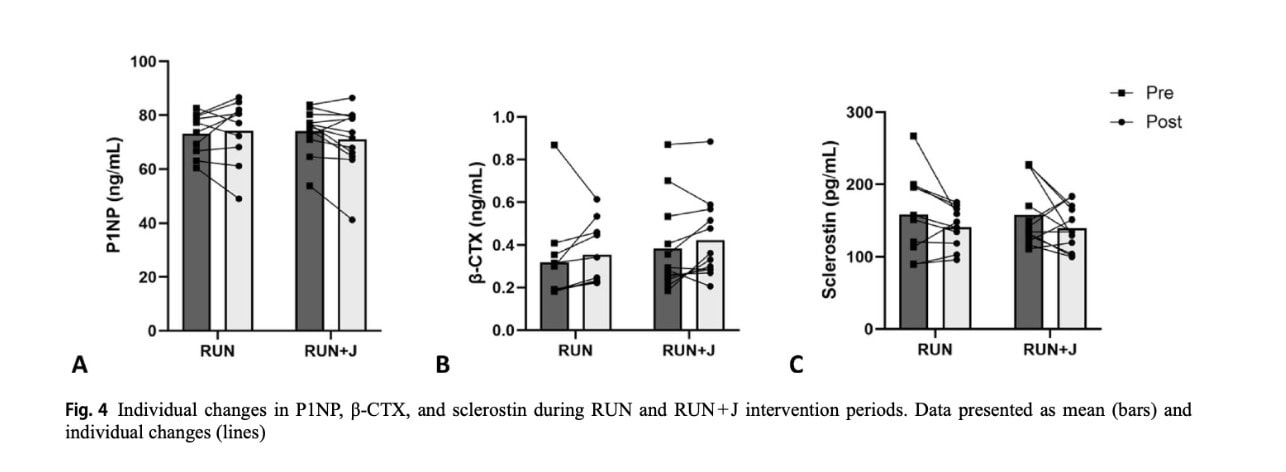
- The bone resorption marker beta-CTX increased over time in both conditions.
- Bone formation markers, including P1NP and sclerostin, did not significantly change over time or differ between conditions.
The study was small and short, and it measured bone markers rather than long-term changes in bone mineral density or stress fracture risk. It also studied young female recreational runners without current low energy availability risk, hormonal contraceptive use, recent bone injury, or low bone density. So we should not overgeneralize. But the direction of the finding is hard to ignore.
What this means for runners
If you are underfueling, your bones may start showing unfavorable metabolic signals within days, not months. And no amount of jumping or plyometrics will help. The more practical approach is to treat energy availability as the foundation: eat enough total calories, enough carbohydrates around training, adequate calcium and vitamin D, and include recovery days that are actually recovery days.
Jump training can be useful for bone and tendon health, but it works best when the body has the resources to adapt.
References
RunClub — Free
Join 300,000+ runners in RunClub
Free training plans for every distance, a daily running game, exclusive coaching content, and a real community of runners. Create your free account in 20 seconds — no card.
Already a member? Log in →












Start the conversation