


The idea that you can swish a carbohydrate, caffeine, or menthol solution around your mouth, spit it out, and improve performance without swallowing anything sounds almost too convenient.
However, a plausible mechanism exists. Receptors in the mouth can signal reward, arousal, and thermal comfort to the brain before the body absorbs a nutrient. Carbohydrate sensing may activate reward and motor-control regions. Caffeine’s bitterness may increase arousal. Menthol activates cold-sensitive receptors and can make exercise feel cooler, especially in the heat.
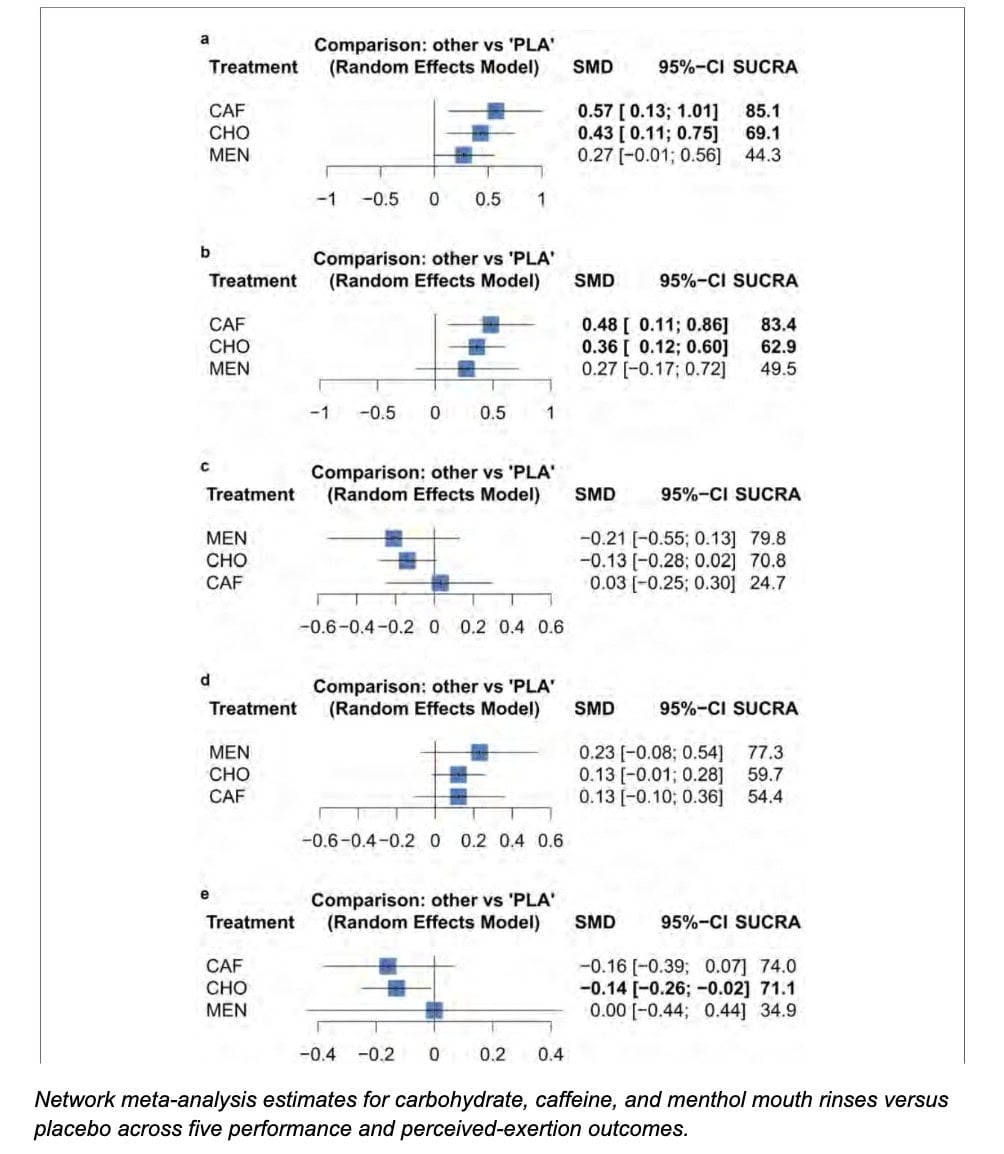
A new systematic review and meta-analysis1Li, Q., Liu, S., Miao, C., Zhang, Y., & Lu, Y. (2026). Effects of carbohydrate, caffeine and menthol mouth rinses on exercise performance and ratings of perceived exertion: a systematic review and network meta-analysis. In Frontiers in nutrition (Vol. 13, p. 1877453). PubMed. https://doi.org/10.3389/fnut.2026.1877453 brought these three strategies into one comparison. The researchers included 57 randomized crossover studies involving 609 participants. Thirty-seven studies tested carbohydrate, 15 tested caffeine, and nine tested menthol, with some studies contributing to more than one comparison. Most involved cycling or running. The typical rinse lasted five to 10 seconds, and repeated rinsing was more common than a single exposure.
- For time to exhaustion, caffeine and carbohydrate rinses both outperformed placebo. The same two rinses also increased work performed during a fixed-time test. Carbohydrate slightly reduced ratings of perceived exertion.
- When the outcome was the time needed to complete a fixed amount of work—the format most similar to a race time trial—none of the three ingredients significantly beat placebo. The same was true for average power.
What this means for runners
A mouth rinse is best viewed as a situational tool, not a replacement for fueling. It may make sense during short, high-intensity sessions, when you are training fasted, when heat perception is limiting, or when swallowing more carbohydrate would upset your stomach. For a long race, ingested carbohydrate and fluid still do physiological work that an oral signal cannot.
If you experiment, match the trial to the problem. Test carbohydrate or caffeine during a hard workout when sustaining output is the goal; test menthol in a hot session where thermal discomfort is prominent. Use a studied concentration, rinse for five to 10 seconds, and rehearse the exact timing. The evidence says they’re “possibly useful.”
References
RunClub — Free
Join 300,000+ runners in RunClub
Free training plans for every distance, a daily running game, exclusive coaching content, and a real community of runners. Create your free account in 20 seconds — no card.
Already a member? Log in →









Start the conversation