


Ice slurry ingestion has become a popular heat-management strategy. The idea is straightforward: drink something very cold, lower core temperature, increase heat storage capacity, and maybe perform better.
That logic makes sense in hot conditions. But what about environments that… aren’t so hot? And more specifically, can cooling before and during exercise improve recovery over the next 48 hours?
A recently published study tested that question1Al-Horani, R., Mardini, M., Al-Rababah, R., Ihsan, M., Malkawi, T., & Allan, R. (2026). Pre- and mid-cooling with ice slurry ingestion: Effects on recovery over 48 h following high-intensity intermittent exercise under temperate conditions. Journal of Thermal Biology, 139, 104504. https://doi.org/10.1016/j.jtherbio.2026.104504 in 17 male athletes. These were mostly soccer players, ranging from trained/developmental to highly trained/national level—so not runners, but the study is still highly applicable.
Each athlete completed two high-intensity intermittent exercise sessions under temperate conditions. The protocol involved four 22.5-minute treadmill-running sessions at speeds ranging from slow to all-out sprint.
- During one trial, athletes consumed a temperate carbohydrate-electrolyte drink at 82.4°F (28°C).
- During the other, they consumed the same drink as an ice slurry at 30.2°F (-1°C).
The drink composition was matched: 6 percent carbohydrate and some sodium. The athletes ingested it before and during the session.
The ice slurry did lower rectal temperature—but only briefly. Core temperature was lower from post-ingestion until before the first running session, by about 0.2 to 0.5°F (0.1 to 0.3°C). But by the end of the first session, the difference was no longer statistically significant, and in later sessions, core temperature was similar between conditions.
Heart rate, perceived effort, repeated sprint times, and gastrointestinal discomfort did not differ meaningfully between ice slurry and temperate fluid.
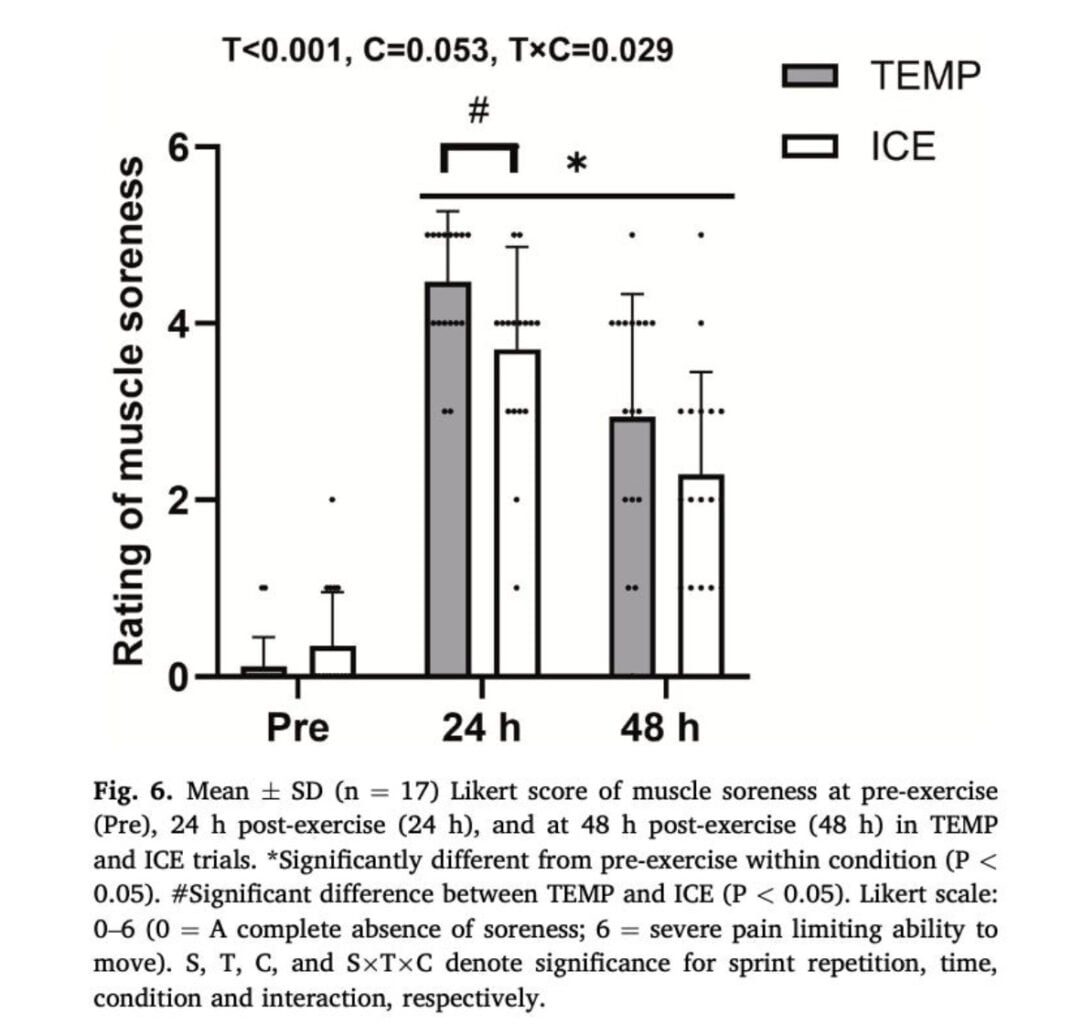
The recovery results were mixed and maybe a little surprising. Muscle soreness was lower with ice slurry at 24 hours (3.7 versus 4.5 on the soreness scale). But the performance recovery signal did not favor cooling. In a 10-second cycling sprint test, peak power actually recovered better in the temperate condition by 48 hours. Peak power was down only 0.7 percent from baseline in the temperate condition, compared with 4.8 percent in the ice slurry condition. Average power showed a similar trend (recovered better with the temperate drink than with the ice slurry).
Markers of nervous system recovery, muscle damage, inflammation, and heart stress did not differ between conditions.
The story here is that the ice slurry slightly reduced soreness, did not reduce physiological stress markers, and may have delayed cycling power recovery after a demanding intermittent session in temperate conditions.
What this means for runners
Ice slurry is probably best viewed as a heat strategy, not a general recovery hack. If you are racing or training hard in hot conditions, internal cooling can still be useful. But in temperate weather, this study suggests that drinking ice slurry before and during a hard session does not automatically improve recovery. For runners, I’d save the logistical hassle for hot races, long efforts, or situations where heat strain is clearly limiting performance.
References
RunClub — Free
Join 300,000+ runners in RunClub
Free training plans for every distance, a daily running game, exclusive coaching content, and a real community of runners. Create your free account in 20 seconds — no card.
Already a member? Log in →





Start the conversation