


VO2 max, lactate threshold, and running economy are the tidy little triangle that’s been used to explain endurance performance for a long time.
If you want to run fast, long (or ideally, fast for a long while), you need a big aerobic engine, the ability to hold a high fraction of that engine, and the mechanical efficiency to turn oxygen into speed without wasting energy.
But anyone who has trained for a marathon, raced an ultra, or watched their heart rate drift upward during what was supposed to be an “easy” long run knows this model doesn’t capture everything about performance.
Two runners can have similar lab values and can even look nearly identical at marathon pace for the first hour. Then, sometime after 90 minutes, one runner keeps rolling while the other starts to lose speed, form, and confidence.
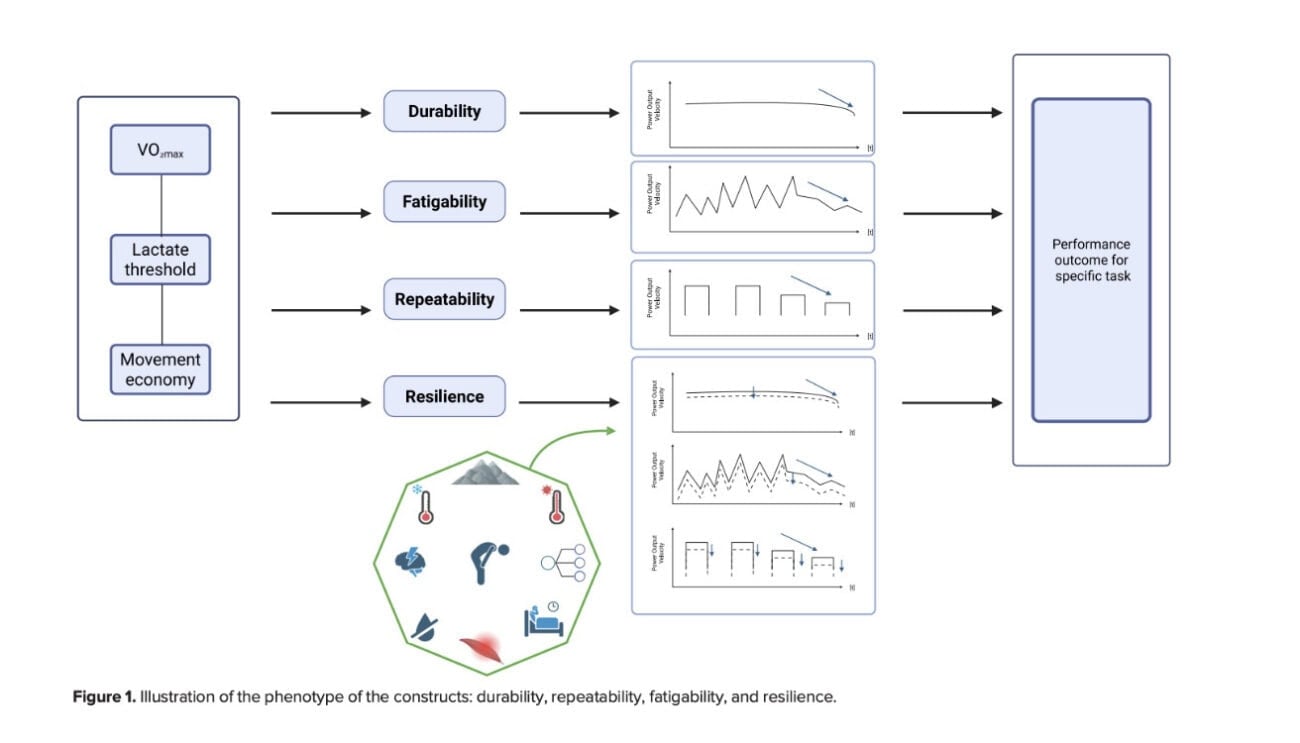
That difference is what sports scientists are increasingly trying to describe with a new set of terms: durability, fatigability, repeatability, and resilience.

This week’s paper1Meixner, B., Joyner, M. J., & Sperlich, B. (2025). Durability, Fatigability, Repeatability and Resilience in Endurance Sports: Definitions, Distinctions, and Implications. Journal of Applied Physiology. https://doi.org/10.1152/japplphysiol.00343.2025 by Benedikt Meixner, Michael Joyner, and Billy Sperlich is not a traditional experiment. It’s a viewpoint article, which means the authors are not testing a new training intervention or reporting a new dataset. Instead, they are trying to clean up the language around these emerging concepts. And honestly, it matters a lot.
Because right now, endurance science has a terminology problem.
A lot of people are using words like durability, fatigue resistance, resilience, and repeatability almost interchangeably. Coaches use them. Researchers use them. Athletes use them. I’ve probably done it too. But these terms do not all mean the same thing. And if we want to measure them, train them, and actually apply them to performance, we need to be more precise.
That is the central idea of this paper. The classic endurance model is still foundational, but it may be incomplete unless we also account for how athletes respond when the race gets long, messy, hot, hilly, mentally demanding, or unpredictable.
The old model still (mostly) works
The authors begin with the traditional Joyner-style endurance model: VO2 max, lactate threshold, and movement economy.
These three variables explain a lot. VO2 max reflects the maximum capacity to take in, transport, and use oxygen. Lactate threshold describes the highest intensity that can be sustained in something close to a metabolic steady state. Economy reflects the energy cost of moving at a given speed or power output.
In a clean lab test, these are incredibly useful. But races are not clean lab tests.
Marathons last long enough for fuel availability, neuromuscular fatigue, cardiac drift, muscle damage, thermoregulation, pacing, and psychology to matter. Trail races add terrain and eccentric loading. Ultras add sleep loss, heat, altitude, gut issues, and emotional volatility.
The authors’ argument is not that VO2 max, threshold, and economy are outdated. It’s that they describe what an athlete can do under relatively fresh and controlled conditions. They do not fully explain what happens after two hours, after repeated surges, after environmental stress, or after fatigue begins to change the body.
Durability
Durability is probably the most important concept here for marathoners and long-distance runners.
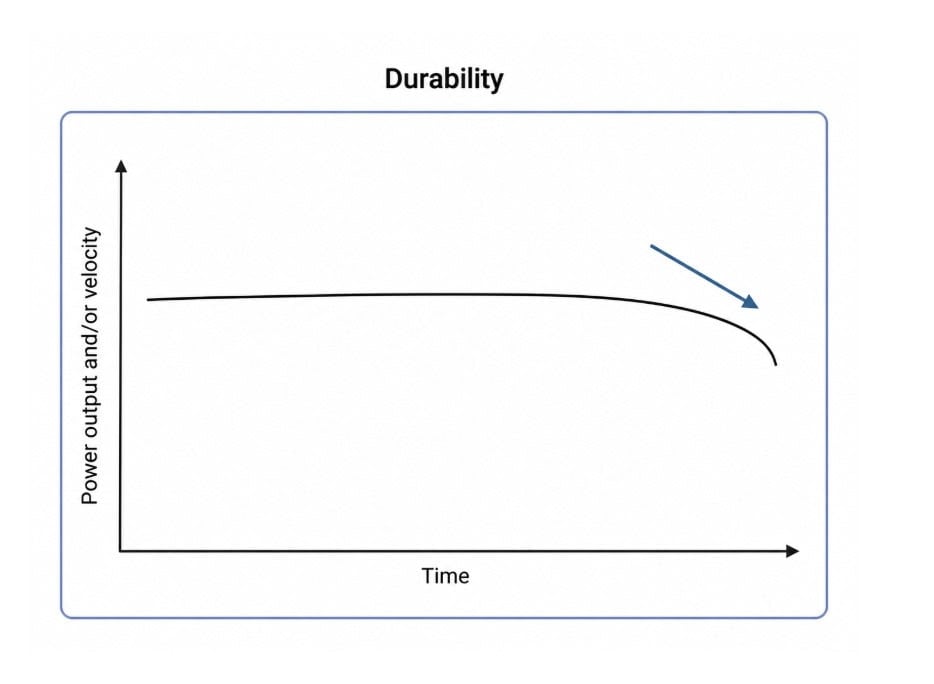
The authors define durability as the deterioration in physiological characteristics over time during prolonged exercise. That sounds a little academic, but the practical meaning is simple: durability is how well your physiology holds together as the miles accumulate.
A durable runner does not just have a good lactate threshold in the lab. They still have a strong lactate threshold after 90 or 120 minutes of running. They do not just have good running economy when fresh. They maintain economy deep into the race. Their heart rate does not drift wildly upward at the same pace. Their stride does not collapse. Their fuel use does not become catastrophically inefficient.
Durability captures what every marathoner eventually learns (usually the hard way)—your fitness on paper is not always the same as your fitness at mile 22.
The authors point to several mechanisms that may contribute to durability, including cardiovascular drift, neuromuscular fatigue, metabolic shifts, carbohydrate depletion, and changes in economy or critical power. They also note that durability can be assessed by looking at physiological drift during prolonged exercise or by testing performance markers before and after a long endurance effort.
For runners, I think durability is one of the missing links between “I’m fit” and “I can execute the race I trained for.” It is not enough to hit marathon pace in a workout when fresh. The question is whether marathon pace still feels metabolically, mechanically, and psychologically manageable after you have already done a lot of work.
Fatigability
Fatigability is related to durability, but it is not exactly the same.
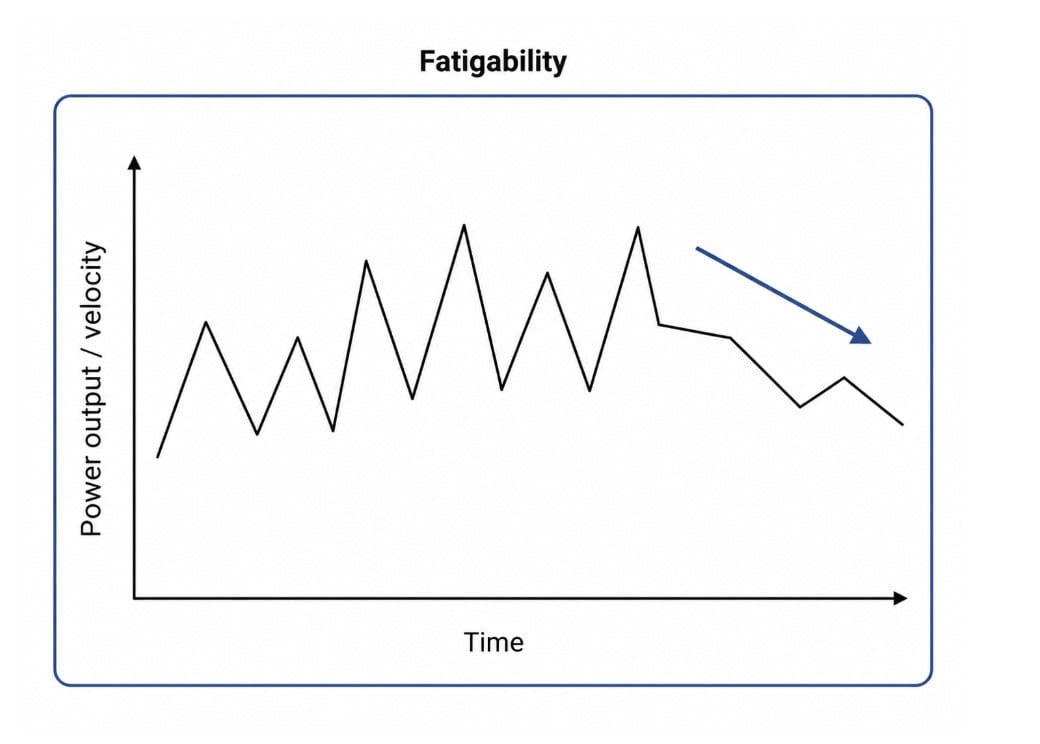
Fatigability refers to the rate and magnitude of performance loss that develops during a continuous or repeated task when fatigue accumulates and recovery is limited or absent. It is about how quickly the athlete starts to decline under load.
This concept is especially obvious in cycling, where athletes may need to respond to surges, climbs, attacks, and stochastic power demands. But it applies to running too, especially in hilly races, trail races, cross-country, tactical racing, and workouts with repeated hard segments.
A runner with high fatigability might look great early but lose speed rapidly as the session or race continues. Their power, pace, mechanics, or perceived effort starts to deteriorate quickly. A runner with low fatigability can absorb the work and keep producing.
The key difference from durability is that fatigability often involves variable or repeated intensity while recovery is limited. Durability is more about preserving physiological function over prolonged steady or semi-steady exercise. Fatigability is more about how quickly the athlete cracks as workload accumulates.
This matters because not all “fatigue resistance” is the same. A marathoner may need durability to preserve pace for 26.2 miles. A trail runner may need low fatigability to handle repeated climbs, descents, accelerations, and technical terrain. A road racer may need to tolerate pace changes without falling apart.
The authors also emphasize that realistic testing matters. A lab test that does not include a race-relevant preload, fueling conditions, or variable intensity might miss the point. That is a big theme of the paper. If we want to understand endurance performance, we need assessments that resemble the actual demands of the sport (which unfortunately, doesn’t always happen in well-controlled laboratory experiments).
Repeatability
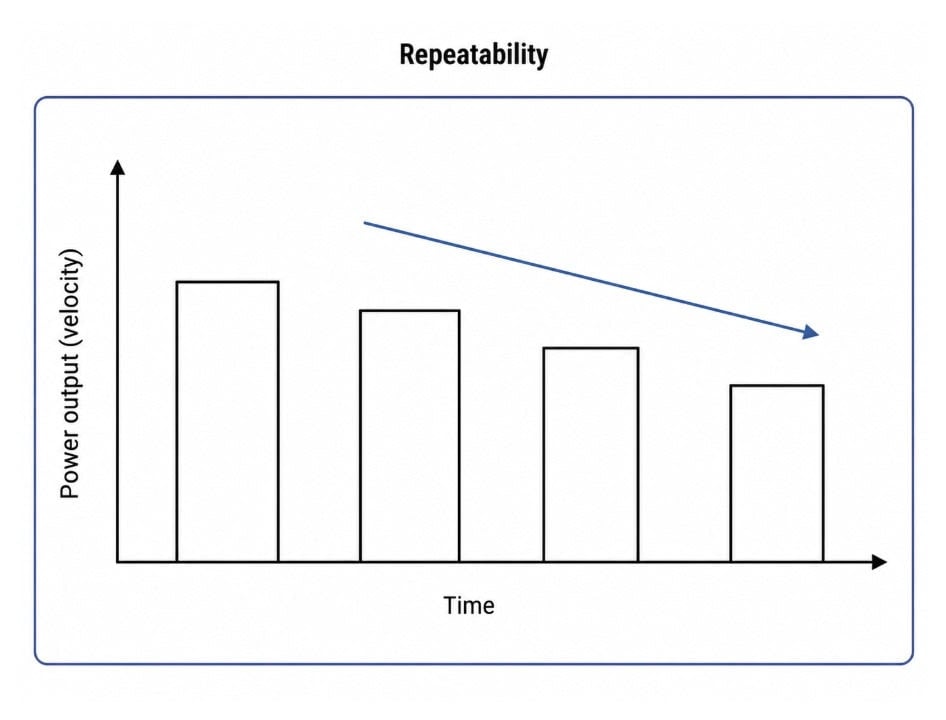
Repeatability is the ability to recover and reproduce high-intensity performance across multiple bouts, stages, heats, or efforts.
This is not the same as fatigability. Fatigability is about decline under load when recovery is limited or absent. Repeatability is about what happens when there is some recovery and the athlete has to go again.
For runners, repeatability shows up in workouts, championships with rounds, relay formats, hill-repeat races, and even training blocks where you have to bounce back from one demanding session to the next.
A runner can be durable but not very repeatable. They may grind well for a long, steady effort but struggle when asked to produce repeated surges or high-intensity bouts. Another athlete may have excellent repeatability in short efforts but lack the durability to hold performance deep into a marathon.
Repeatability depends on recovery kinetics. That’s how quickly heart rate, lactate, neuromuscular function, metabolic processes, and fuel availability rebound between efforts. The paper notes that this trait appears trainable and may improve with maturation and accumulated training experience. Running more fixes everything.
That fits what many coaches observe in practice. Experienced endurance athletes often get better not just because their peak numbers improve, but because they become harder to break. They recover faster between efforts. They can stack work. They can race again. They can handle the surges and still have something left.
Resilience
Resilience is the broadest and perhaps most slippery concept.
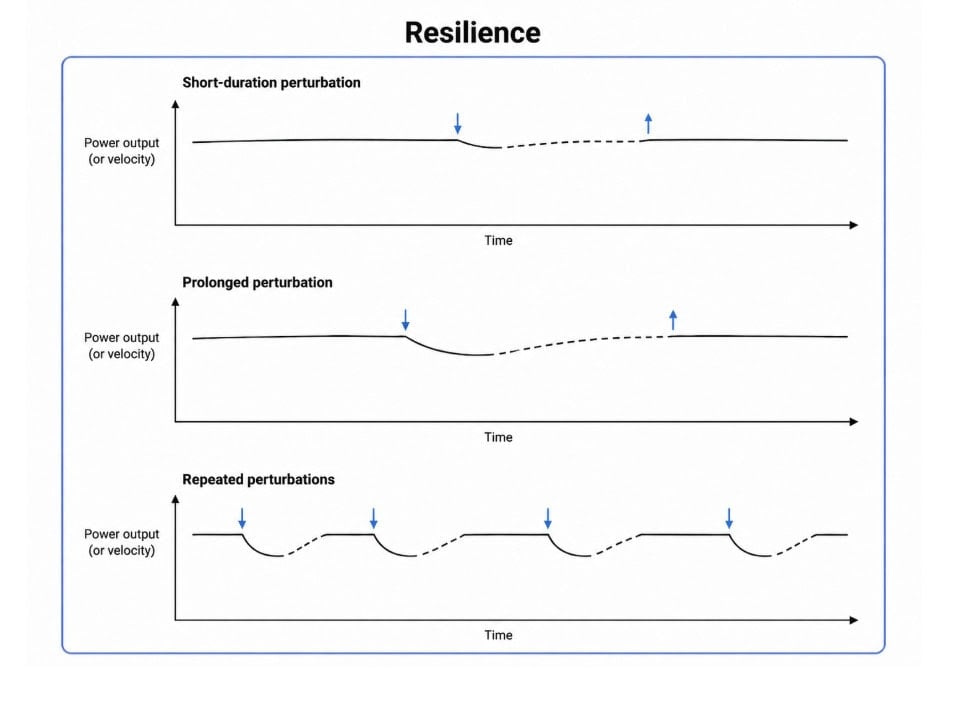
The authors describe resilience as the capacity to maintain or regain physiological and mechanical function under fatigue, environmental extremes, or other perturbations. That includes heat, altitude, dehydration, mental fatigue, pain, sleep loss, terrain, psychological stress, and other real-world challenges.
A resilient athlete is not just fit in perfect conditions. They can adapt when the day gets ugly. They can manage heat. They can adjust pacing. They can fuel when the gut is unhappy. They can keep moving when the terrain changes. They can absorb mental fatigue without a total performance collapse.
For ultra-trail runners, resilience may be one of the defining traits. But even in the marathon, resilience matters. A hot race day, a missed bottle, a bad patch, or unexpected hills can expose whether an athlete’s fitness is robust or fragile.
This is not just about wanting it more. Resilience has physiological roots—thermoregulation, substrate use, neuromuscular function, hydration, sleep, cognition, and psychological regulation all play a role.
That is important because runners often moralize fatigue. When we fall apart, we assume we were weak, unmotivated, or mentally soft. Sometimes that is true. But often the body is dealing with a complex set of stressors that were not adequately trained, fueled, or prepared for.
Resilience can be trained, but it requires specificity. Heat acclimation helps with heat. Hill and downhill training help with terrain. Long runs help with prolonged fatigue. Fueling practice helps with gut tolerance. Sleep and recovery help preserve the systems that keep you adaptable. Although I’d like to think there is some “cross adaptation” that happens, too.
What this means for runners
Stop thinking about fitness only through fresh-state metrics. Those things matter, but the race-relevant question is how well those abilities hold up under fatigue.
Importantly, the paper argues that these constructs should not be treated as interchangeable names for “good at not getting tired.” They are different capacities, with different mechanisms and different relevance depending on the event.
For marathoners, durability may be especially important: how much does your threshold, economy, heart rate, and mechanical output deteriorate after prolonged running?
For trail runners, fatigability and resilience may become more important because the race includes variable terrain, climbs, descents, environmental stress, and muscular damage.
For athletes in heats or stage-based events, repeatability may be decisive.
The key is not to train everything hard all the time, but to ask: what does my event actually demand after the easy part is over?
Once you identify your weaknesses (we all have one or two…), train them!
None of this means we throw out VO2 max, lactate threshold, or running economy. Those are still the foundation.
But the next frontier in endurance performance may be understanding not just how high your ceiling is, but how much of that ceiling you can still access when the going gets tough.
That is what durability, fatigability, repeatability, and resilience are trying to describe.
The lesson for runners is simple: don’t just train to be fast when fresh. Train to remain yourself when tired.









0 Comments